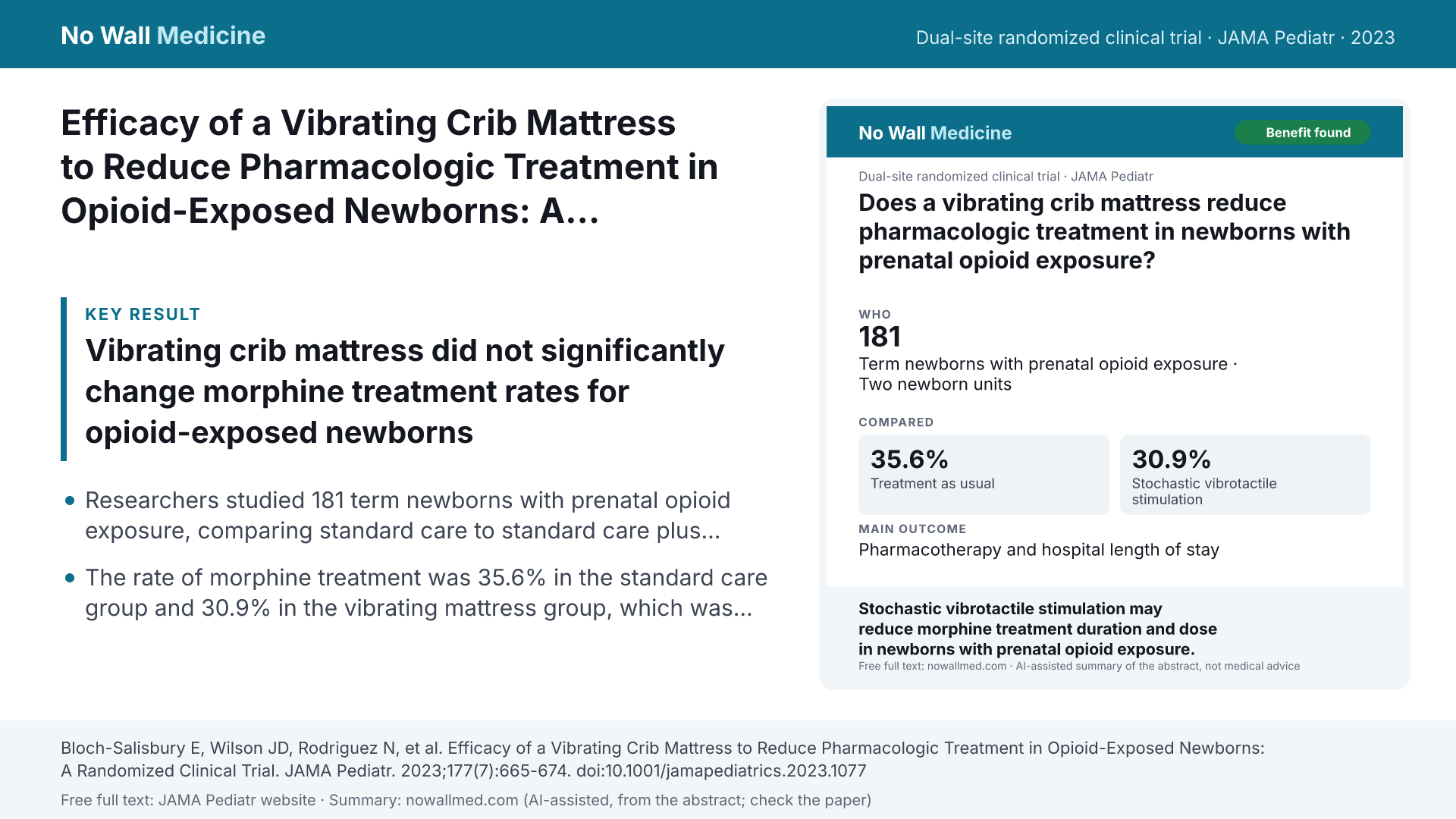
Vibrating crib mattress did not significantly change morphine treatment rates for opioid-exposed newborns
Efficacy of a Vibrating Crib Mattress to Reduce Pharmacologic Treatment in Opioid-Exposed Newborns: A Randomized Clinical Trial
Dual-site randomized clinical trialBenefit found
Does a vibrating crib mattress reduce pharmacologic treatment in newborns with prenatal opioid exposure?
Who
181
Term newborns with prenatal opioid exposure · Two newborn units
Compared
35.6%Treatment as usual (31 of 87 infants)
30.9%Stochastic vibrotactile stimulation (29 of 94 infants)
Main outcome
Pharmacotherapy and hospital length of stay
Result: hazard ratio 1.96 (95% CI 1.01-3.81)
Bottom line: Stochastic vibrotactile stimulation may reduce morphine treatment duration and dose in newborns with prenatal opioid exposure.
JAMA Pediatr · 2023-05-15Download image
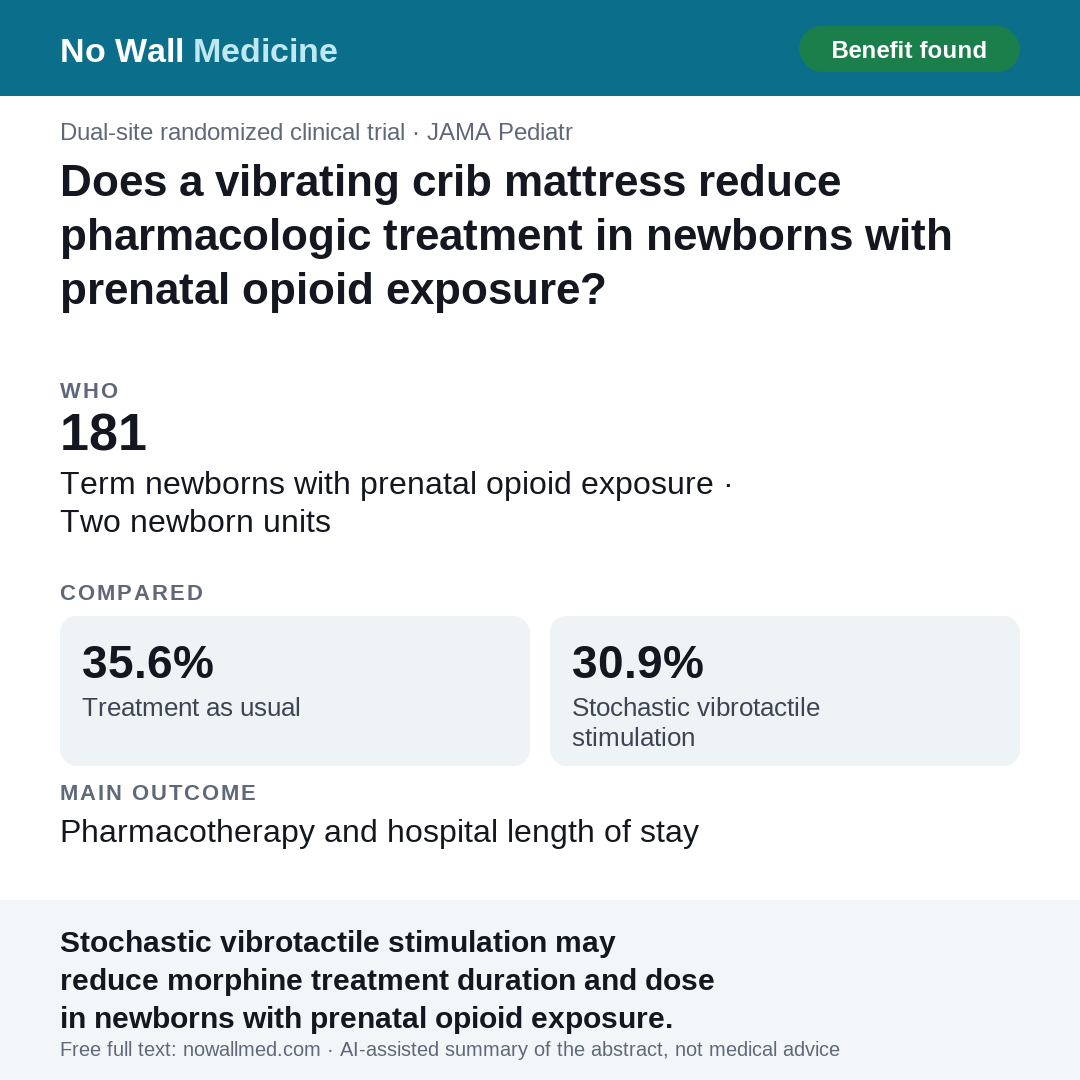
Clinical question: Does a vibrating crib mattress reduce pharmacologic treatment in newborns with prenatal opioid exposure?
Why it matters: Pharmacologic agents like morphine are used to treat newborns with prenatal opioid exposure, but these drugs may have adverse effects on neurodevelopment.
Key points
- Researchers studied 181 term newborns with prenatal opioid exposure, comparing standard care to standard care plus a vibrating mattress providing random vibrotactile stimulation.
- The rate of morphine treatment was 35.6% in the standard care group and 30.9% in the vibrating mattress group, which was not a significant difference.
- Among infants transferred to the neonatal intensive care unit for morphine, those using the vibrating mattress finished treatment 3.18 fewer days on average.
Headline and key points written with AI from the paper’s abstract, with every number checked against it. Read the paper before relying on them.
Was this summary helpful?
Subject terms
Cite this article
Bloch-Salisbury E, Wilson JD, Rodriguez N, et al. Efficacy of a Vibrating Crib Mattress to Reduce Pharmacologic Treatment in Opioid-Exposed Newborns: A Randomized Clinical Trial. JAMA Pediatr. 2023;177(7):665-674. doi:10.1001/jamapediatrics.2023.1077
Spotted a mistake? Suggest a correction