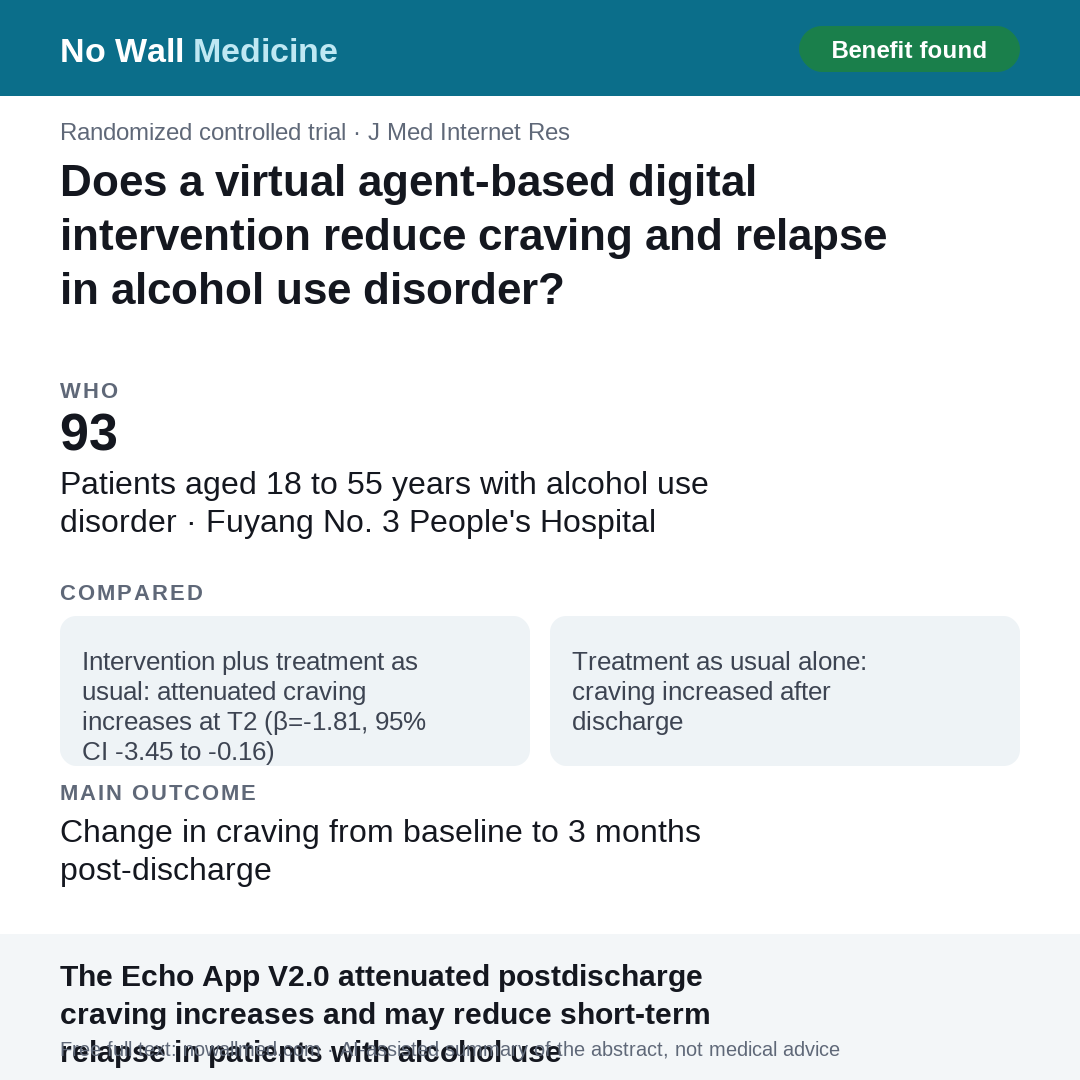
Clinical question: Does a virtual agent-based digital intervention reduce craving and relapse in alcohol use disorder?
Why it matters: Text-only psychological interventions have limitations in mental health treatment that virtual agents powered by dialogue trees may help overcome.
Key points
Researchers studied 93 patients with alcohol use disorder, comparing standard treatment to standard treatment plus a four-week virtual agent digital intervention.
The intervention group showed significantly smaller increases in alcohol cravings at 1 month and 3 months after discharge compared to the control group.
At 1 month after discharge, the intervention group had lower relapse rates and better sleep quality, though relapse rates were similar at 3 months.
Limitation the authors note: The finding regarding reduced relapse rates was sensitive to missing-data assumptions in sensitivity analyses and was not sustained at 3 months.
Headline and key points written with AI from the paper’s abstract, with every number checked against it. Read the paper before relying on them.
ClinicalAge, a framework for modelling ageing trajectories from longitudinal electronic health records in the UK: a model development and validation study
A prognostic model for use at labour onset to estimate the risk of severe fetal compromise at birth: a retrospective, model development and validation study