Mirtazapine and duloxetine improved negative schizophrenia symptoms better than placebo in meta-analysis
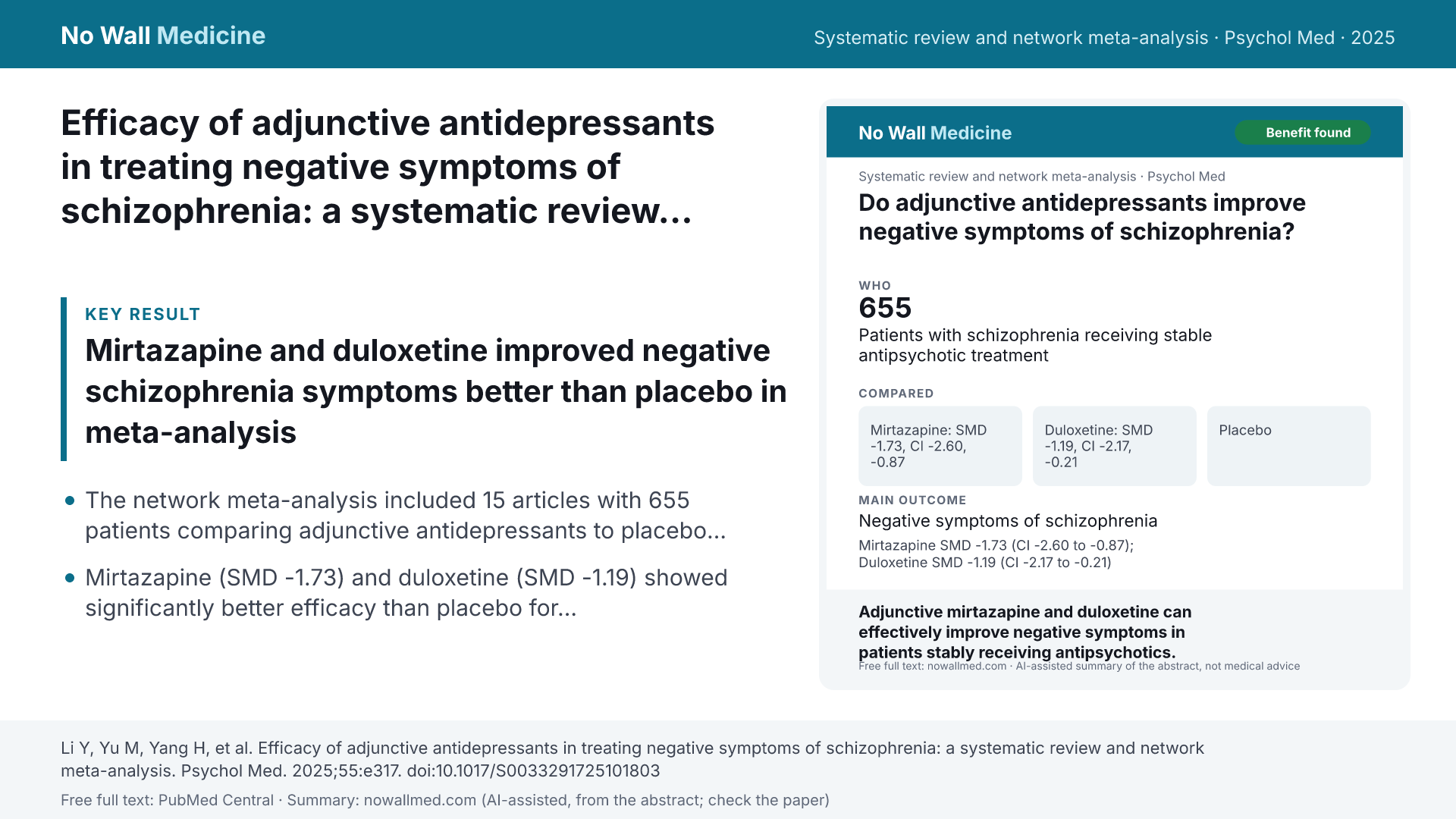
Efficacy of adjunctive antidepressants in treating negative symptoms of schizophrenia: a systematic review and network meta-analysis
Systematic review and network meta-analysisBenefit found
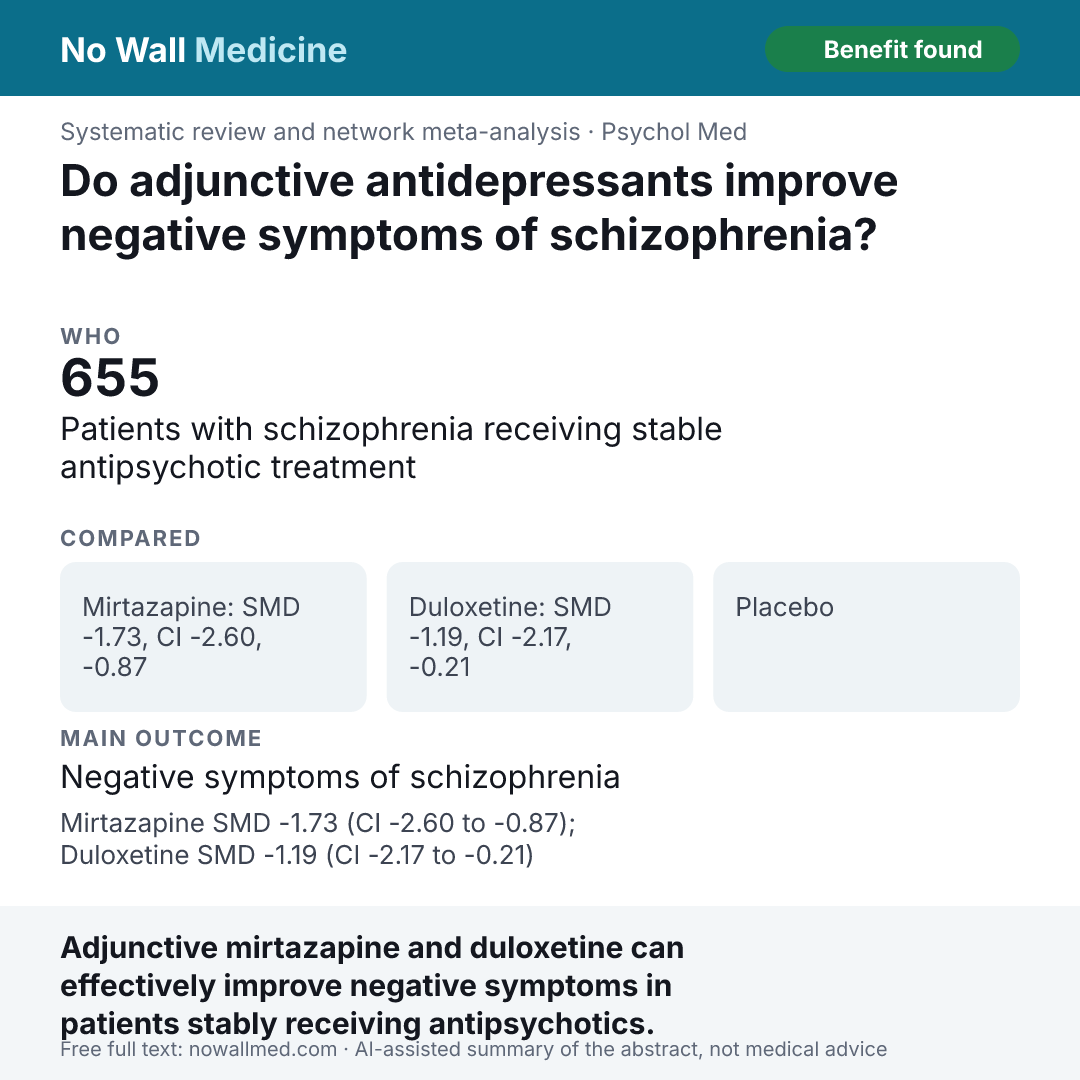
Do adjunctive antidepressants improve negative symptoms of schizophrenia?
Who
655
Patients with schizophrenia receiving stable antipsychotic treatment
Compared
Mirtazapine: SMD -1.73, CI -2.60, -0.87
Duloxetine: SMD -1.19, CI -2.17, -0.21
Placebo
Main outcome
Negative symptoms of schizophrenia
Result: Mirtazapine SMD -1.73 (CI -2.60 to -0.87); Duloxetine SMD -1.19 (CI -2.17 to -0.21)
Bottom line: Adjunctive mirtazapine and duloxetine can effectively improve negative symptoms in patients stably receiving antipsychotics.
Psychol Med · 2025-10-24 · Save PNG
Clinical question: Do adjunctive antidepressants improve negative symptoms of schizophrenia?
Why it matters: The efficacy of antidepressant treatment for negative symptoms of schizophrenia remains a matter of considerable controversy.
Key points
- The network meta-analysis included 15 articles with 655 patients comparing adjunctive antidepressants to placebo for negative symptoms.
- Mirtazapine (SMD -1.73) and duloxetine (SMD -1.19) showed significantly better efficacy than placebo for negative symptoms.
- Mirtazapine differed significantly from reboxetine, escitalopram, and bupropion, while other antidepressant comparisons showed no significant differences.
Headline and key points written with AI from the paper’s abstract, with every number checked against it. Read the paper before relying on them.
Was this summary helpful?
Subject terms
Headline, design, result, key points, caveat and citation as plain text.
Cite this article
Li Y, Yu M, Yang H, et al. Efficacy of adjunctive antidepressants in treating negative symptoms of schizophrenia: a systematic review and network meta-analysis. Psychol Med. 2025;55:e317. doi:10.1017/S0033291725101803
Spotted a mistake? Suggest a correction