Weight-shift training with visual biofeedback improves walking asymmetry in patients with chronic stroke
Efficacy of anterioposterior weight-shift training with visual biofeedback for step length asymmetry and functional mobility in chronic stroke: a randomized controlled trial
Randomized controlled trialBenefit found
Does anterioposterior weight-shift training with visual biofeedback improve step length asymmetry in chronic stroke?
Who
34
Patients with chronic hemiplegic stroke exhibiting step-length asymmetry
Compared
Anterioposterior training group: Significant improvements in the Step Length Asymmetry Index
Control group
Main outcome
Step Length Asymmetry Index
Bottom line: Anterioposterior weight-shift training with visual biofeedback effectively improves step length asymmetry and paretic limb mechanics.
J Neuroeng Rehabil · 2026-07-24Download image
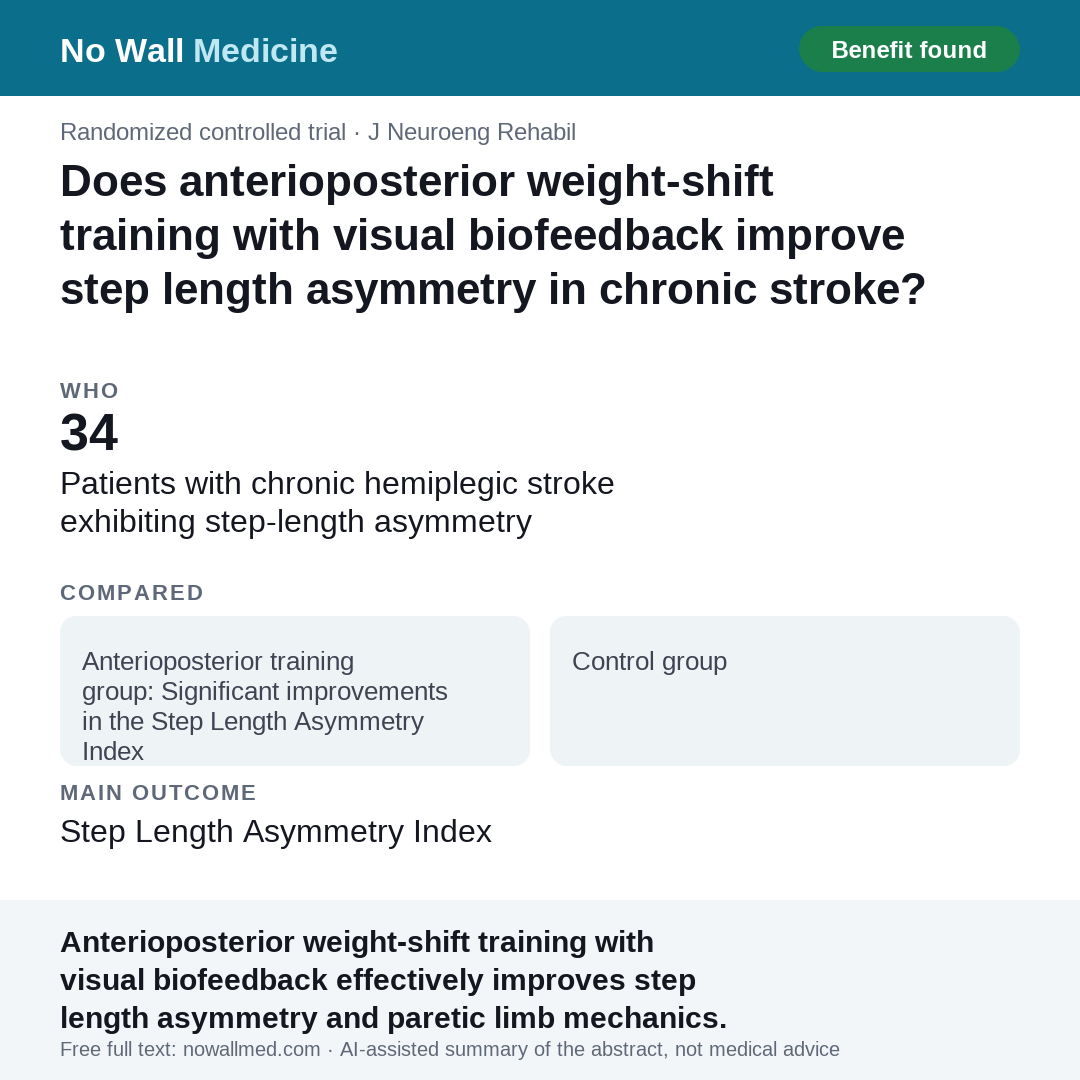
Clinical question: Does anterioposterior weight-shift training with visual biofeedback improve step length asymmetry in chronic stroke?
Why it matters: Patients with chronic stroke often experience persistent step length asymmetry, which can reduce walking efficiency and increase the risk of musculoskeletal complications.
Key points
- Researchers studied 34 patients with chronic hemiplegic stroke who had uneven step lengths during walking.
- The training group showed significant improvements in the Step Length Asymmetry Index compared to the control group (p < 0.05).
- The intervention improved maximum safe walking speed and swing time asymmetry, but showed no significant difference in energy consumption (p < 0.05).
Headline and key points written with AI from the paper’s abstract, with every number checked against it. Read the paper before relying on them.
Topics
Cite this article
Lee JW, Jo YJ, Baek YS, Kim S, Kim JH, Kim DH. Efficacy of anterioposterior weight-shift training with visual biofeedback for step length asymmetry and functional mobility in chronic stroke: a randomized controlled trial. J Neuroeng Rehabil. 2026. doi:10.1186/s12984-026-02030-6
Spotted a mistake? Suggest a correction