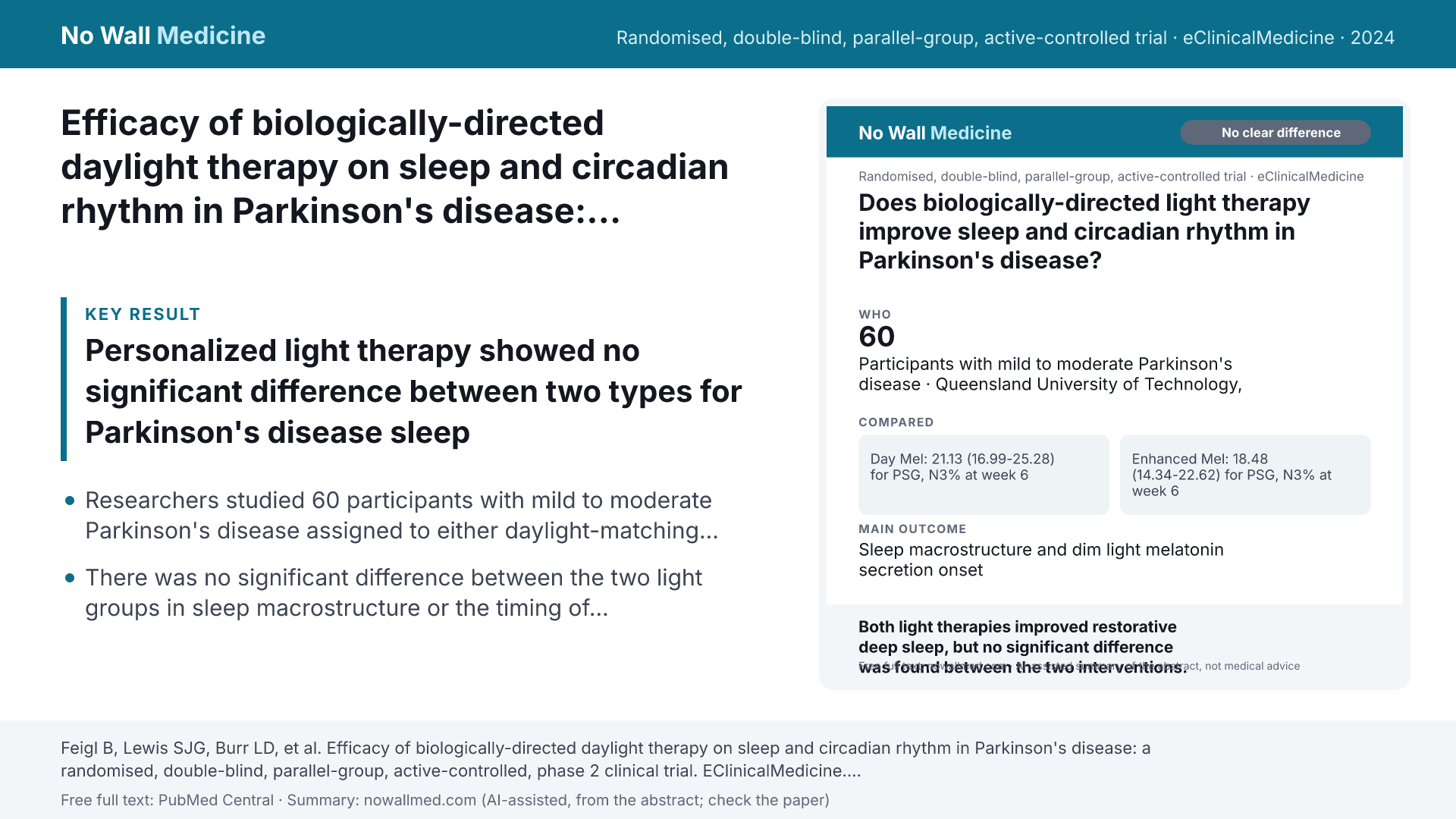
Personalized light therapy showed no significant difference between two types for Parkinson's disease sleep
Efficacy of biologically-directed daylight therapy on sleep and circadian rhythm in Parkinson's disease: a randomised, double-blind, parallel-group, active-controlled, phase 2 clinical trial
Randomised, double-blind, parallel-group, active-controlled trialNo clear difference
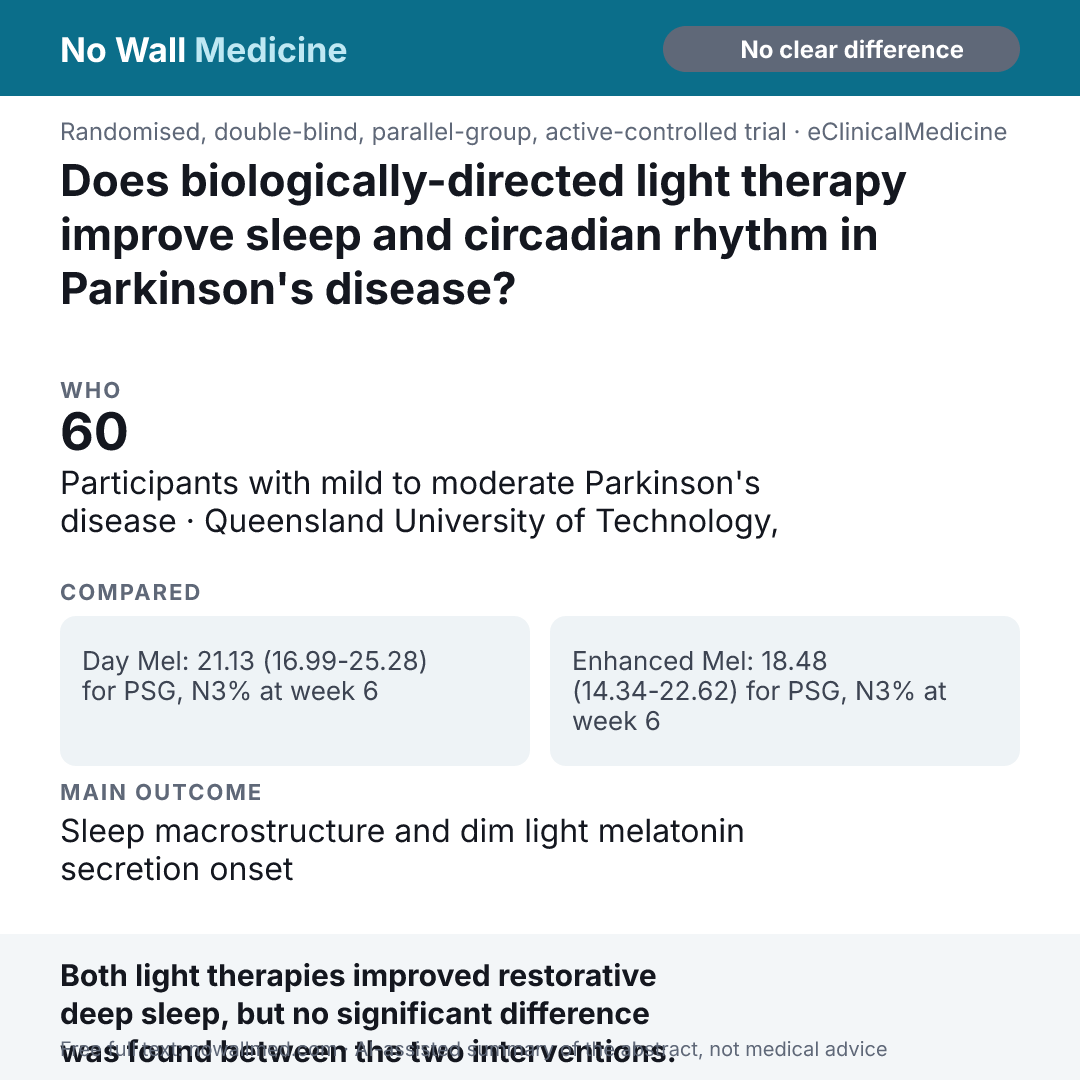
Does biologically-directed light therapy improve sleep and circadian rhythm in Parkinson's disease?
Who
60
Participants with mild to moderate Parkinson's disease · Queensland University of Technology, Australia
Compared
Day Mel: 21.13 (16.99-25.28) for PSG, N3% at week 6
Enhanced Mel: 18.48 (14.34-22.62) for PSG, N3% at week 6
Main outcome
Sleep macrostructure and dim light melatonin secretion onset
Bottom line: Both light therapies improved restorative deep sleep, but no significant difference was found between the two interventions.
Limitation: The lack of significant difference between groups may be due to the early disease stage.
Funded by: Michael J Fox Foundation, Shake IT Up Australia, NHMRC, Australian Research Council
eClinicalMedicine · 2024-02-10 · Save PNG
Clinical question: Does biologically-directed light therapy improve sleep and circadian rhythm in Parkinson's disease?
Why it matters: Previous light therapies for sleep behavior lacked standardized protocols and were not personalized to an individual's internal biological clock, or chronotype.
Key points
- Researchers studied 60 participants with mild to moderate Parkinson's disease assigned to either daylight-matching light or enhanced melanopsin-stimulating light for 4 weeks.
- There was no significant difference between the two light groups in sleep macrostructure or the timing of melatonin secretion at any follow-up timepoint.
- Both light groups showed a significant improvement in the restorative deep sleep phase at week 6, with a mean difference from baseline of -3.87 (95% CI: -6.91 to -0.83).
Headline and key points written with AI from the paper’s abstract, with every number checked against it. Read the paper before relying on them.
Was this summary helpful?
Headline, design, result, key points, caveat and citation as plain text.
Cite this article
Feigl B, Lewis SJG, Burr LD, et al. Efficacy of biologically-directed daylight therapy on sleep and circadian rhythm in Parkinson's disease: a randomised, double-blind, parallel-group, active-controlled, phase 2 clinical trial. EClinicalMedicine. 2024;69:102474. doi:10.1016/j.eclinm.2024.102474
Spotted a mistake? Suggest a correction