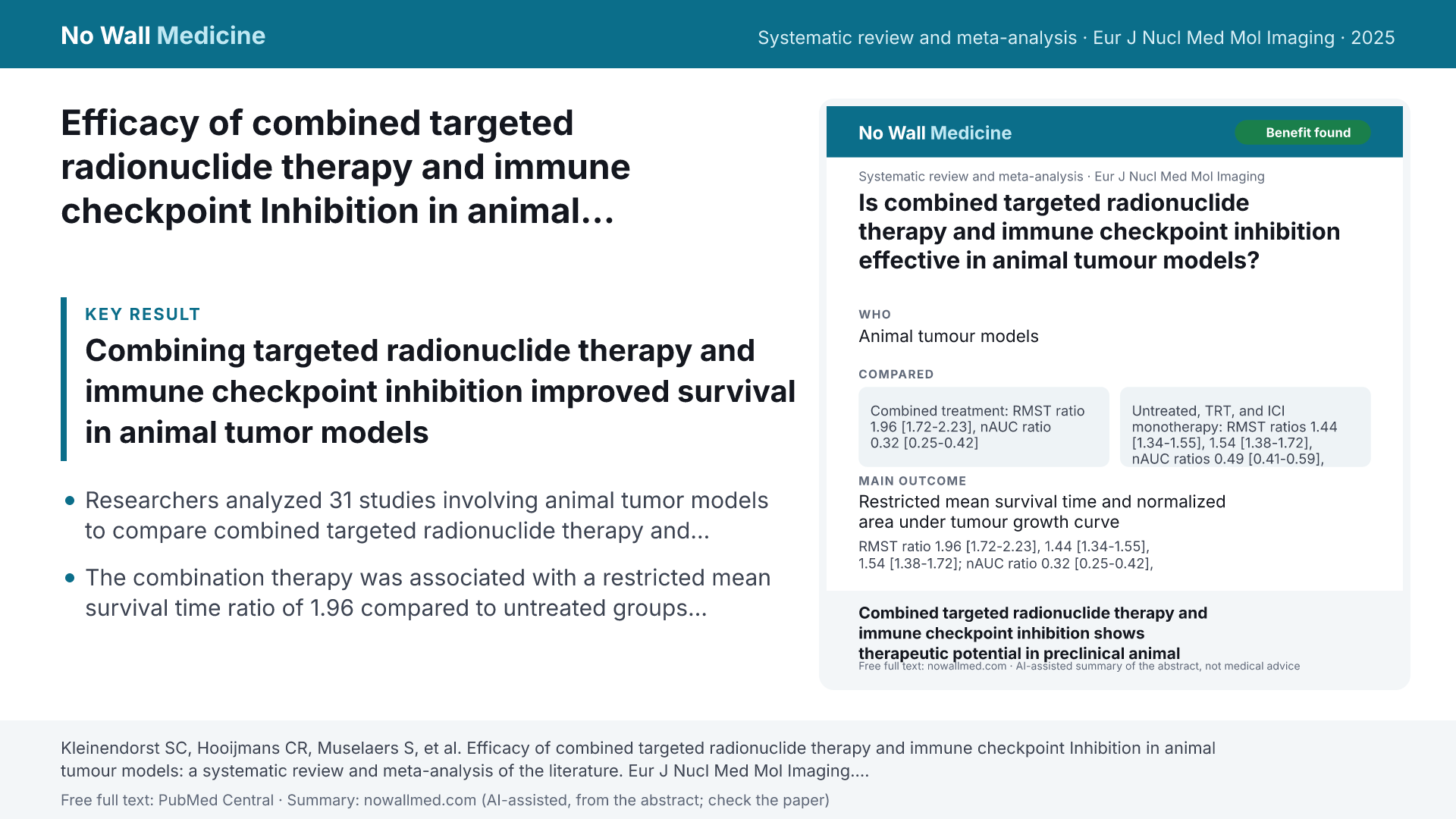
Combining targeted radionuclide therapy and immune checkpoint inhibition improved survival in animal tumor models
Efficacy of combined targeted radionuclide therapy and immune checkpoint Inhibition in animal tumour models: a systematic review and meta-analysis of the literature
Systematic review and meta-analysisBenefit found
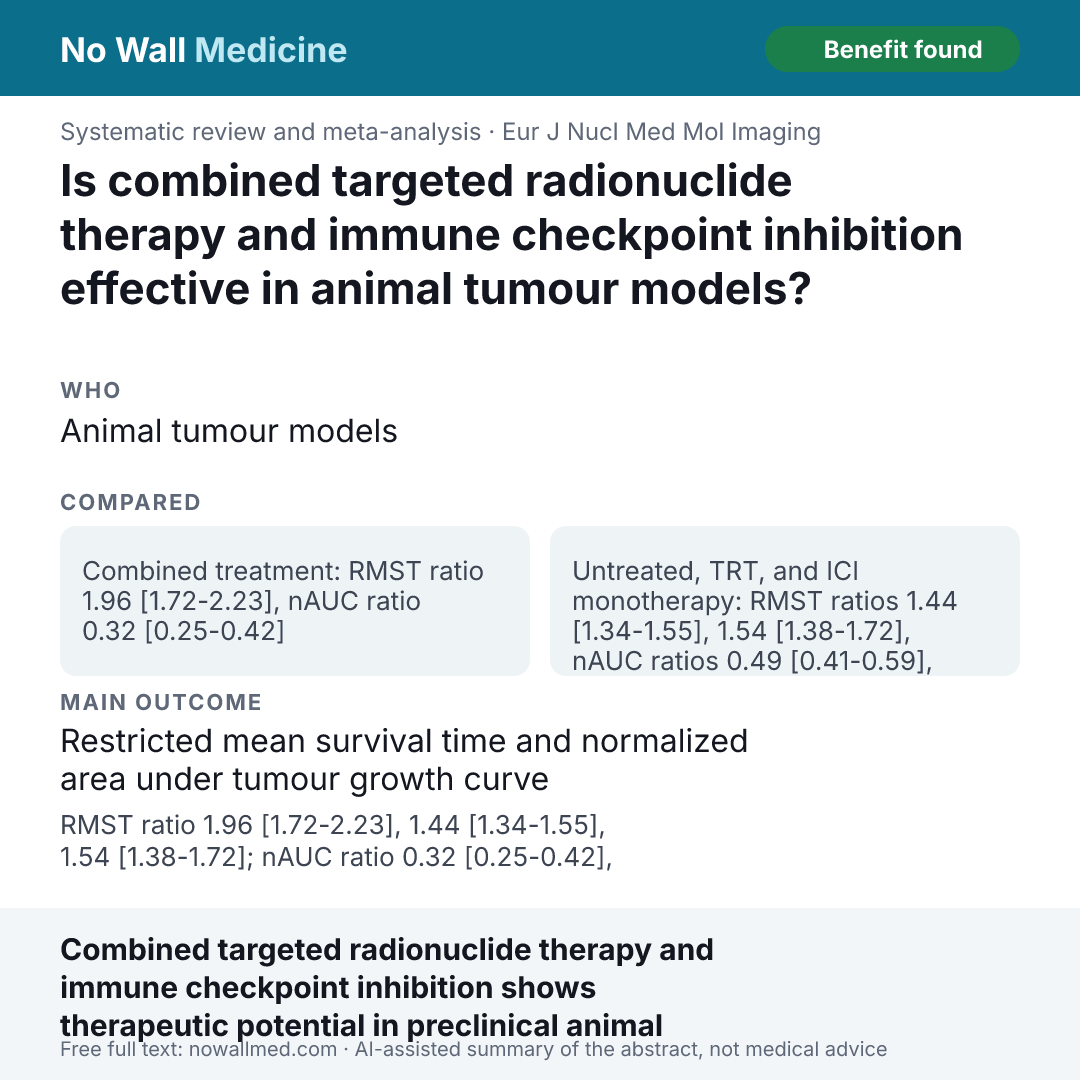
Is combined targeted radionuclide therapy and immune checkpoint inhibition effective in animal tumour models?
Who
Animal tumour models
Compared
Combined treatment: RMST ratio 1.96 [1.72-2.23], nAUC ratio 0.32 [0.25-0.42]
Untreated, TRT, and ICI monotherapy: RMST ratios 1.44 [1.34-1.55], 1.54 [1.38-1.72], nAUC ratios 0.49 [0.41-0.59], 0.41 [0.31-0.55]
Main outcome
Restricted mean survival time and normalized area under tumour growth curve
Result: RMST ratio 1.96 [1.72-2.23], 1.44 [1.34-1.55], 1.54 [1.38-1.72]; nAUC ratio 0.32 [0.25-0.42], 0.49 [0.41-0.59], 0.41 [0.31-0.55]
Bottom line: Combined targeted radionuclide therapy and immune checkpoint inhibition shows therapeutic potential in preclinical animal tumour models.
Limitation: Poor reporting in studies and high between-study heterogeneity.
Eur J Nucl Med Mol Imaging · 2025-04-26 · Save PNG
Clinical question: Is combined targeted radionuclide therapy and immune checkpoint inhibition effective in animal tumour models?
Why it matters: The potential for combining targeted radionuclide therapy and immune checkpoint inhibition is being explored because radiation may have effects that influence the immune system.
Key points
- Researchers analyzed 31 studies involving animal tumor models to compare combined targeted radionuclide therapy and immune checkpoint inhibition against single treatments or no treatment.
- The combination therapy was associated with a restricted mean survival time ratio of 1.96 compared to untreated groups and 1.44 or 1.54 compared to single therapies.
- The combination therapy was associated with a normalized area under the tumor growth curve ratio of 0.32 compared to untreated groups and 0.49 or 0.41 compared to single therapies.
Limitation the authors note: The quality of the included studies could not always be assessed due to poor reporting and there was high between-study heterogeneity.
Headline and key points written with AI from the paper’s abstract, with every number checked against it. Read the paper before relying on them.
Was this summary helpful?
Subject terms
Headline, design, result, key points, caveat and citation as plain text.
Cite this article
Kleinendorst SC, Hooijmans CR, Muselaers S, et al. Efficacy of combined targeted radionuclide therapy and immune checkpoint Inhibition in animal tumour models: a systematic review and meta-analysis of the literature. Eur J Nucl Med Mol Imaging. 2025;52(12):4735-4751. doi:10.1007/s00259-025-07293-0
Spotted a mistake? Suggest a correction