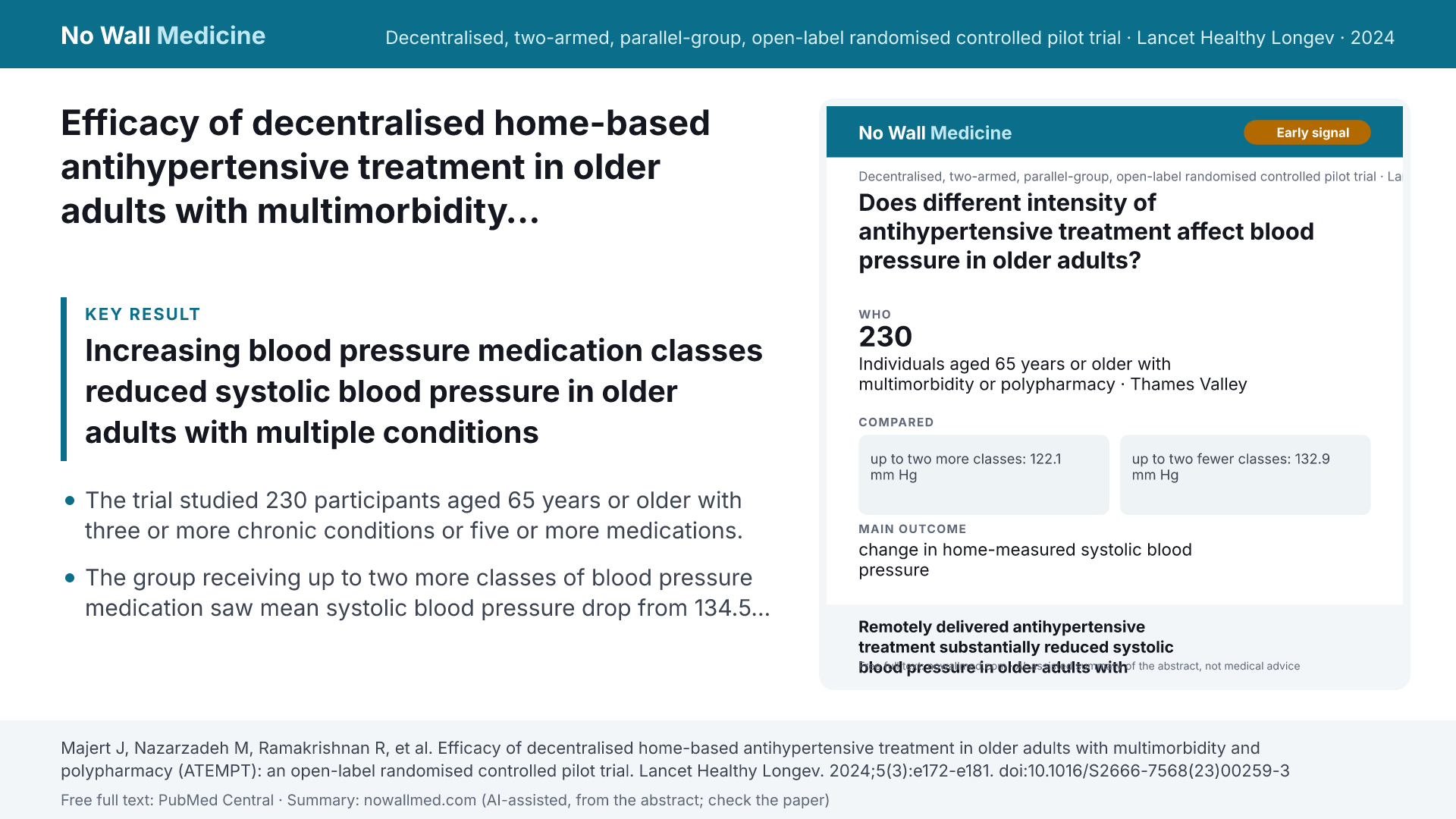
Increasing blood pressure medication classes reduced systolic blood pressure in older adults with multiple conditions
Efficacy of decentralised home-based antihypertensive treatment in older adults with multimorbidity and polypharmacy (ATEMPT): an open-label randomised controlled pilot trial
Decentralised, two-armed, parallel-group, open-label randomised controlled pilot trialEarly signal
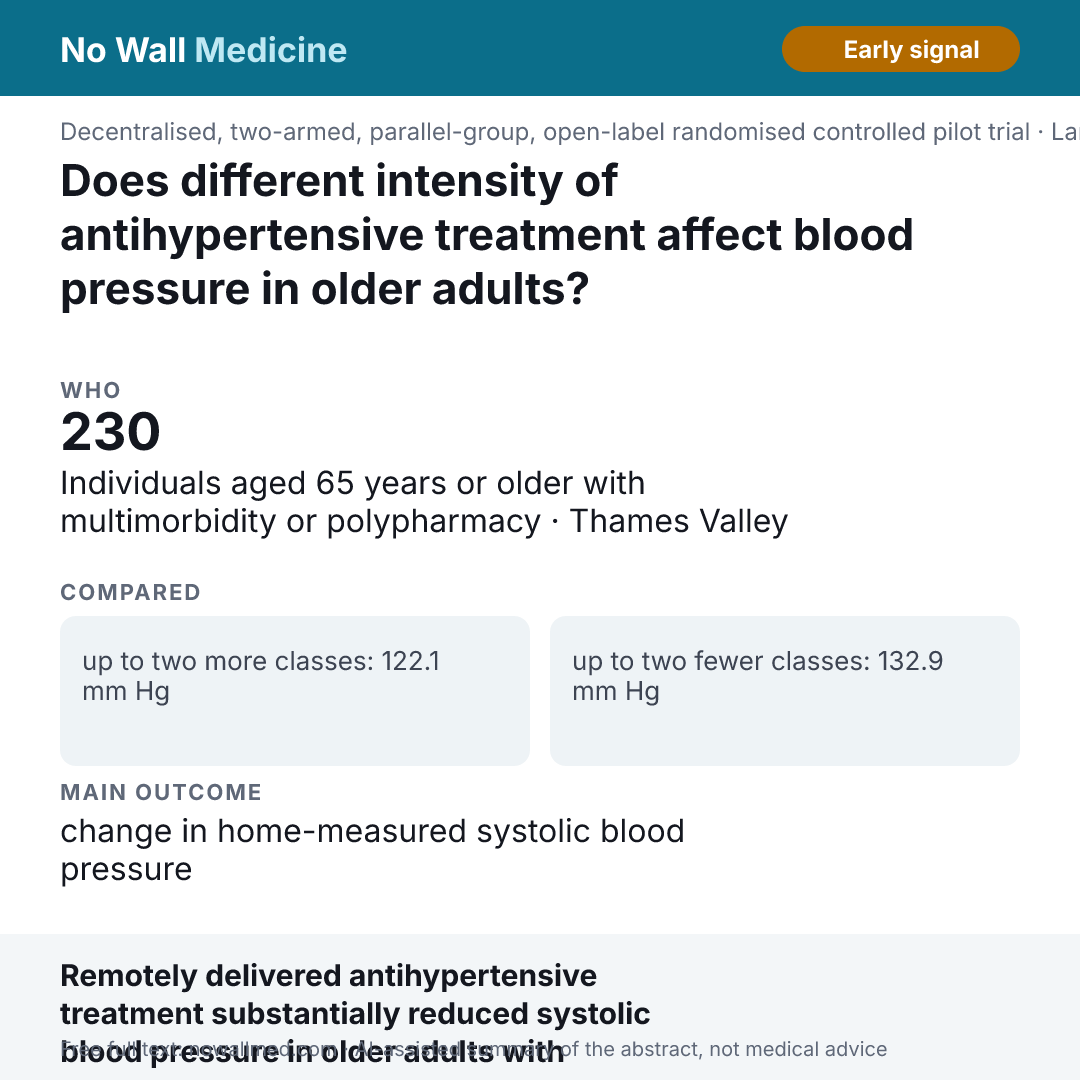
Does different intensity of antihypertensive treatment affect blood pressure in older adults?
Who
230
Individuals aged 65 years or older with multimorbidity or polypharmacy · Thames Valley area, South East England
Compared
up to two more classes: 122.1 mm Hg
up to two fewer classes: 132.9 mm Hg
Main outcome
change in home-measured systolic blood pressure
Result: mean difference of -10.7 mm Hg (95% CI -17.5 to -4.0)
Bottom line: Remotely delivered antihypertensive treatment substantially reduced systolic blood pressure in older adults with multimorbidity and polypharmacy.
Lancet Healthy Longev · 2024-02-08 · Funded by National Institute for Health Research Oxford Biomedical Research Centre and Oxford Martin School
Why it matters: Older patients with multiple chronic conditions and many medications are often under-represented in clinical trials regarding the effects of different blood pressure treatment intensities.
Headline and visual abstract written with AI from the paper’s abstract, with every number checked against it. Read the paper before relying on them.
Was this summary helpful?
Abstract
Background
Older patients with multimorbidity and polypharmacy have been under-represented in clinical trials. We aimed to assess the effect of different intensities of antihypertensive treatment on changes in blood pressure, major safety outcomes, and patient-reported outcomes in this population. Methods
ATEMPT was a decentralised, two-armed, parallel-group, open-label randomised controlled pilot trial conducted in the Thames Valley area, South East England. Individuals aged 65 years or older with multimorbidity (three or more chronic conditions) or polypharmacy (five or more types of medications) and a systolic blood pressure of 115-165 mm Hg were eligible for inclusion. Participants were identified through a search of national hospital discharge databases, identification of patients registered with an online pharmacy, and via targeted advertising on social media platforms. Participants were randomly assigned to receive up to two more classes versus up to two fewer classes of antihypertensive medications. Apart from routine home visits for conducting the baseline assessment, all communication, monitoring, and management of participants by the trial team was conducted remotely. The primary outcome was change in home-measured blood pressure. Findings
Between Dec 15, 2020, and Aug 31, 2022, 230 participants were randomly assigned (n=126 to more vs n=104 to fewer antihypertensive medications). The frequency of serious adverse events was similar across both groups; no cardiovascular events occurred in the more antihypertensive drugs group, compared with six in the fewer antihypertensive drugs group, of which two were fatal. Over a 13-month follow-up period, the mean systolic blood pressure in the group allocated to receive more antihypertensive medications decreased from 134·5 mm Hg (SD 10·7) at baseline to 122·1 mm Hg (10·5). By contrast, in the group allocated to receive fewer antihypertensive medications, it remained relatively unchanged, moving from 134·8 mm Hg (SD 11·2) at baseline to 132·9 mm Hg (15·3); this corresponded to a mean difference of -10·7 mm Hg (95% CI -17·5 to -4·0). Interpretation
Remotely delivered antihypertensive treatment substantially reduced systolic blood pressure in older adults who are often less represented in trials, with no increase in the risk of serious adverse events. The results of this trial will inform a larger clinical trial focusing on assessing major cardiovascular events, safety, physical functioning, and cognitive function that is currently in the planning stages. These results also underscore the efficiency of decentralised trial designs, which might be of broader interest in other settings. Funding
National Institute for Health Research Oxford Biomedical Research Centre and the Oxford Martin School.
Abstract reproduced under the article’s CC BY licence.
Subject terms
Cite this article
Majert J, Nazarzadeh M, Ramakrishnan R, et al. Efficacy of decentralised home-based antihypertensive treatment in older adults with multimorbidity and polypharmacy (ATEMPT): an open-label randomised controlled pilot trial. Lancet Healthy Longev. 2024;5(3):e172-e181. doi:10.1016/S2666-7568(23)00259-3
Spotted a mistake? Suggest a correction