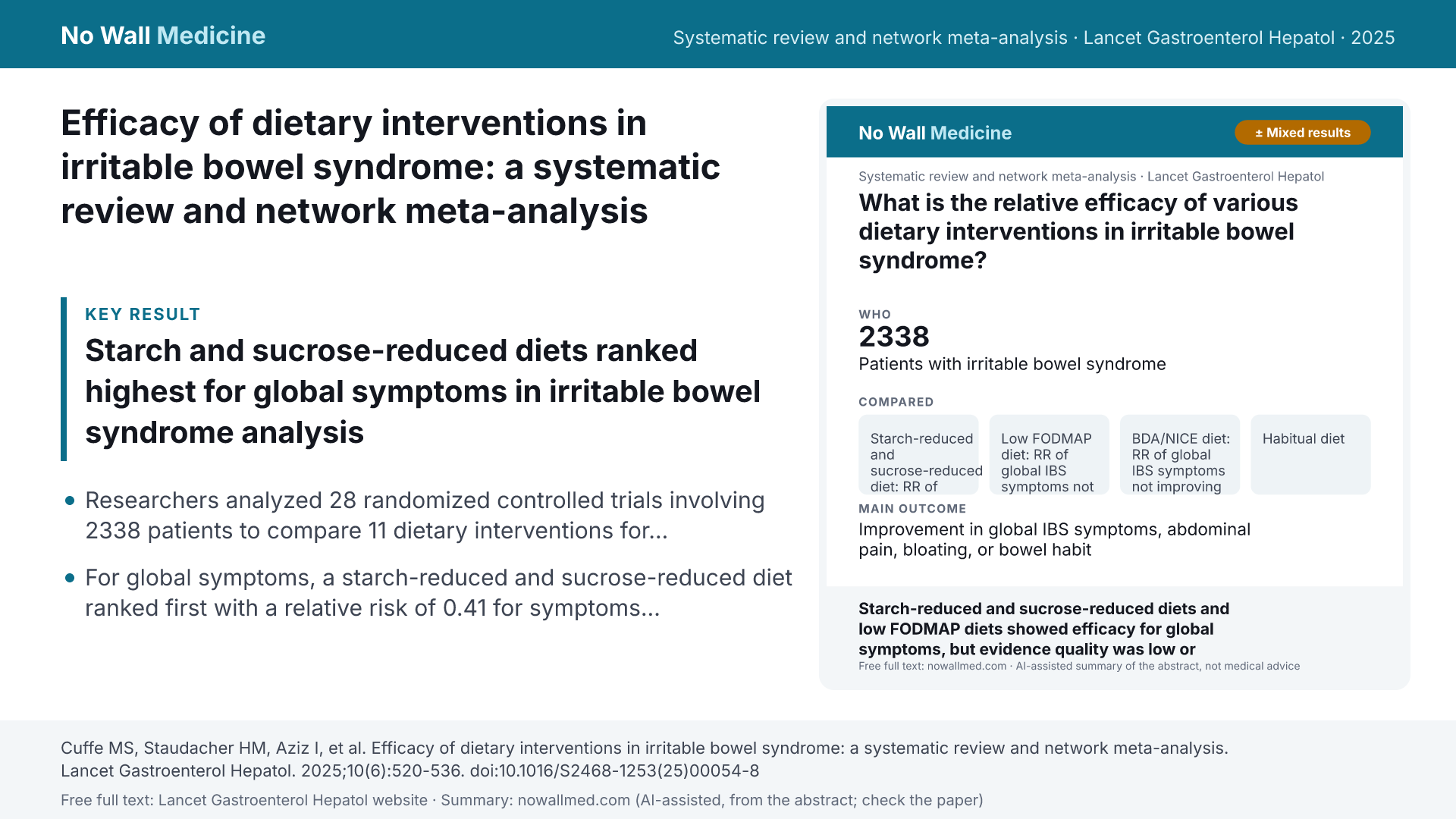
Starch and sucrose-reduced diets ranked highest for global symptoms in irritable bowel syndrome analysis
Efficacy of dietary interventions in irritable bowel syndrome: a systematic review and network meta-analysis
Systematic review and network meta-analysisMixed results
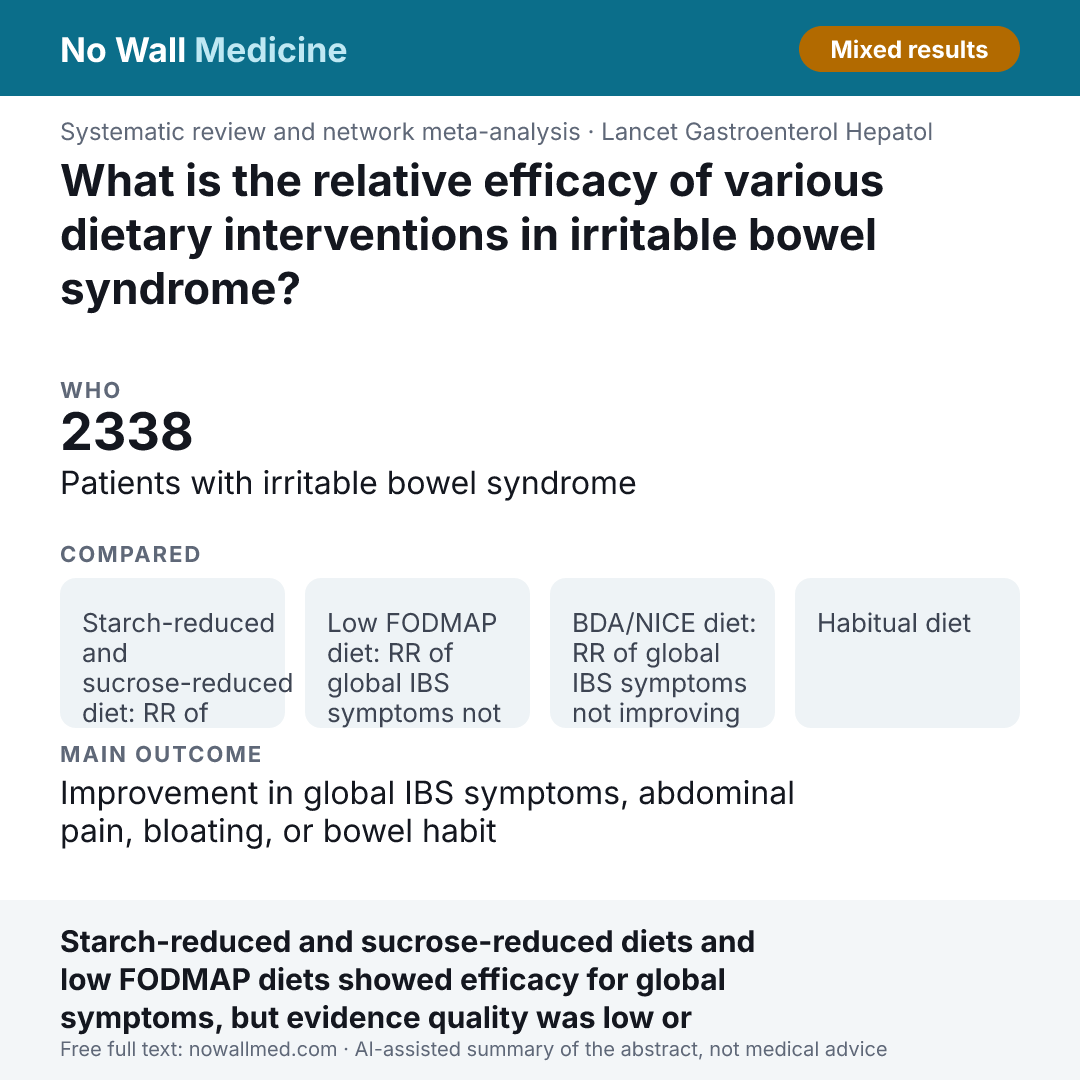
What is the relative efficacy of various dietary interventions in irritable bowel syndrome?
Who
2338
Patients with irritable bowel syndrome
Compared
Starch-reduced and sucrose-reduced diet: RR of global IBS symptoms not improving 0·41 (95% CI 0·26-0·67)
Low FODMAP diet: RR of global IBS symptoms not improving 0·51 (95% CI 0·37-0·70)
BDA/NICE diet: RR of global IBS symptoms not improving 0·62 (95% CI 0·43-0·90)
Habitual diet
Main outcome
Improvement in global IBS symptoms, abdominal pain, bloating, or bowel habit
Bottom line: Starch-reduced and sucrose-reduced diets and low FODMAP diets showed efficacy for global symptoms, but evidence quality was low or very low.
Limitation: All comparisons across the network were rated as low or very low confidence.
Lancet Gastroenterol Hepatol · 2025-04-18 · Save PNG
Clinical question: What is the relative efficacy of various dietary interventions in irritable bowel syndrome?
Why it matters: The relative effectiveness of different dietary interventions for managing irritable bowel syndrome symptoms is currently unclear.
Key points
- Researchers analyzed 28 randomized controlled trials involving 2338 patients to compare 11 dietary interventions for irritable bowel syndrome.
- For global symptoms, a starch-reduced and sucrose-reduced diet ranked first with a relative risk of 0.41 for symptoms not improving, followed by the low FODMAP diet at 0.51.
- A low FODMAP diet, which limits fermentable carbohydrates, was the only intervention found superior to a habitual diet for abdominal bloating or distension.
Headline and key points written with AI from the paper’s abstract, with every number checked against it. Read the paper before relying on them.
Was this summary helpful?
Subject terms
Headline, design, result, key points, caveat and citation as plain text.
Cite this article
Cuffe MS, Staudacher HM, Aziz I, et al. Efficacy of dietary interventions in irritable bowel syndrome: a systematic review and network meta-analysis. Lancet Gastroenterol Hepatol. 2025;10(6):520-536. doi:10.1016/S2468-1253(25)00054-8
Spotted a mistake? Suggest a correction