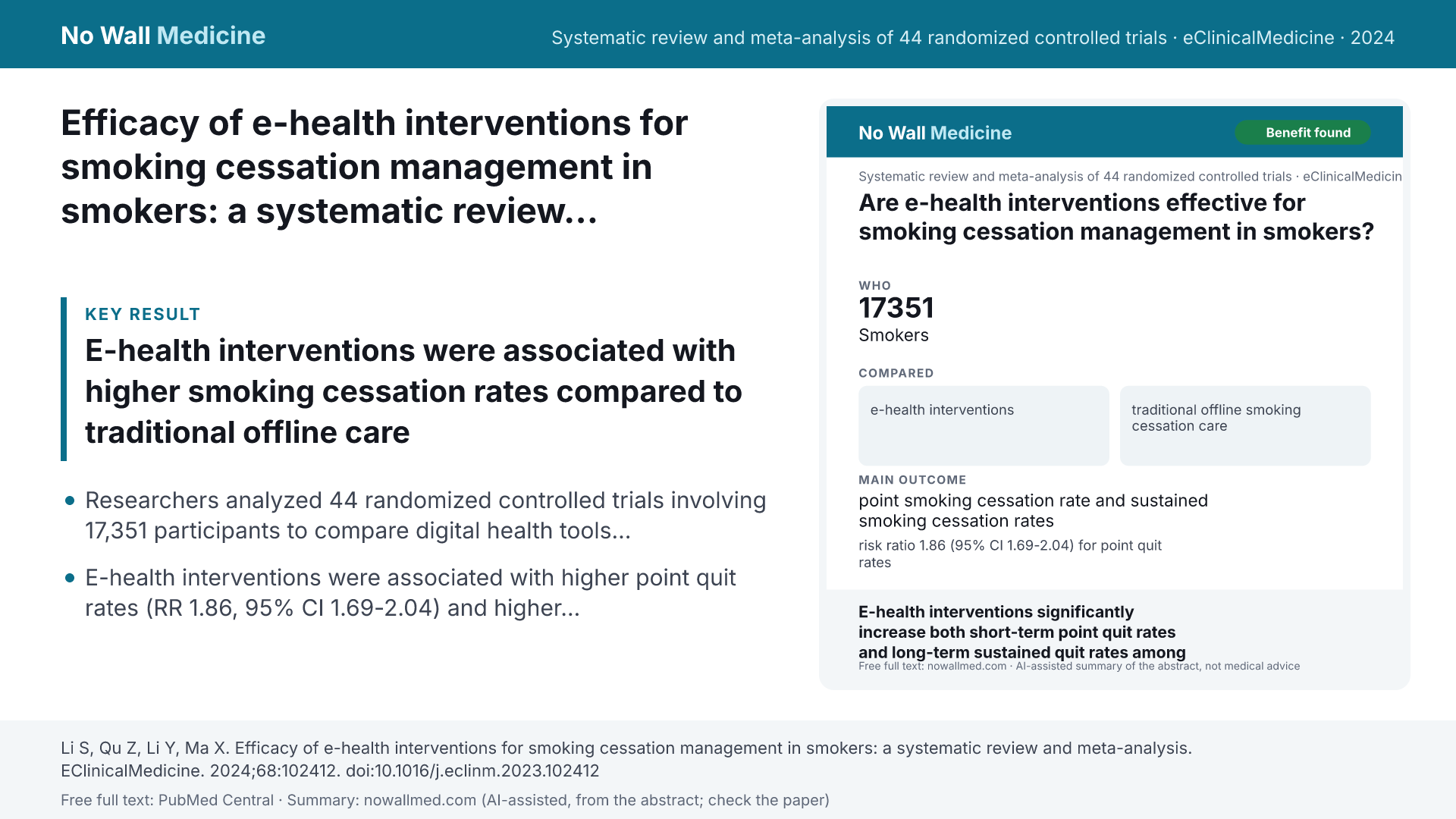
E-health interventions were associated with higher smoking cessation rates compared to traditional offline care
Efficacy of e-health interventions for smoking cessation management in smokers: a systematic review and meta-analysis
Systematic review and meta-analysis of 44 randomized controlled trialsBenefit found
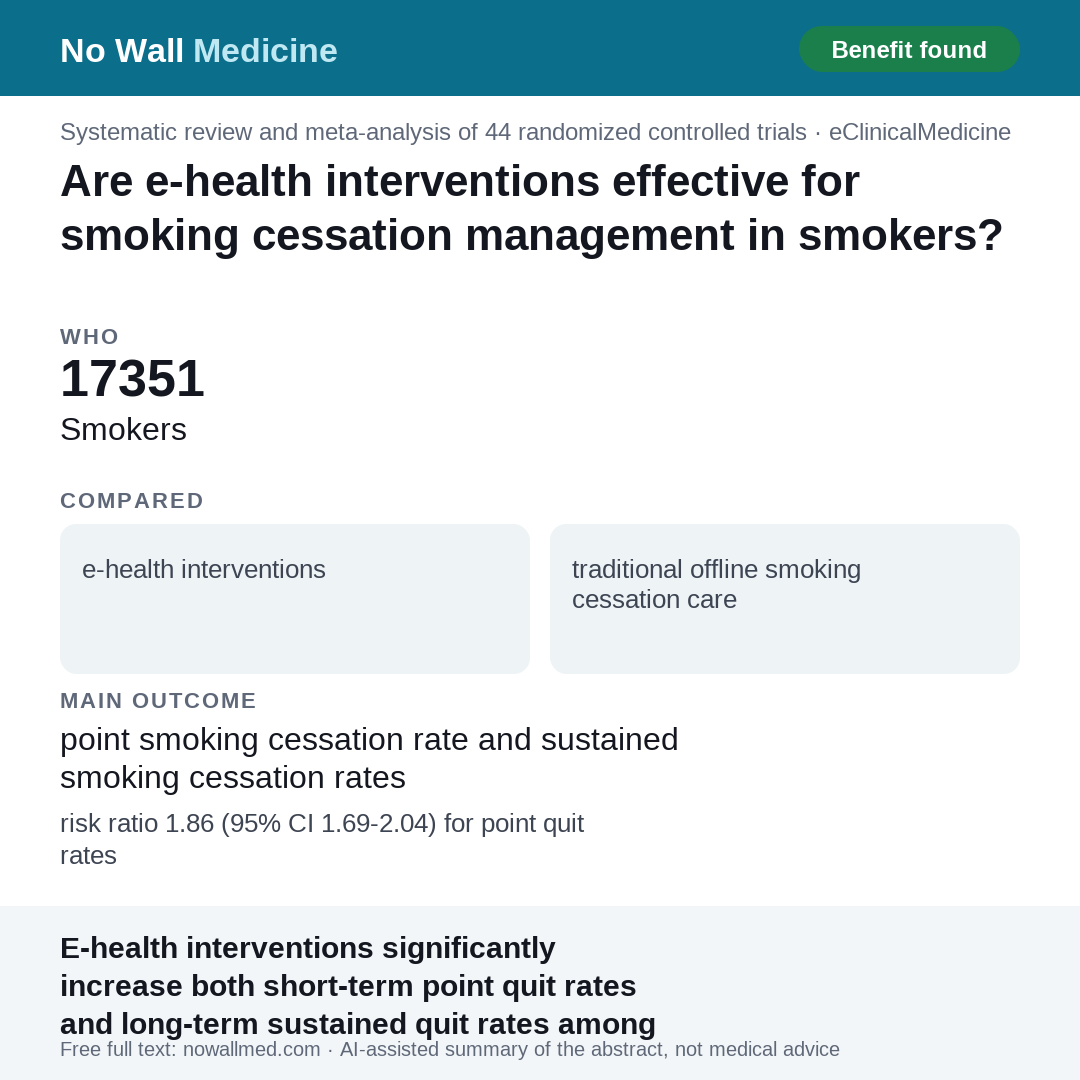
Are e-health interventions effective for smoking cessation management in smokers?
Who
17351
Smokers
Compared
e-health interventions
traditional offline smoking cessation care
Main outcome
point smoking cessation rate and sustained smoking cessation rates
Result: risk ratio 1.86 (95% CI 1.69-2.04) for point quit rates
Bottom line: E-health interventions significantly increase both short-term point quit rates and long-term sustained quit rates among smokers.
eClinicalMedicine · 2024-01-05Download image
Clinical question: Are e-health interventions effective for smoking cessation management in smokers?
Key points
- Researchers analyzed 44 randomized controlled trials involving 17,351 participants to compare digital health tools with traditional offline smoking cessation methods.
- E-health interventions were associated with higher point quit rates (RR 1.86, 95% CI 1.69-2.04) and higher long-term sustained quit rates (RR 1.79, 95% CI 1.60-2.00).
- Text and telephone interventions showed a higher short-term quit rate for up to 7 days (RR 2.10, 95% CI 1.77-2.48) compared to other methods.
Limitation the authors note: Further follow-up research is needed to evaluate the sustained effectiveness of interventions on smokers' continuous abstinence over a longer period greater than one year.
Headline and key points written with AI from the paper’s abstract, with every number checked against it. Read the paper before relying on them.
Was this summary helpful?
Headline, design, result, key points, caveat and citation as plain text.
Cite this article
Li S, Qu Z, Li Y, Ma X. Efficacy of e-health interventions for smoking cessation management in smokers: a systematic review and meta-analysis. eClinicalMedicine. 2024. doi:10.1016/j.eclinm.2023.102412
Spotted a mistake? Suggest a correction