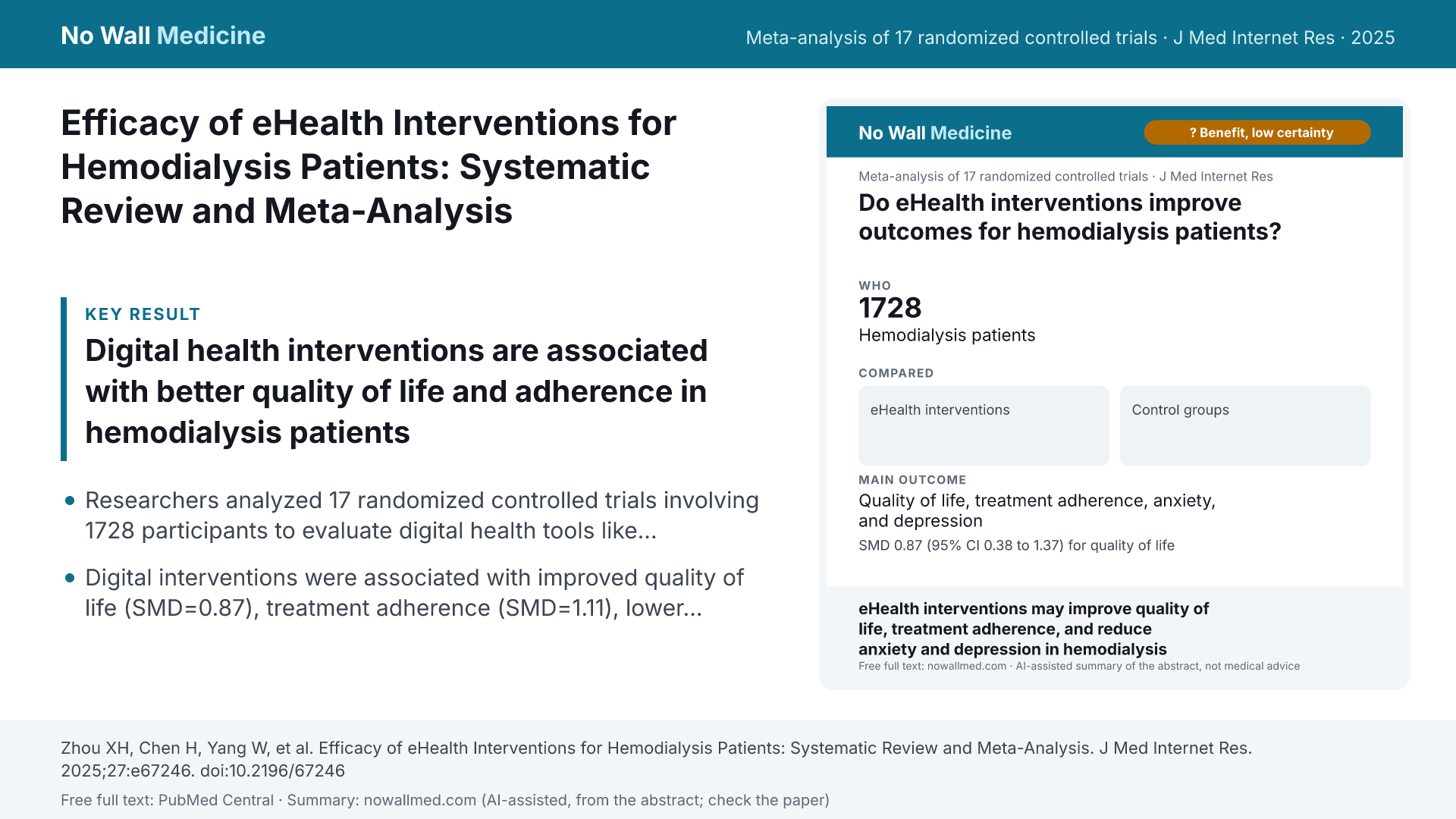
Digital health interventions are associated with better quality of life and adherence in hemodialysis patients
Efficacy of eHealth Interventions for Hemodialysis Patients: Systematic Review and Meta-Analysis
Meta-analysis of 17 randomized controlled trialsBenefit, low certainty
Do eHealth interventions improve outcomes for hemodialysis patients?
Who
1728
Hemodialysis patients
Compared
eHealth interventions
Control groups
Main outcome
Quality of life, treatment adherence, anxiety, and depression
Result: SMD 0.87 (95% CI 0.38 to 1.37) for quality of life
Bottom line: eHealth interventions may improve quality of life, treatment adherence, and reduce anxiety and depression in hemodialysis patients.
Limitation: High risk of performance and detection bias in most included trials.
J Med Internet Res · 2025-03-26 · Save PNG
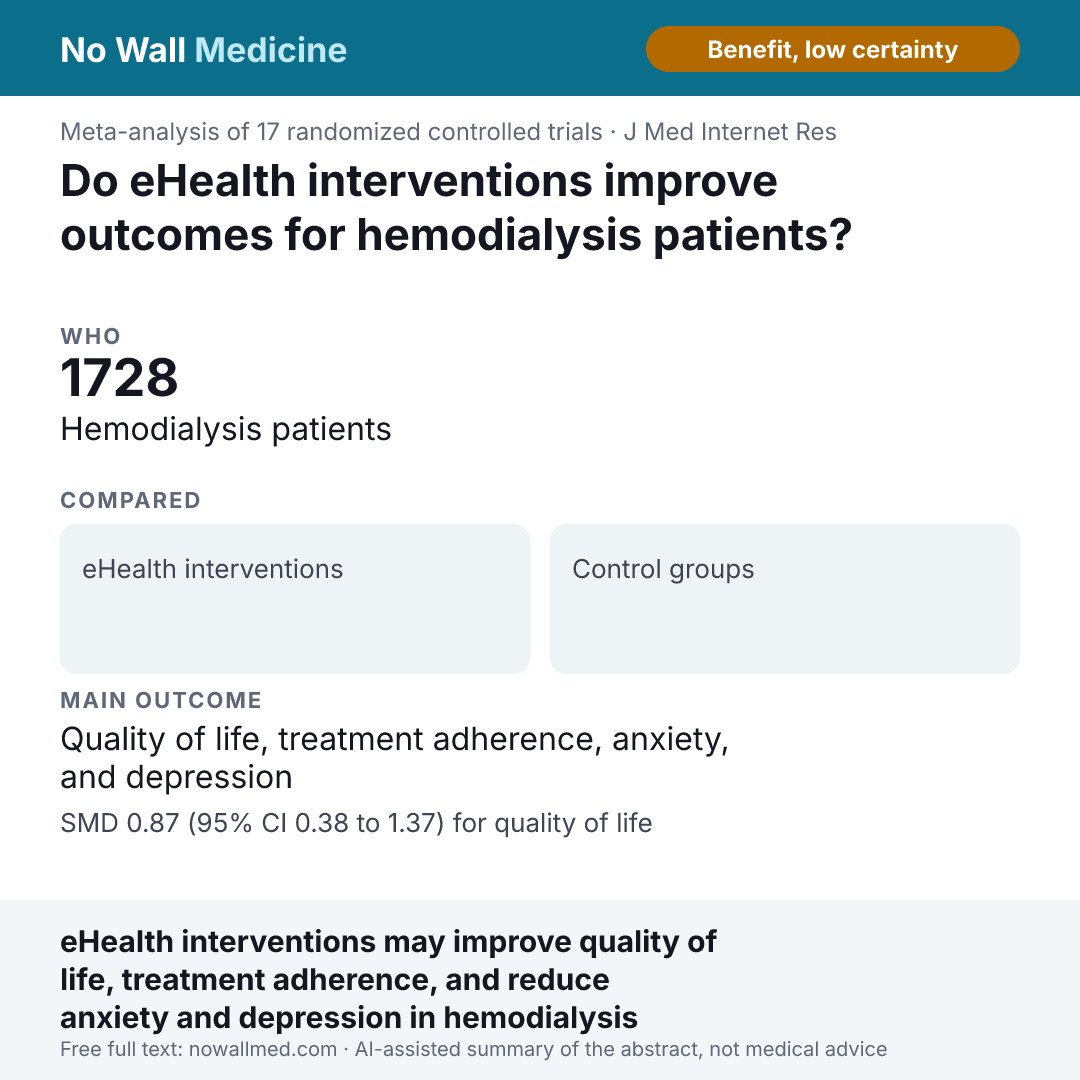
Clinical question: Do eHealth interventions improve outcomes for hemodialysis patients?
Why it matters: The efficacy of digital health interventions for improving quality of life, treatment adherence, and psychological outcomes in hemodialysis patients was not well understood due to a lack of quantitative evidence.
Key points
- Researchers analyzed 17 randomized controlled trials involving 1728 participants to evaluate digital health tools like text messages, mobile apps, and video sessions.
- Digital interventions were associated with improved quality of life (SMD=0.87), treatment adherence (SMD=1.11), lower anxiety (SMD=-2.11), and lower depression (SMD=-2.46).
- The interventions varied in length from 4 weeks to 12 months, with 3 months being the most common duration.
Limitation the authors note: A large majority of the included studies had some concern regarding selection bias or high risk of performance and detection bias.
Headline and key points written with AI from the paper’s abstract, with every number checked against it. Read the paper before relying on them.
Was this summary helpful?
Subject terms
Headline, design, result, key points, caveat and citation as plain text.
Cite this article
Zhou XH, Chen H, Yang W, et al. Efficacy of eHealth Interventions for Hemodialysis Patients: Systematic Review and Meta-Analysis. J Med Internet Res. 2025;27:e67246. doi:10.2196/67246
Spotted a mistake? Suggest a correction