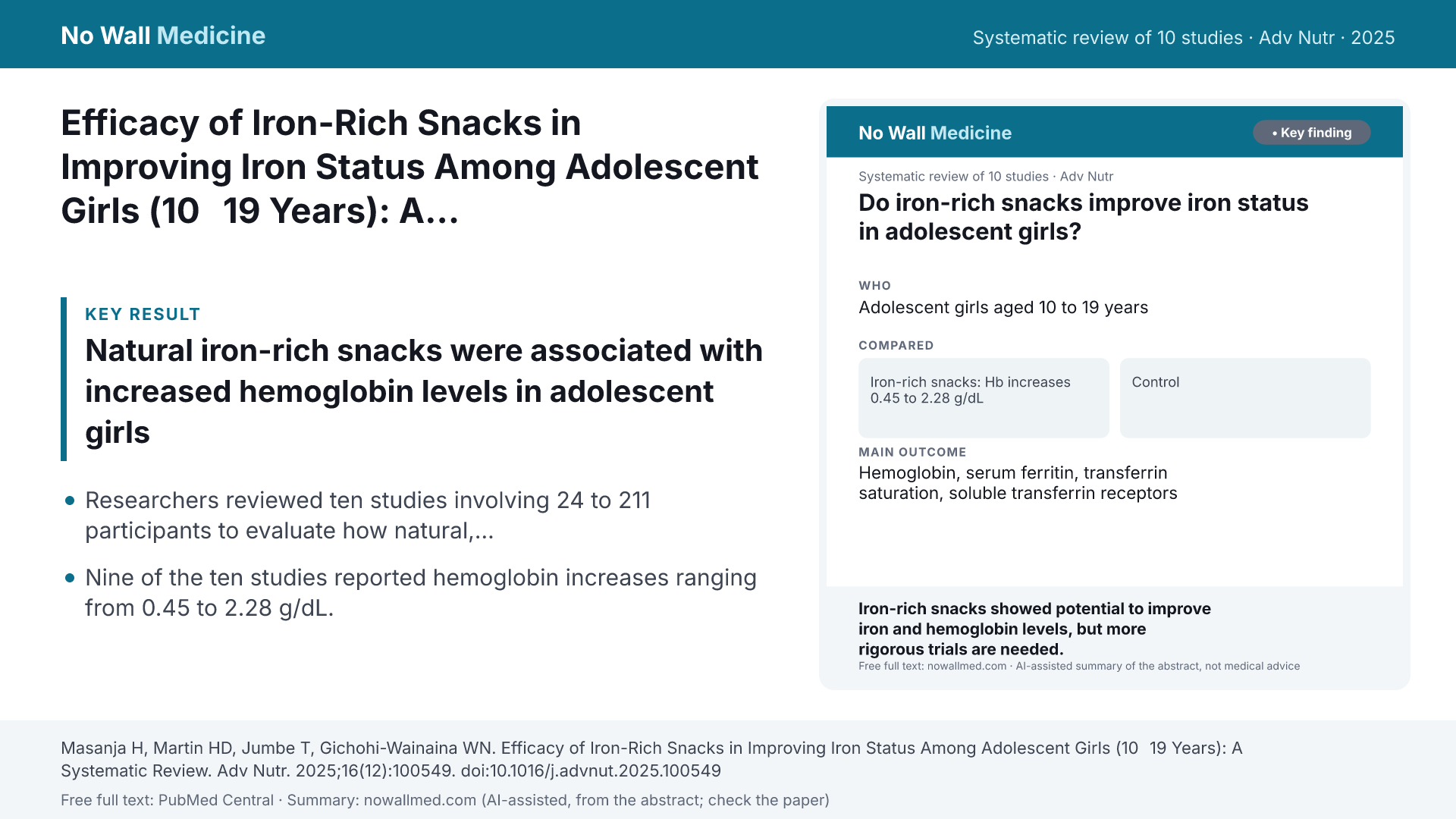
Natural iron-rich snacks were associated with increased hemoglobin levels in adolescent girls
Efficacy of Iron-Rich Snacks in Improving Iron Status Among Adolescent Girls (10‒19 Years): A Systematic Review
Systematic review of 10 studiesKey finding
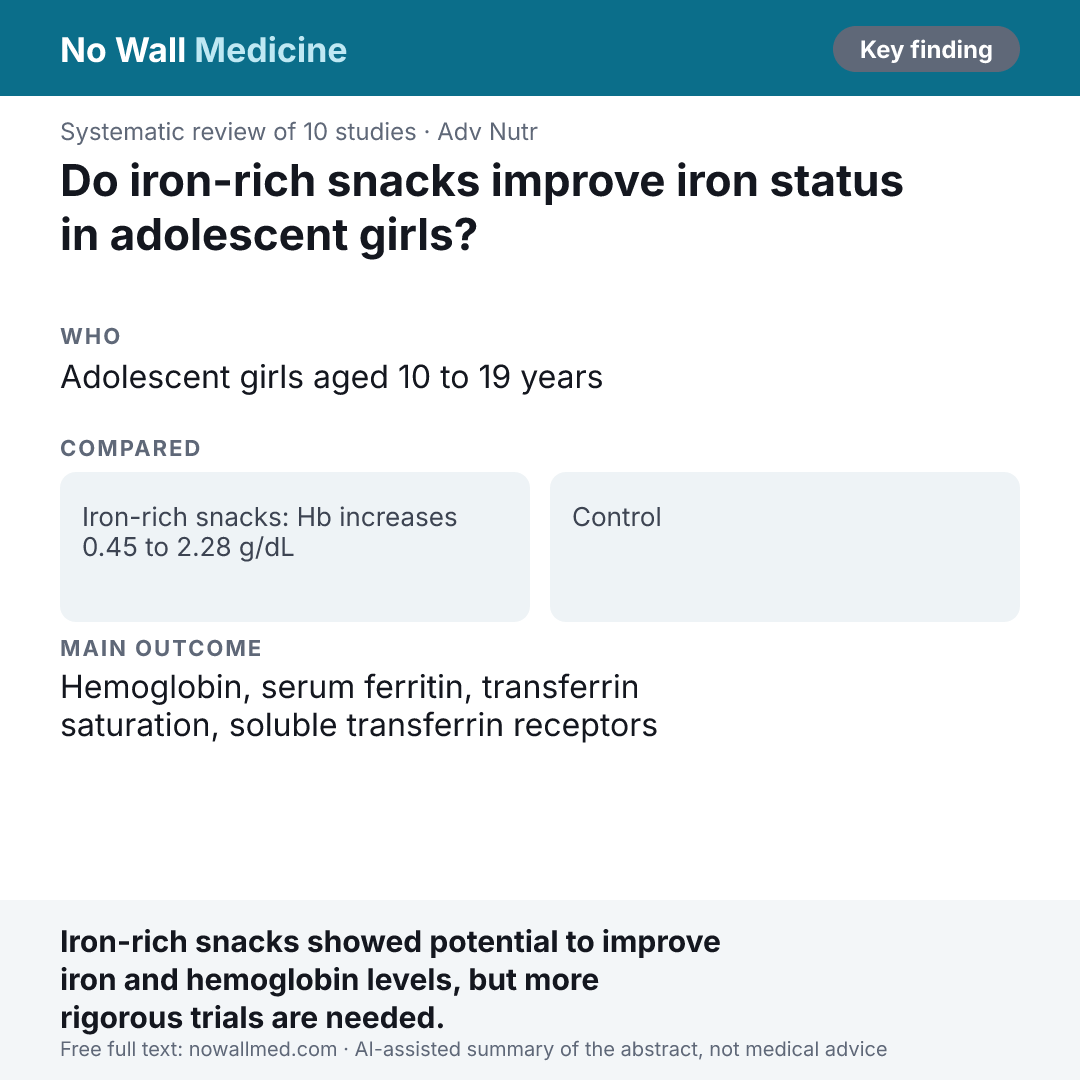
Do iron-rich snacks improve iron status in adolescent girls?
Who
Adolescent girls aged 10 to 19 years
Compared
Iron-rich snacks: Hb increases 0.45 to 2.28 g/dL
Control
Main outcome
Hemoglobin, serum ferritin, transferrin saturation, soluble transferrin receptors
Bottom line: Iron-rich snacks showed potential to improve iron and hemoglobin levels, but more rigorous trials are needed.
Limitation: Nine studies had moderate risk of bias; one had high selection bias.
Adv Nutr · 2025-10-29 · Save PNG
Clinical question: Do iron-rich snacks improve iron status in adolescent girls?
Why it matters: The efficacy of natural, non-commercially fortified iron-rich snacks in improving iron status among adolescent girls remains to be fully confirmed.
Key points
- Researchers reviewed ten studies involving 24 to 211 participants to evaluate how natural, non-commercially fortified snacks affect iron status in girls aged 10 to 19 years.
- Nine of the ten studies reported hemoglobin increases ranging from 0.45 to 2.28 g/dL.
- Only one study reported improvements in serum iron from 25.482 ± 0.036 g/dL to 41.511 ± 0.033 g/dL and ferritin from 10.827 ± 0.192 ng/mL to 14.016 ± 0.103 ng/mL.
Limitation the authors note: Nine studies had a moderate risk of bias due to performance, detection, and reporting issues, while one study had high selection bias.
Headline and key points written with AI from the paper’s abstract, with every number checked against it. Read the paper before relying on them.
Was this summary helpful?
Subject terms
Headline, design, result, key points, caveat and citation as plain text.
Cite this article
Masanja H, Martin HD, Jumbe T, Gichohi-Wainaina WN. Efficacy of Iron-Rich Snacks in Improving Iron Status Among Adolescent Girls (10‒19 Years): A Systematic Review. Adv Nutr. 2025;16(12):100549. doi:10.1016/j.advnut.2025.100549
Spotted a mistake? Suggest a correction