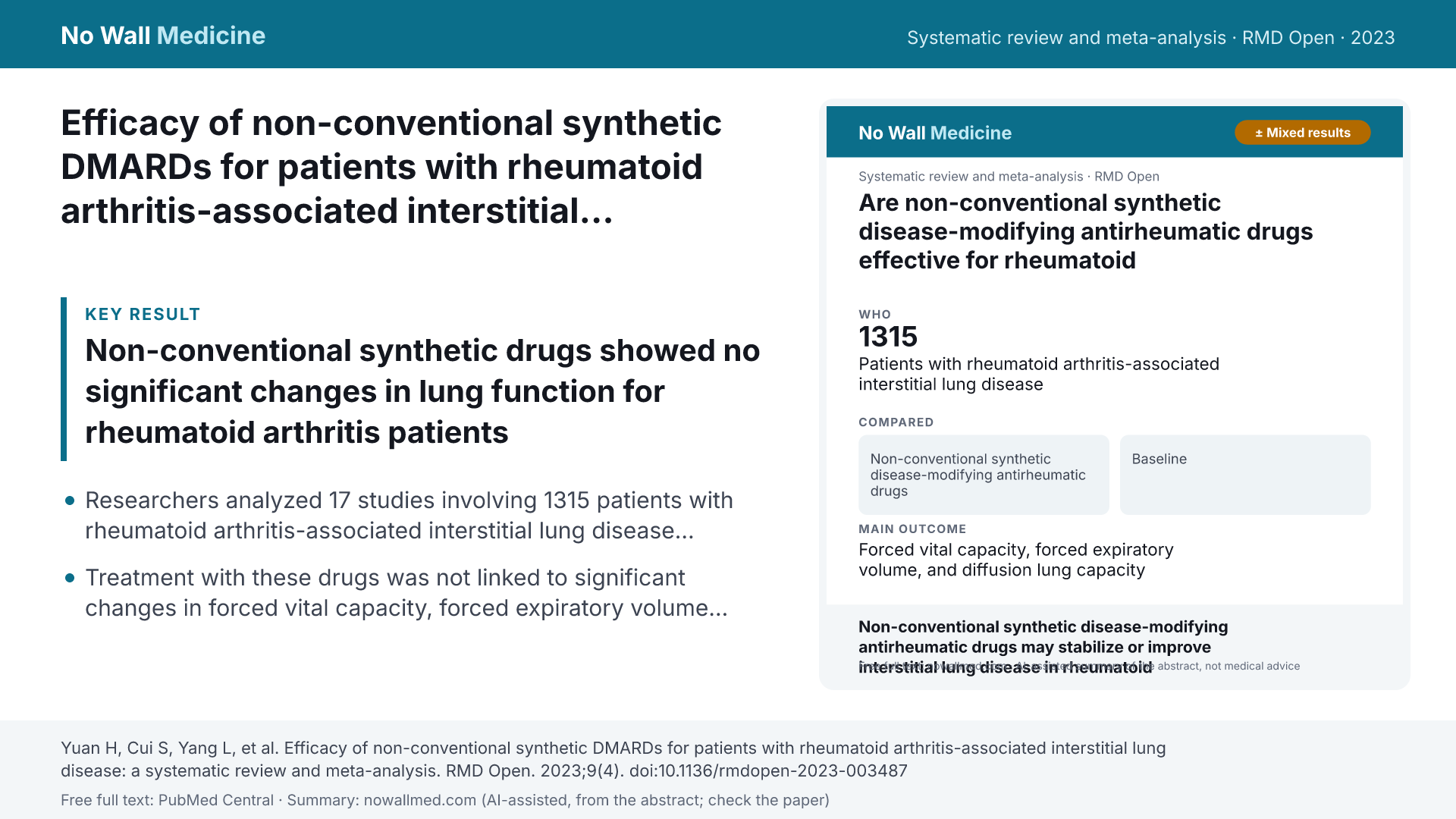
Non-conventional synthetic drugs showed no significant changes in lung function for rheumatoid arthritis patients
Efficacy of non-conventional synthetic DMARDs for patients with rheumatoid arthritis-associated interstitial lung disease: a systematic review and meta-analysis
Systematic review and meta-analysisMixed results
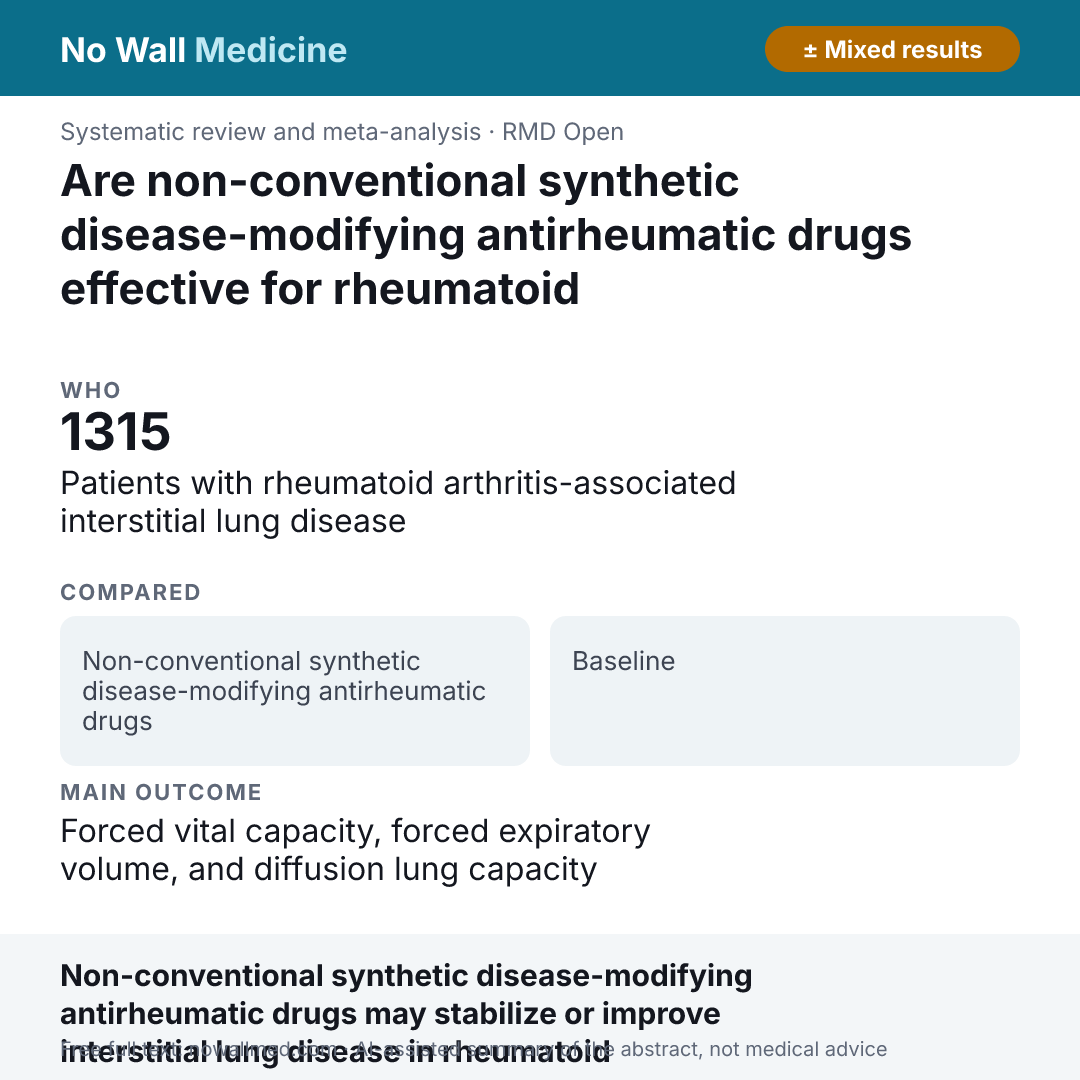
Are non-conventional synthetic disease-modifying antirheumatic drugs effective for rheumatoid arthritis-associated interstitial lung disease?
Who
1315
Patients with rheumatoid arthritis-associated interstitial lung disease
Compared
Non-conventional synthetic disease-modifying antirheumatic drugs
Baseline
Main outcome
Forced vital capacity, forced expiratory volume, and diffusion lung capacity
Bottom line: Non-conventional synthetic disease-modifying antirheumatic drugs may stabilize or improve interstitial lung disease in rheumatoid arthritis patients.
RMD Open · 2023-10-30 · PROSPERO CRD42022356816
Headline and visual abstract written with AI from the paper’s abstract, with every number checked against it. Read the paper before relying on them.
Was this summary helpful?
Abstract
Objectives
We conducted a systematic review and meta-analysis to determine the efficacy of non-conventional synthetic disease-modifying antirheumatic drug (ncs-DMARD) strategies on patients with rheumatoid arthritis (RA)-associated interstitial lung disease (ILD). Methods
PubMed, EMBASE, the Cochrane Library and Web of Science were searched for relevant articles from inception to 1 June 2022. The results obtained from the analysis were expressed as mean difference (MD), effect size and 95% CI. Results
A total of 17 studies, including 1315 patients with RA-ILD, were eligible. The ncs-DMARDs included abatacept, rituximab, tocilizumab, tumour necrosis factor and Janus kinase inhibitors. Compared with the baseline, there were no significant changes in forced vital capacity (FVC), forced expiratory volume in the first second (FEV1) and diffusion lung capacity for carbon monoxide (DLCO) values in the pooled data after ncs-DMARD treatment (alone or combined with conventional therapy) (p=0.36 for FVC; p=0.96 for FEV1 and p=0.46 for DLCO). Of note, FVC was obviously increased in rituximab subgroup (MD=-4.62, 95% CI -8.90 to -0.33, p=0.03). Also, high-resolution CT non-progression rate and fatality rate due to ILD progression in patients with RA-ILD were 0.792 (95% CI 0.746 to 0.834, p=0.015) and 0.049 (95% CI 0.035 to 0.065, p=0.000), respectively. Conclusion
ncs-DMARDs alone or combined with conventional therapy might be an optimal and promising treatment for stabilising or improving ILD in patients with RA-ILD. Prospero registration number
CRD42022356816.
Abstract reproduced under the article’s CC BY licence.
Subject terms
Cite this article
Yuan H, Cui S, Yang L, et al. Efficacy of non-conventional synthetic DMARDs for patients with rheumatoid arthritis-associated interstitial lung disease: a systematic review and meta-analysis. RMD Open. 2023;9(4). doi:10.1136/rmdopen-2023-003487
Spotted a mistake? Suggest a correction