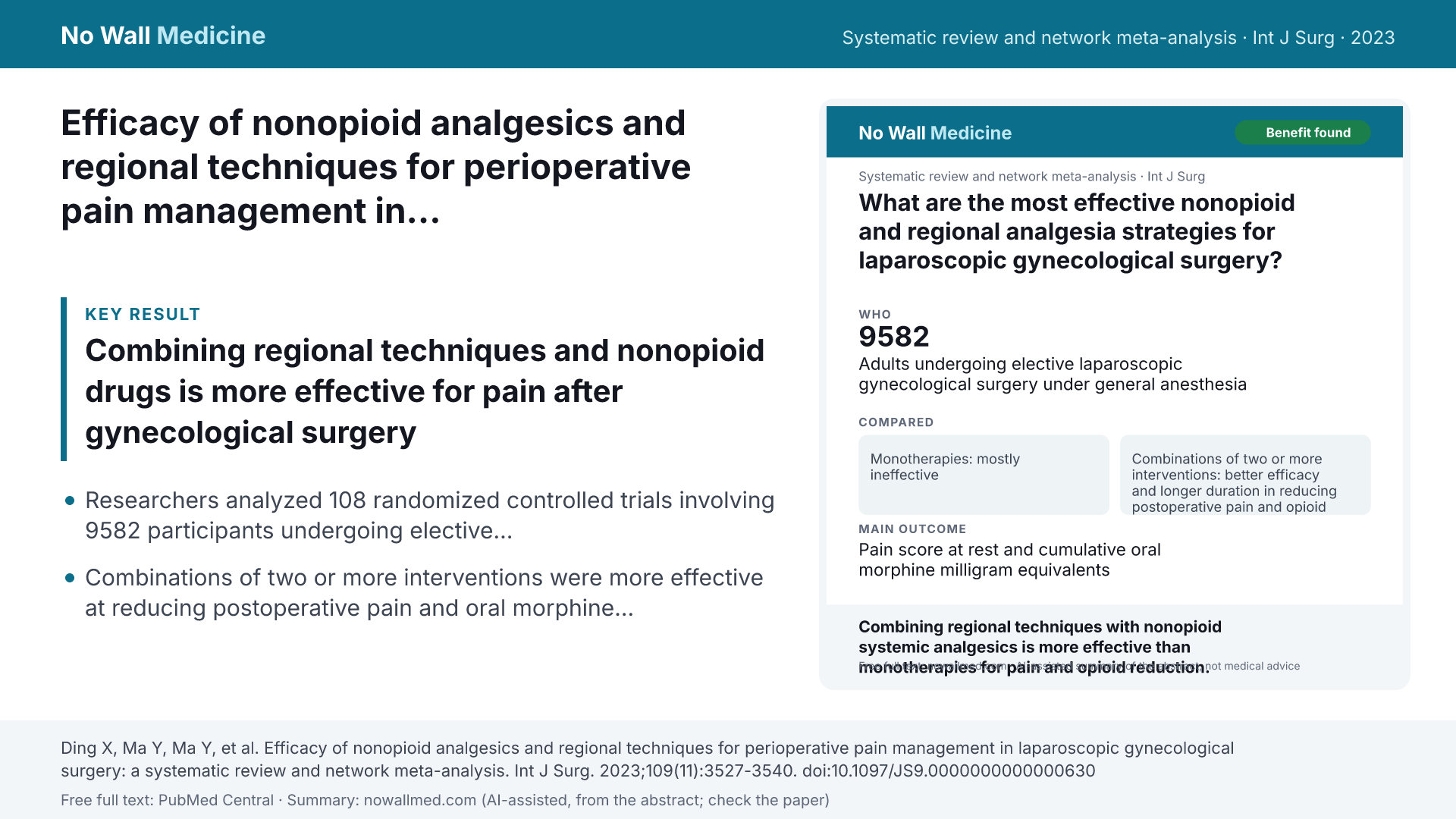
Efficacy of nonopioid analgesics and regional techniques for perioperative pain management in laparoscopic gynecological surgery: a systematic review and network meta-analysis
Key result: Combining regional techniques and nonopioid drugs is more effective for pain after gynecological surgery
Key points
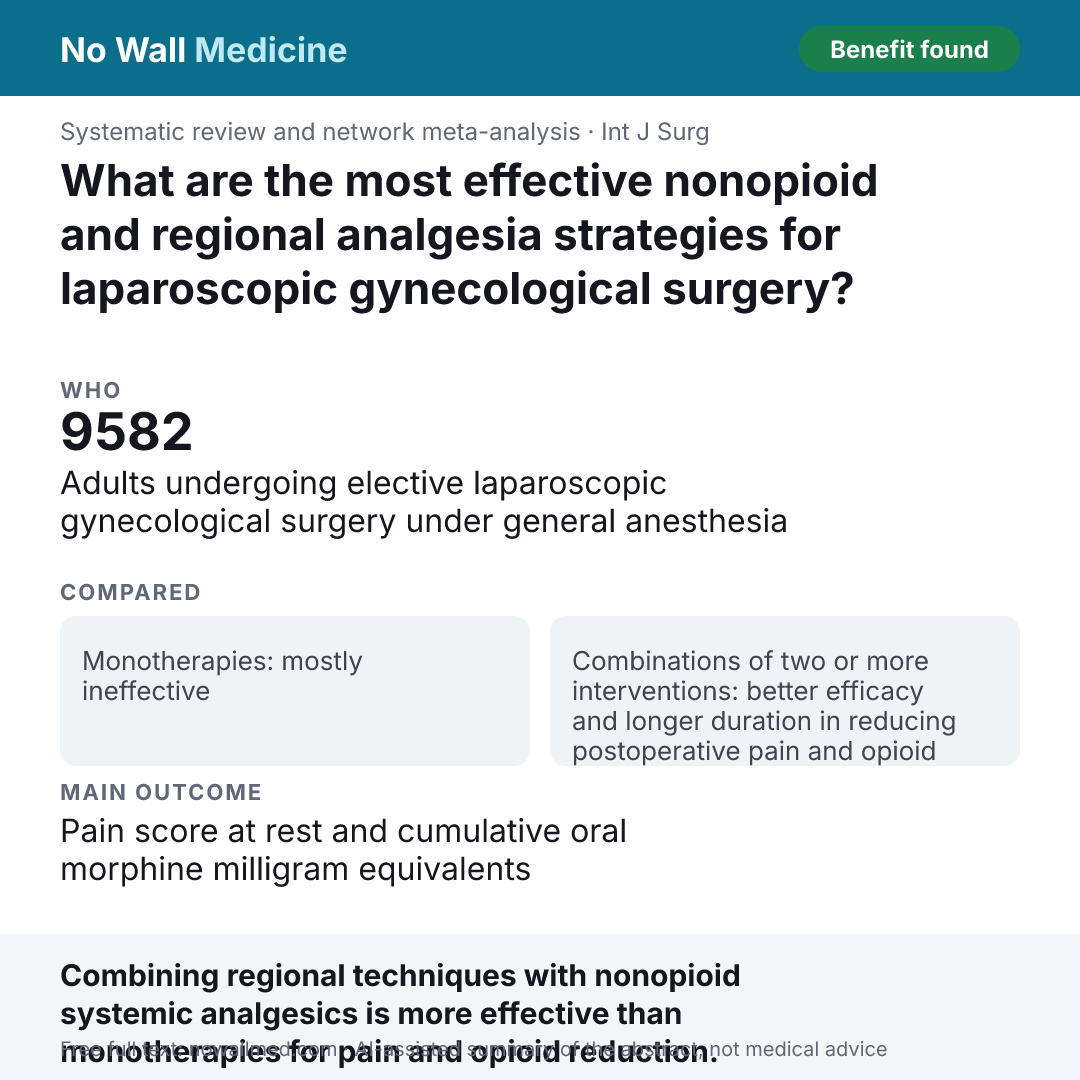
- Researchers analyzed 108 randomized controlled trials involving 9582 participants undergoing elective laparoscopic gynecological surgery under general anesthesia.
- Combinations of two or more interventions were more effective at reducing postoperative pain and oral morphine milligram equivalents within 24 h than single treatments.
- The most effective peripheral nerve blocks, which are injections of numbing medicine near nerves, were ultrasound-guided transversus abdominis plane block with adjuvant and ultrasound-guided quadratus lumborum block.
Why it matters: The optimal approach for managing pain during and after laparoscopic gynecological surgery is unclear, which limits the development of evidence-based recovery protocols.
Limitation the authors note: The authors noted that further high-quality and larger trials are needed due to low confidence levels for certain interventions.
Discussion prompts
- Would these patients look like yours? Who was left out?
- Is the main outcome one that matters to patients?
- Is the difference large enough to change what you do?
Cite: Ding X, Ma Y, Ma Y, et al. Efficacy of nonopioid analgesics and regional techniques for perioperative pain management in laparoscopic gynecological surgery: a systematic review and network meta-analysis. Int J Surg. 2023;109(11):3527-3540. doi:10.1097/JS9.0000000000000630
Free full text: PubMed Central · Summary and visual abstract: nowallmed.com/a/efficacy-of-nonopioid-analgesics-and-regional-techniques-for-e6t5v9/ (AI-assisted from the abstract; check the paper before relying on it).