Chlorfenapyr-pyrethroid insecticidal nets were more effective than pyrethroid-only nets for malaria control
Efficacy of pyriproxyfen-pyrethroid long-lasting insecticidal nets (LLINs) and chlorfenapyr-pyrethroid LLINs compared with pyrethroid-only LLINs for malaria control in Benin: a cluster-randomised, superiority trial
Cluster-randomised, superiority trialMixed results
Are pyriproxyfen-pyrethroid or chlorfenapyr-pyrethroid nets more effective than pyrethroid-only nets for malaria control?
Who
216289
Children aged 6 months to 10 years in Benin · Zou Department, Benin
Compared
Pyrethroid-only LLIN reference group: 1·03 cases per child-year (95% CI 0·96-1·09)
Pyriproxyfen-pyrethroid LLIN group: 0·84 cases per child-year (0·78-0·90)
Chlorfenapyr-pyrethroid LLIN group: 0·56 cases per child-year (0·51-0·61)
Main outcome
Malaria case incidence measured over 2 years
Result: hazard ratio 0·54 (95% CI 0·42-0·70) for chlorfenapyr-pyrethroid
Bottom line: Chlorfenapyr-pyrethroid nets provided greater protection than pyrethroid-only nets, while pyriproxyfen-pyrethroid nets conferred similar protection.
Funded by: UNITAID, The Global Fund
Lancet · 2023-01-24Download image
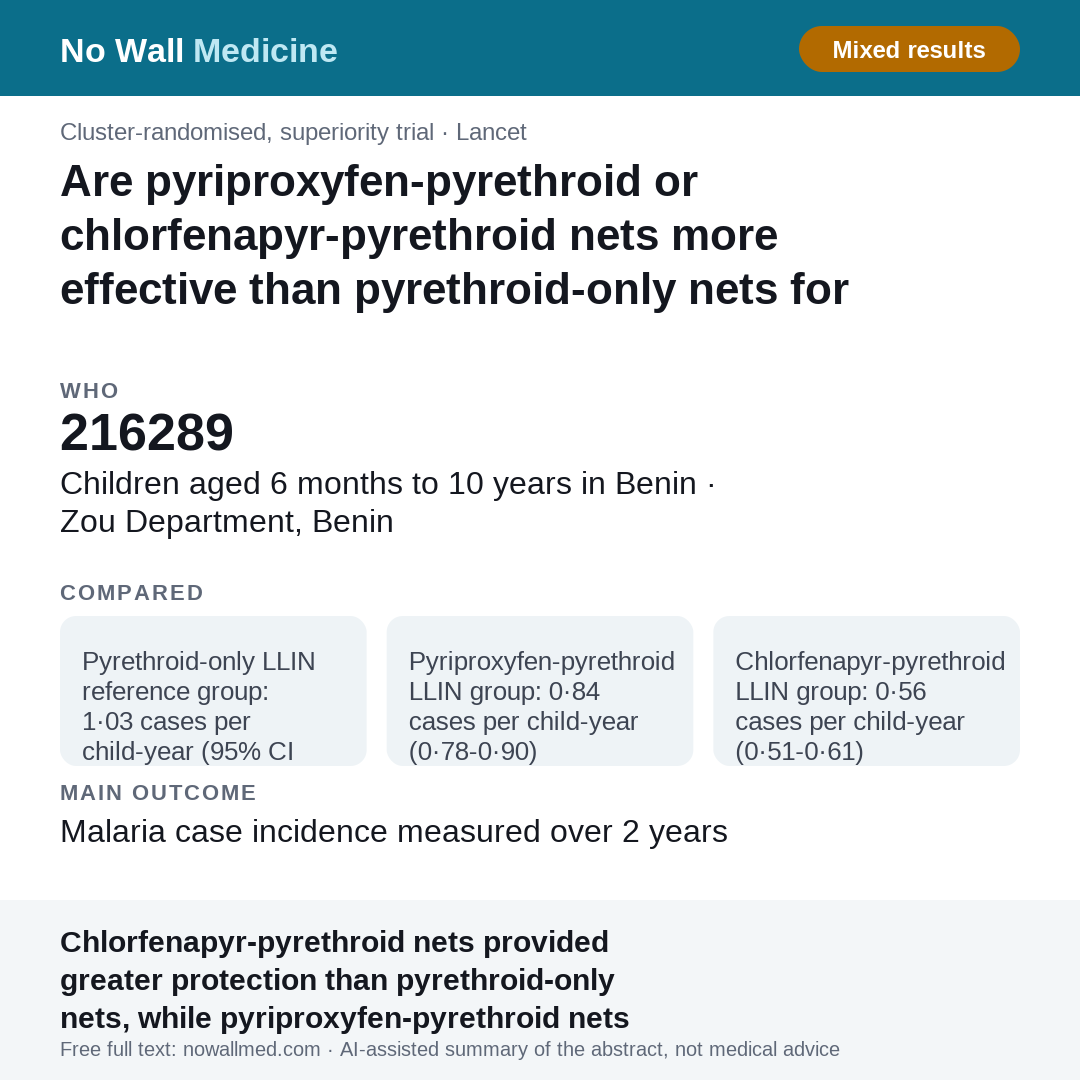
Clinical question: Are pyriproxyfen-pyrethroid or chlorfenapyr-pyrethroid nets more effective than pyrethroid-only nets for malaria control?
Why it matters: Malaria control is facing challenges in sub-Saharan Africa due to rebounds in transmission caused by pyrethroid-resistant mosquitoes.
Key points
- Researchers conducted a cluster-randomised trial in Benin involving 54,030 households and 216,289 inhabitants to compare different types of long-lasting insecticidal nets.
- Chlorfenapyr-pyrethroid nets resulted in 0.56 malaria cases per child-year compared to 1.03 cases per child-year with pyrethroid-only nets (p<0.0001).
- Pyriproxyfen-pyrethroid nets resulted in 0.84 cases per child-year, which was not statistically different from the 1.03 cases in the pyrethroid-only group (p=0.28).
Headline and key points written with AI from the paper’s abstract, with every number checked against it. Read the paper before relying on them.
Abstract
Background
New classes of long-lasting insecticidal nets (LLINs) combining mixtures of insecticides with different modes of action could put malaria control back on track after rebounds in transmission across sub-Saharan Africa. We evaluated the relative efficacy of pyriproxyfen-pyrethroid LLINs and chlorfenapyr-pyrethroid LLINs compared with standard LLINs against malaria transmission in an area of high pyrethroid resistance in Benin. Methods
We conducted a cluster-randomised, superiority trial in Zou Department, Benin. Clusters were villages or groups of villages with a minimum of 100 houses. We used restricted randomisation to randomly assign 60 clusters to one of three LLIN groups (1:1:1): to receive nets containing either pyriproxyfen and alpha-cypermethrin (pyrethroid), chlorfenapyr and alpha-cypermethrin, or alpha-cypermethrin only (reference). Households received one LLIN for every two people. The field team, laboratory staff, analyses team, and community members were masked to the group allocation. The primary outcome was malaria case incidence measured over 2 years after net distribution in a cohort of children aged 6 months-10 years, in the intention-to-treat population. This study is ongoing and is registered with ClinicalTrials.gov, NCT03931473. Findings
Between May 23 and June 24, 2019, 53 854 households and 216 289 inhabitants were accounted for in the initial census and included in the study. Between March 19 and 22, 2020, 115 323 LLINs were distributed to 54 030 households in an updated census. A cross-sectional survey showed that study LLIN usage was highest at 9 months after distribution (5532 [76·8%] of 7206 participants), but decreased by 24 months (4032 [60·6%] of 6654). Mean malaria incidence over 2 years after LLIN distribution was 1·03 cases per child-year (95% CI 0·96-1·09) in the pyrethroid-only LLIN reference group, 0·84 cases per child-year (0·78-0·90) in the pyriproxyfen-pyrethroid LLIN group (hazard ratio [HR] 0·86, 95% CI 0·65-1·14; p=0·28), and 0·56 cases per child-year (0·51-0·61) in the chlorfenapyr-pyrethroid LLIN group (HR 0·54, 95% CI 0·42-0·70; p<0·0001). Interpretation
Over 2 years, chlorfenapyr-pyrethroid LLINs provided greater protection from malaria than pyrethroid-only LLINs in an area with pyrethroid-resistant mosquitoes. Pyriproxyfen-pyrethroid LLINs conferred protection similar to pyrethroid-only LLINs. These findings provide crucial second-trial evidence to enable WHO to make policy recommendations on these new LLIN classes. This study confirms the importance of chlorfenapyr as an LLIN treatment to control malaria in areas with pyrethroid-resistant vectors. However, an arsenal of new active ingredients is required for successful long-term resistance management, and additional innovations, including pyriproxyfen, need to be further investigated for effective vector control strategies. Funding
UNITAID, The Global Fund.
Abstract reproduced under the article’s CC BY licence.
Topics
Cite this article
Accrombessi M, Cook J, Dangbenon E, Yovogan B, Akpovi H, Sovi A. Efficacy of pyriproxyfen-pyrethroid long-lasting insecticidal nets (LLINs) and chlorfenapyr-pyrethroid LLINs compared with pyrethroid-only LLINs for malaria control in Benin: a cluster-randomised, superiority trial. Lancet. 2023. doi:10.1016/S0140-6736(22)02319-4
Spotted a mistake? Suggest a correction