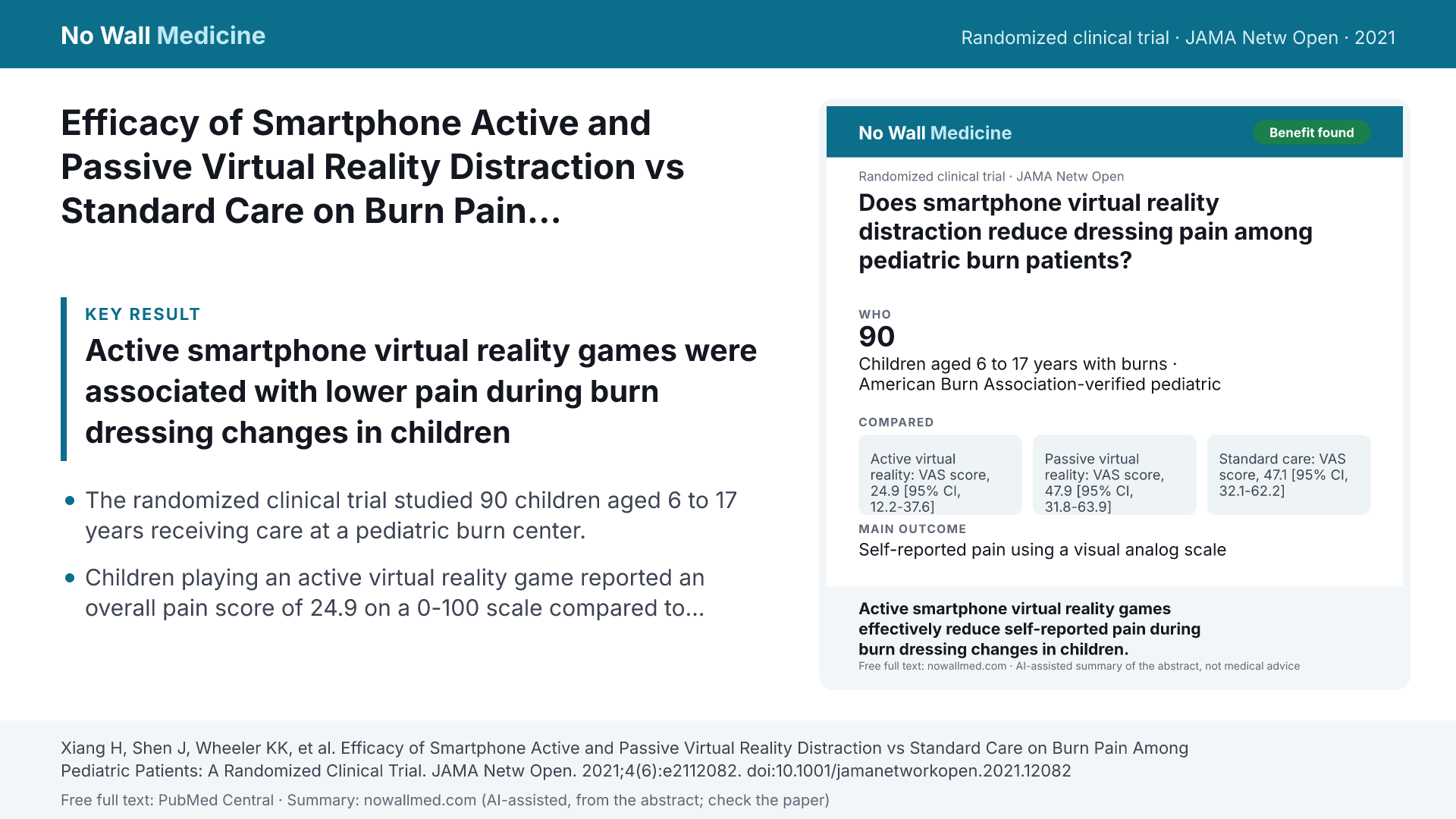
Efficacy of Smartphone Active and Passive Virtual Reality Distraction vs Standard Care on Burn Pain Among Pediatric Patients: A Randomized Clinical Trial
Key result: Active smartphone virtual reality games were associated with lower pain during burn dressing changes in children
Key points
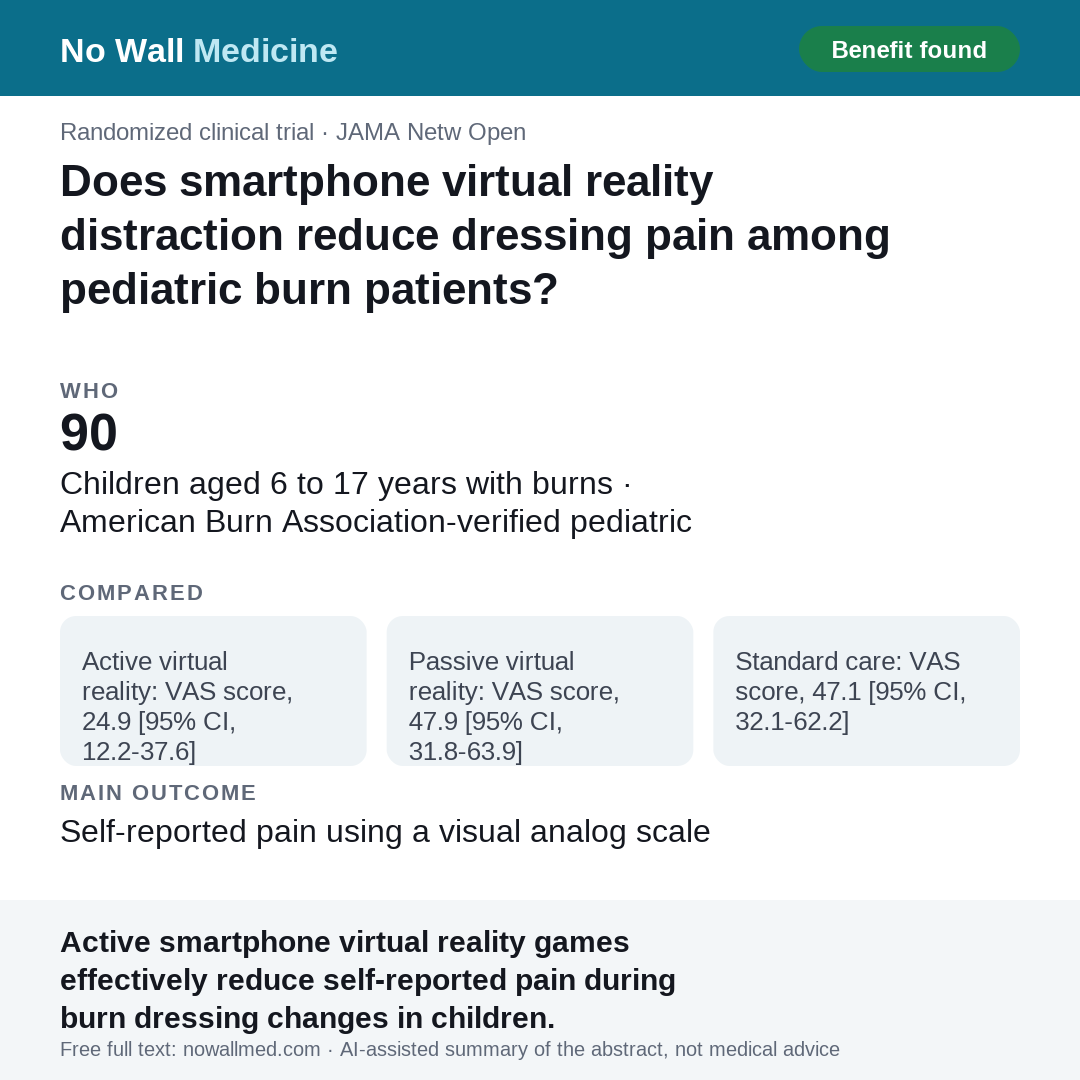
- The randomized clinical trial studied 90 children aged 6 to 17 years receiving care at a pediatric burn center.
- Children playing an active virtual reality game reported an overall pain score of 24.9 on a 0-100 scale compared to 47.1 for the standard care group.
- The active virtual reality group also reported a lower worst pain score of 27.4 compared to 47.9 for the passive virtual reality group and 48.8 for standard care.
Why it matters: It was unknown if smartphone-based virtual reality games could effectively manage pain for pediatric patients during dressing changes in real-world burn clinics.
Discussion prompts
- Would these patients look like yours? Who was left out?
- Is the main outcome one that matters to patients?
- Is the difference large enough to change what you do?
Cite: Xiang H, Shen J, Wheeler KK, et al. Efficacy of Smartphone Active and Passive Virtual Reality Distraction vs Standard Care on Burn Pain Among Pediatric Patients: A Randomized Clinical Trial. JAMA Netw Open. 2021. doi:10.1001/jamanetworkopen.2021.12082
Free full text: PubMed Central · Summary and visual abstract: nowallmed.com/a/efficacy-of-smartphone-active-and-passive-virtual-reality-distraction-i8mi24/ (AI-assisted from the abstract; check the paper before relying on it).