Surveillance bronchoscopy and clinically indicated bronchoscopy show no difference in detecting acute lung transplant rejection
Efficacy of surveillance bronchoscopy versus clinically indicated bronchoscopy for detection of acute lung transplant rejection: a systematic review and meta-analysis
Meta-analysis of three prospective studiesNo clear difference
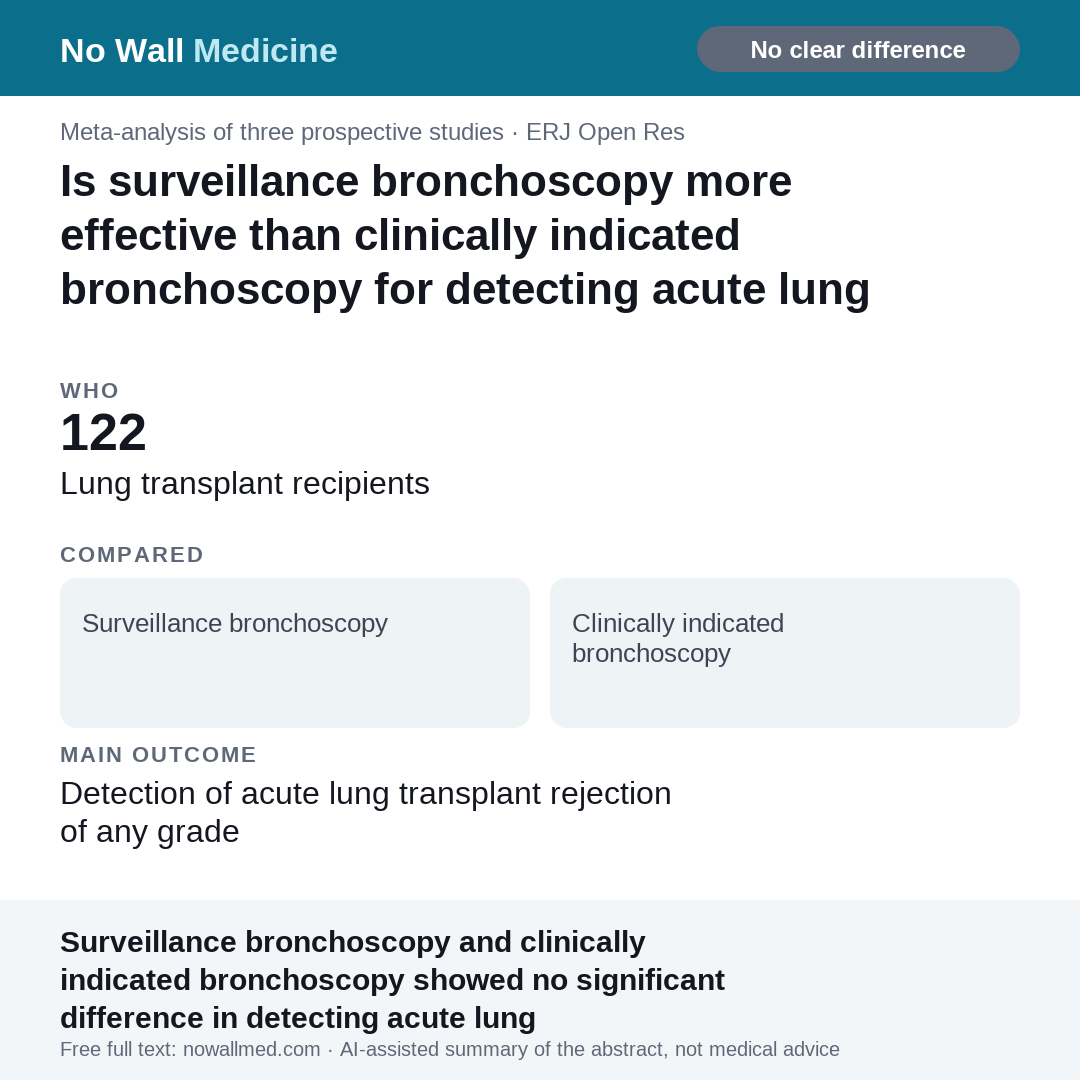
Is surveillance bronchoscopy more effective than clinically indicated bronchoscopy for detecting acute lung transplant rejection?
Who
122
Lung transplant recipients
Compared
Surveillance bronchoscopy
Clinically indicated bronchoscopy
Main outcome
Detection of acute lung transplant rejection of any grade
Bottom line: Surveillance bronchoscopy and clinically indicated bronchoscopy showed no significant difference in detecting acute lung transplant rejection.
Limitation: Limited number of studies and small sample sizes
ERJ Open Res · 2024-10-07Download image
Clinical question: Is surveillance bronchoscopy more effective than clinically indicated bronchoscopy for detecting acute lung transplant rejection?
Why it matters: It is unknown whether routine surveillance bronchoscopy is more effective than bronchoscopy performed only when symptoms suggest a problem for detecting acute lung transplant rejection.
Key points
- Researchers analyzed three observational cohort studies involving 122 patients and 527 bronchoscopies to compare surveillance and clinically indicated methods.
- Neither surveillance bronchoscopy nor clinically indicated bronchoscopy was associated with a higher likelihood of detecting acute lung transplant rejection of any grade.
- Subgroup analyses showed no advantage for surveillance bronchoscopy in detecting minimal rejection, which is classified as grade A1.
Limitation the authors note: The authors noted a limited number of studies and small sample sizes in the analyzed data.
Headline and key points written with AI from the paper’s abstract, with every number checked against it. Read the paper before relying on them.
Cite this article
Fricke K, Sievi NA, Schmidt FP, Schuurmans MM, Kohler M. Efficacy of surveillance bronchoscopy versus clinically indicated bronchoscopy for detection of acute lung transplant rejection: a systematic review and meta-analysis. ERJ Open Res. 2024. doi:10.1183/23120541.00404-2024
Spotted a mistake? Suggest a correction
Top studies every Monday
The week’s key trials and guidelines in your specialties, plus any topics you follow. By email, free.
Get the weekly digest