Technology-based interventions showed no statistically significant effect on reducing loneliness in randomized controlled trials
Efficacy of Technology-Based Interventions on the Reduction of Loneliness: Systematic Review and Meta-Analysis
Meta-analysis of randomized controlled trialsNo clear difference
Are technology-based interventions effective in reducing loneliness?
Who
580
All age groups
Compared
Technology-based interventions
Control group
Main outcome
Loneliness reduction
Result: standardized mean difference -0.21 (95% CI -0.59 to 0.17)
Bottom line: Technology-based interventions did not provide evidence for a reliable reduction in loneliness across the lifespan.
Limitation: Limited number of eligible trials prevented analysis of potential moderators.
J Med Internet Res · 2026-05-08Download image
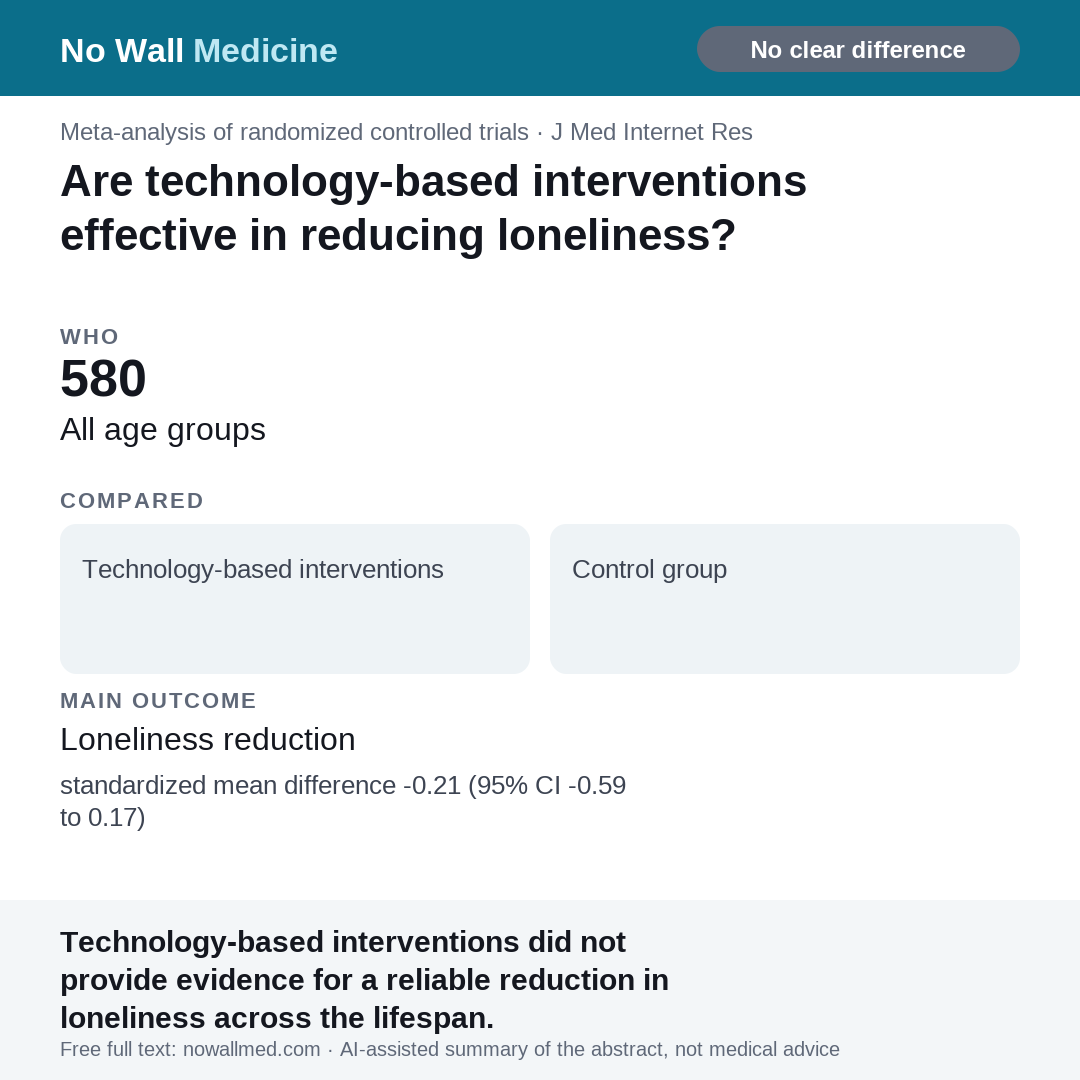
Clinical question: Are technology-based interventions effective in reducing loneliness?
Why it matters: There is a growing demand for effective ways to mitigate loneliness as populations age, but evidence for technology-based solutions is needed.
Key points
- Researchers analyzed 7 randomized controlled trials involving 580 participants to measure how technology-based interventions affect loneliness.
- The meta-analysis found a small and statistically nonsignificant overall effect with a pooled standardized mean difference of -0.21 (95% CI -0.59 to 0.17).
- A wide prediction interval of -1.14 to 0.63 suggests that future results could range from substantial reductions to moderate increases in loneliness.
Limitation the authors note: The limited number of eligible trials prevented the researchers from examining differences between different types of interventions.
Headline and key points written with AI from the paper’s abstract, with every number checked against it. Read the paper before relying on them.
Topics
Cite this article
Meier Z, Buchtova M, Sandora J, Novak L, Helvich J, Buchta O. Efficacy of Technology-Based Interventions on the Reduction of Loneliness: Systematic Review and Meta-Analysis. J Med Internet Res. 2026. doi:10.2196/80059
Spotted a mistake? Suggest a correction