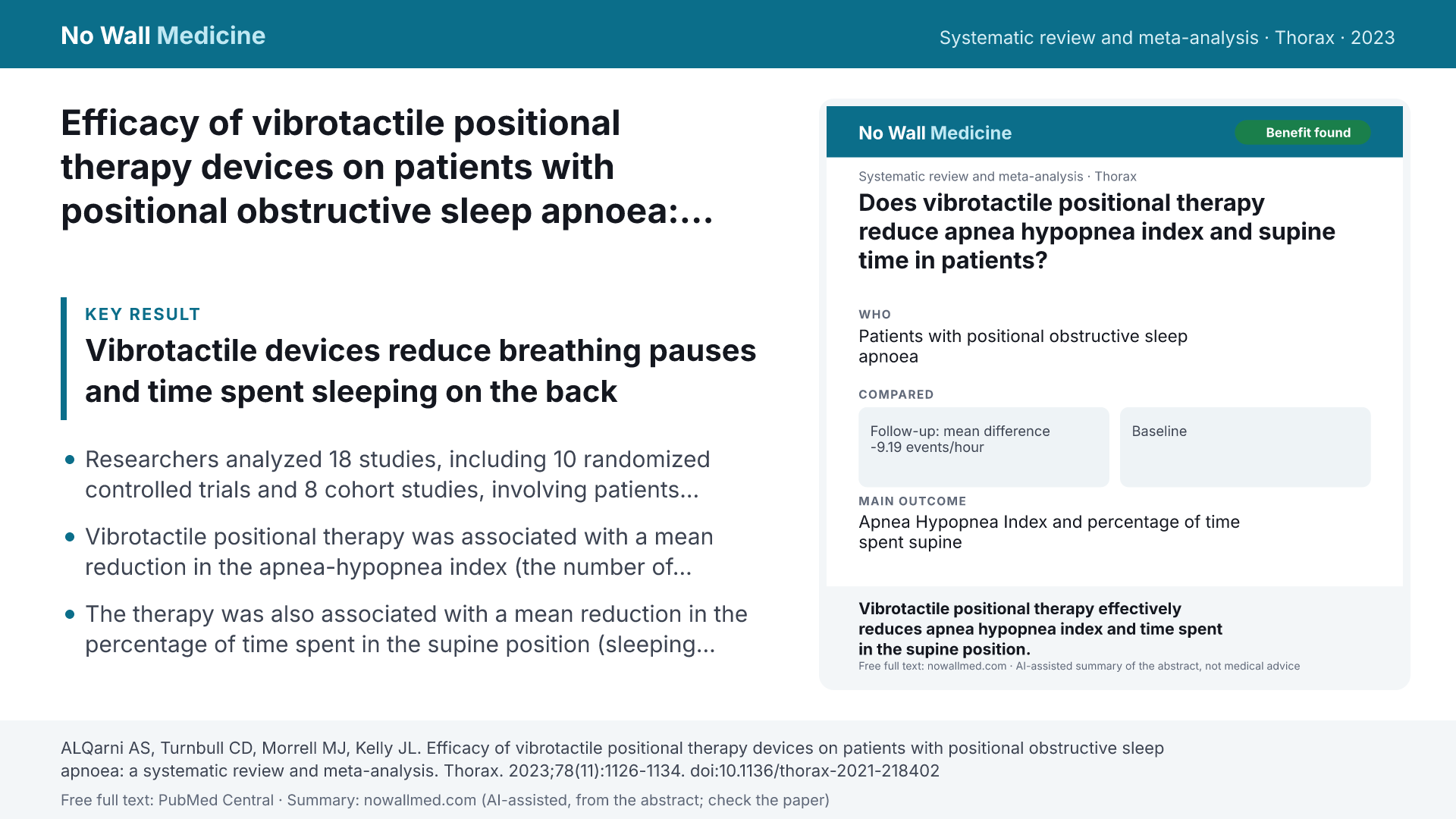
Vibrotactile devices reduce breathing pauses and time spent sleeping on the back
Efficacy of vibrotactile positional therapy devices on patients with positional obstructive sleep apnoea: a systematic review and meta-analysis
Systematic review and meta-analysisBenefit found
Does vibrotactile positional therapy reduce apnea hypopnea index and supine time in patients?
Who
Patients with positional obstructive sleep apnoea
Compared
Follow-up: mean difference -9.19 events/hour
Baseline
Main outcome
Apnea Hypopnea Index and percentage of time spent supine
Result: mean difference -9.19 events/hour (95% CI -11.68 to -6.70)
Bottom line: Vibrotactile positional therapy effectively reduces apnea hypopnea index and time spent in the supine position.
Limitation: Limited data and follow-up was often brief regarding patient-centred outcomes.
Thorax · 2023-06-21 · Save PNG
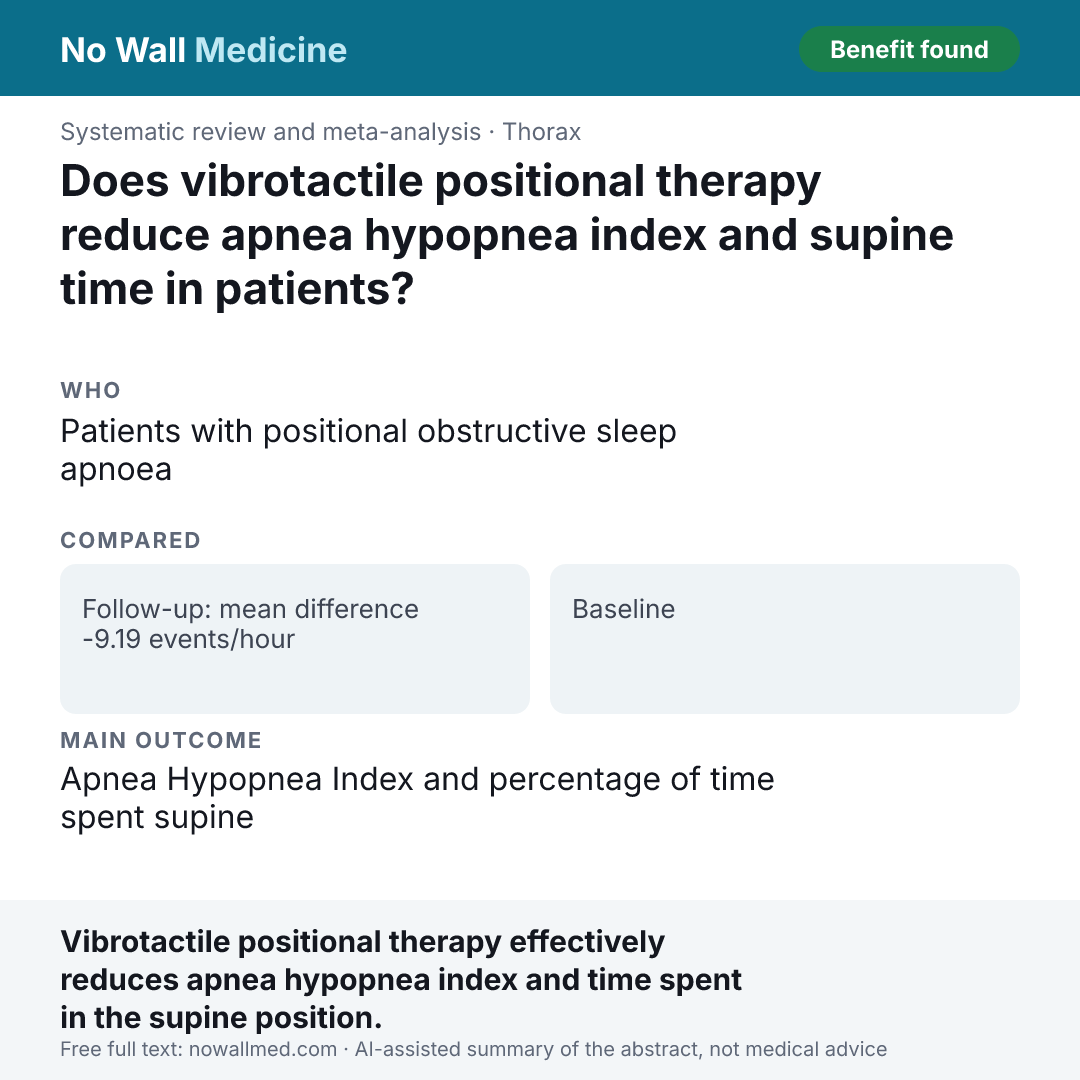
Clinical question: Does vibrotactile positional therapy reduce apnea hypopnea index and supine time in patients?
Key points
- Researchers analyzed 18 studies, including 10 randomized controlled trials and 8 cohort studies, involving patients with positional obstructive sleep apnea.
- Vibrotactile positional therapy was associated with a mean reduction in the apnea-hypopnea index (the number of breathing pauses per hour) of -9.19 events/hour.
- The therapy was also associated with a mean reduction in the percentage of time spent in the supine position (sleeping on the back) of -32.79%.
Limitation the authors note: The authors stated that follow-up was often brief and there were limited data regarding patient-centered outcomes.
Headline and key points written with AI from the paper’s abstract, with every number checked against it. Read the paper before relying on them.
Was this summary helpful?
Abstract
Introduction
Vibrotactile positional therapy (PT) devices are a new treatment modality for positional obstructive sleep apnoea (POSA). This review aimed to determine the effect of vibrotactile PT on the Apnoea Hypopnoea Index (AHI) and the percentage of time spent in the supine position (%Tsupine) in patients with POSA, compared with baseline. Secondary aims were to investigate the effect on daytime sleepiness, quality of life and sleep quality. Methods
A systematic review and meta-analysis was performed of randomised controlled trials (RCTs) and cohort studies that investigated the effect of vibrotactile PT in POSA patients. Searches were performed via MEDLINE, CENTRAL and Embase up to 29 October 2022. Results
1119 studies were identified, 18 studies met the inclusion criteria (10 RCTs, 8 cohort studies). The use of vibrotactile PT significantly reduced the AHI at follow-up compared with baseline (mean difference (95% CI) -9.19 events/hour (-11.68 to -6.70); p<0.00001). The mean %Tsupine was also significantly reduced (mean difference (95% CI) -32.79% (-38.75% to -26.83%); p<0.00001). The percentage changes in the AHI and %Tsupine were 43% and 70%, respectively. Secondary outcomes were daytime sleepiness, quality of life and sleep indices. These showed minimal change, although follow-up was short. Conclusion
Vibrotactile PT devices are effective in treating POSA; reducing both AHI and %Tsupine. The effect on sleep quality, daytime sleepiness and disease-specific quality of life was minimal. However, there were limited data and follow-up was often brief, meaning that further research is needed to determine the effect of vibrotactile PT on patient-centred outcomes. Prospero registration number
CRD42020188617.
Abstract reproduced under the article’s CC BY NC licence.
Subject terms
Headline, design, result, key points, caveat and citation as plain text.
Cite this article
ALQarni AS, Turnbull CD, Morrell MJ, Kelly JL. Efficacy of vibrotactile positional therapy devices on patients with positional obstructive sleep apnoea: a systematic review and meta-analysis. Thorax. 2023;78(11):1126-1134. doi:10.1136/thorax-2021-218402
Spotted a mistake? Suggest a correction