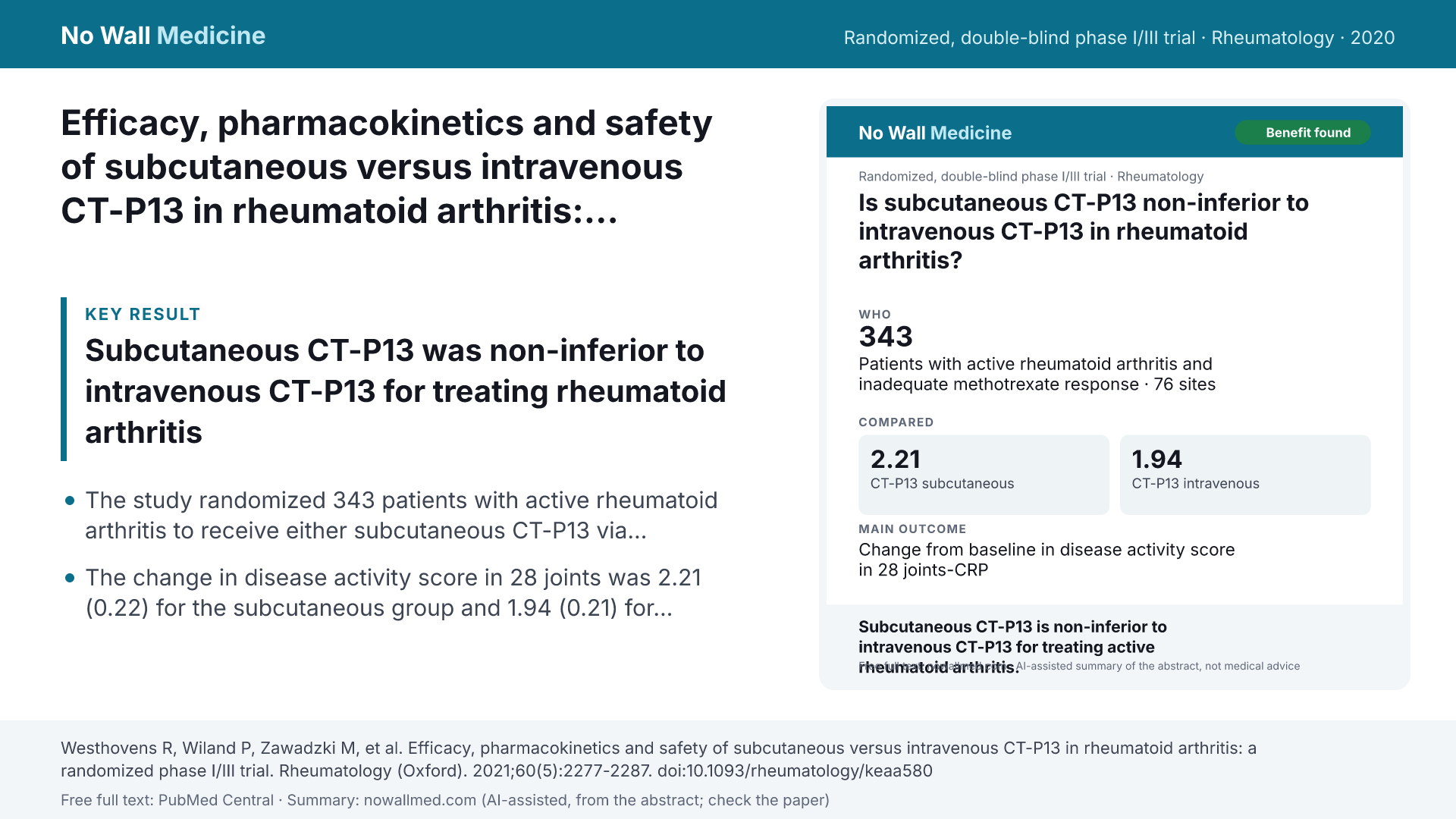
Subcutaneous CT-P13 was non-inferior to intravenous CT-P13 for treating rheumatoid arthritis
Efficacy, pharmacokinetics and safety of subcutaneous versus intravenous CT-P13 in rheumatoid arthritis: a randomized phase I/III trial
Randomized, double-blind phase I/III trialBenefit found
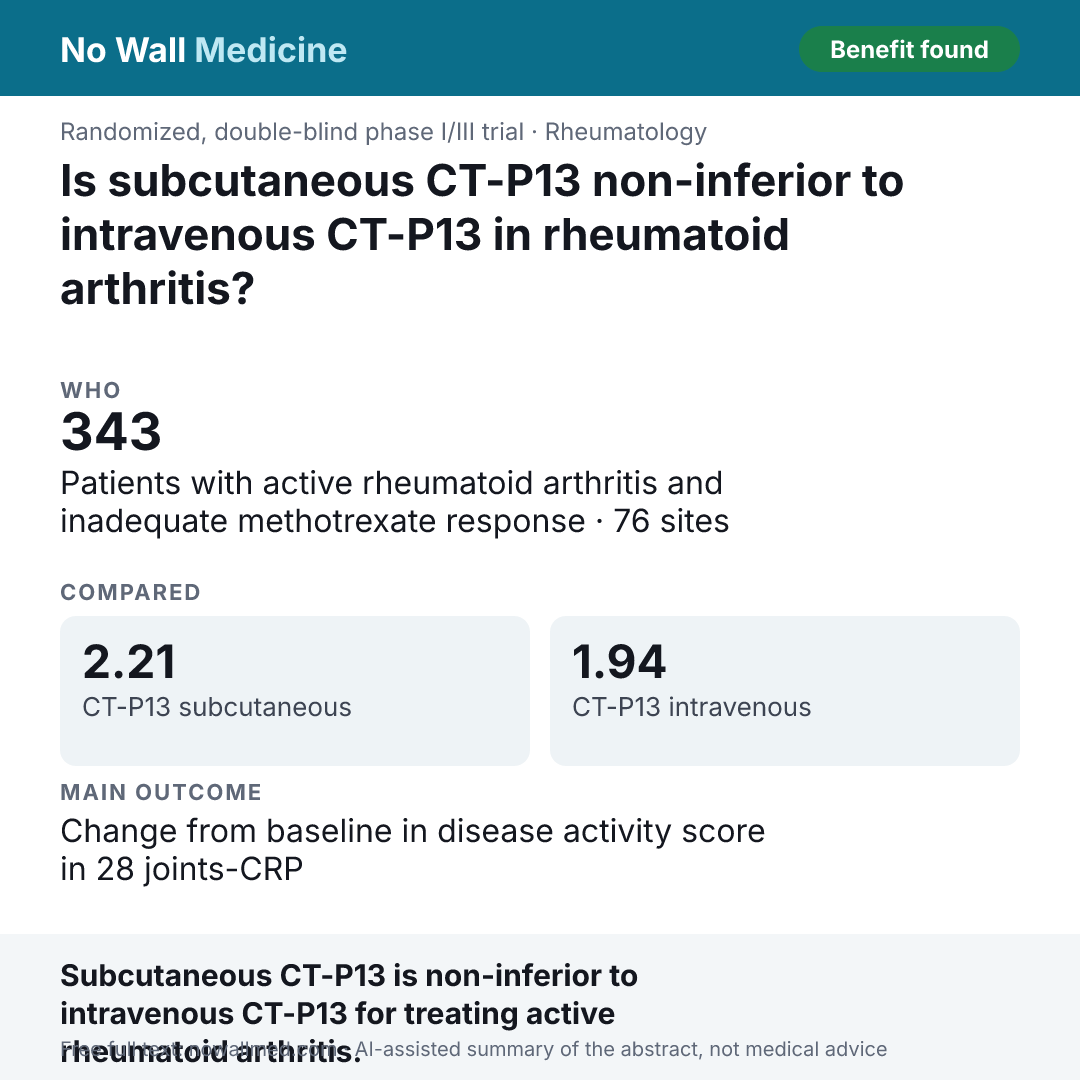
Is subcutaneous CT-P13 non-inferior to intravenous CT-P13 in rheumatoid arthritis?
Who
343
Patients with active rheumatoid arthritis and inadequate methotrexate response · 76 sites
Compared
2.21CT-P13 subcutaneous (0.22)
1.94CT-P13 intravenous (0.21)
Main outcome
Change from baseline in disease activity score in 28 joints-CRP
Result: difference 0.27 (95% CI: 0.02, 0.52)
Bottom line: Subcutaneous CT-P13 is non-inferior to intravenous CT-P13 for treating active rheumatoid arthritis.
Rheumatology · 2020-11-25 · Save PNG
Same trial (NCT03147248)
Papers we list that report this registered trial, oldest first. Read a secondary analysis alongside the main results.
- Main results Benefit found
This paper Rheumatology 2020-11 - Secondary analysis Benefit found
Subcutaneous infliximab showed significantly improved efficacy compared to intravenous infliximab at week 30 Rheumatology 2022-12
Clinical question: Is subcutaneous CT-P13 non-inferior to intravenous CT-P13 in rheumatoid arthritis?
Key points
- The study randomized 343 patients with active rheumatoid arthritis to receive either subcutaneous CT-P13 via pre-filled syringe or intravenous CT-P13.
- The change in disease activity score in 28 joints was 2.21 (0.22) for the subcutaneous group and 1.94 (0.21) for the intravenous group.
- Treatment-emergent adverse events occurred in 54.8% of the subcutaneous group and 66.9% of the intravenous group, with no treatment-related deaths.
Headline and key points written with AI from the paper’s abstract, with every number checked against it. Read the paper before relying on them.
Was this summary helpful?
Subject terms
Headline, design, result, key points, caveat and citation as plain text.
Cite this article
Westhovens R, Wiland P, Zawadzki M, et al. Efficacy, pharmacokinetics and safety of subcutaneous versus intravenous CT-P13 in rheumatoid arthritis: a randomized phase I/III trial. Rheumatology (Oxford). 2021;60(5):2277-2287. doi:10.1093/rheumatology/keaa580
Spotted a mistake? Suggest a correction