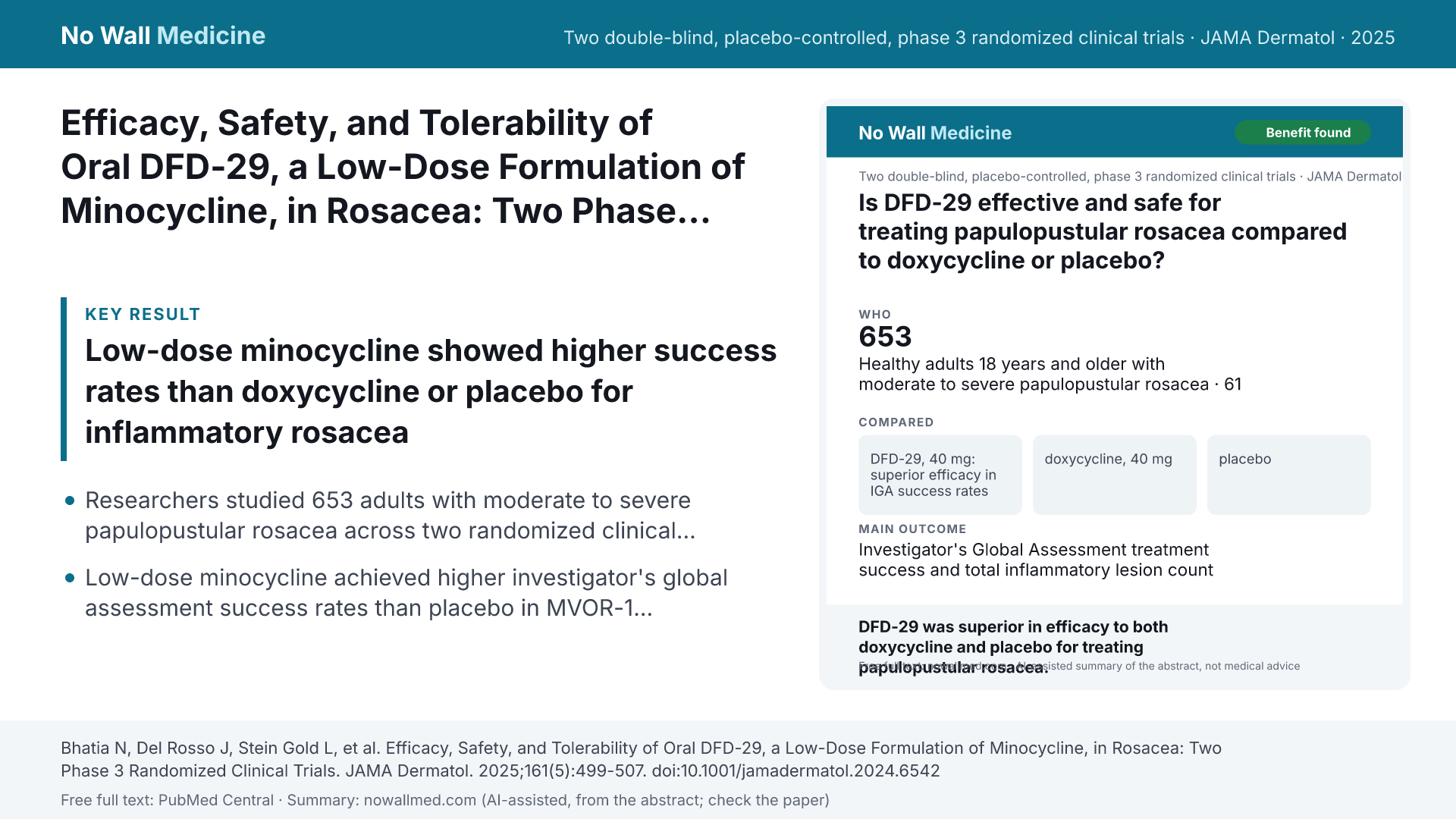
Low-dose minocycline showed higher success rates than doxycycline or placebo for inflammatory rosacea
Efficacy, Safety, and Tolerability of Oral DFD-29, a Low-Dose Formulation of Minocycline, in Rosacea: Two Phase 3 Randomized Clinical Trials
Two double-blind, placebo-controlled, phase 3 randomized clinical trialsBenefit found
Is DFD-29 effective and safe for treating papulopustular rosacea compared to doxycycline or placebo?
Who
653
Healthy adults 18 years and older with moderate to severe papulopustular rosacea · 61 centers in the US and Germany
Compared
DFD-29, 40 mg: superior efficacy in IGA success rates
doxycycline, 40 mg
placebo
Main outcome
Investigator's Global Assessment treatment success and total inflammatory lesion count reductions
Bottom line: DFD-29 was superior in efficacy to both doxycycline and placebo for treating papulopustular rosacea.
JAMA Dermatol · 2025-03-05 · Save PNG
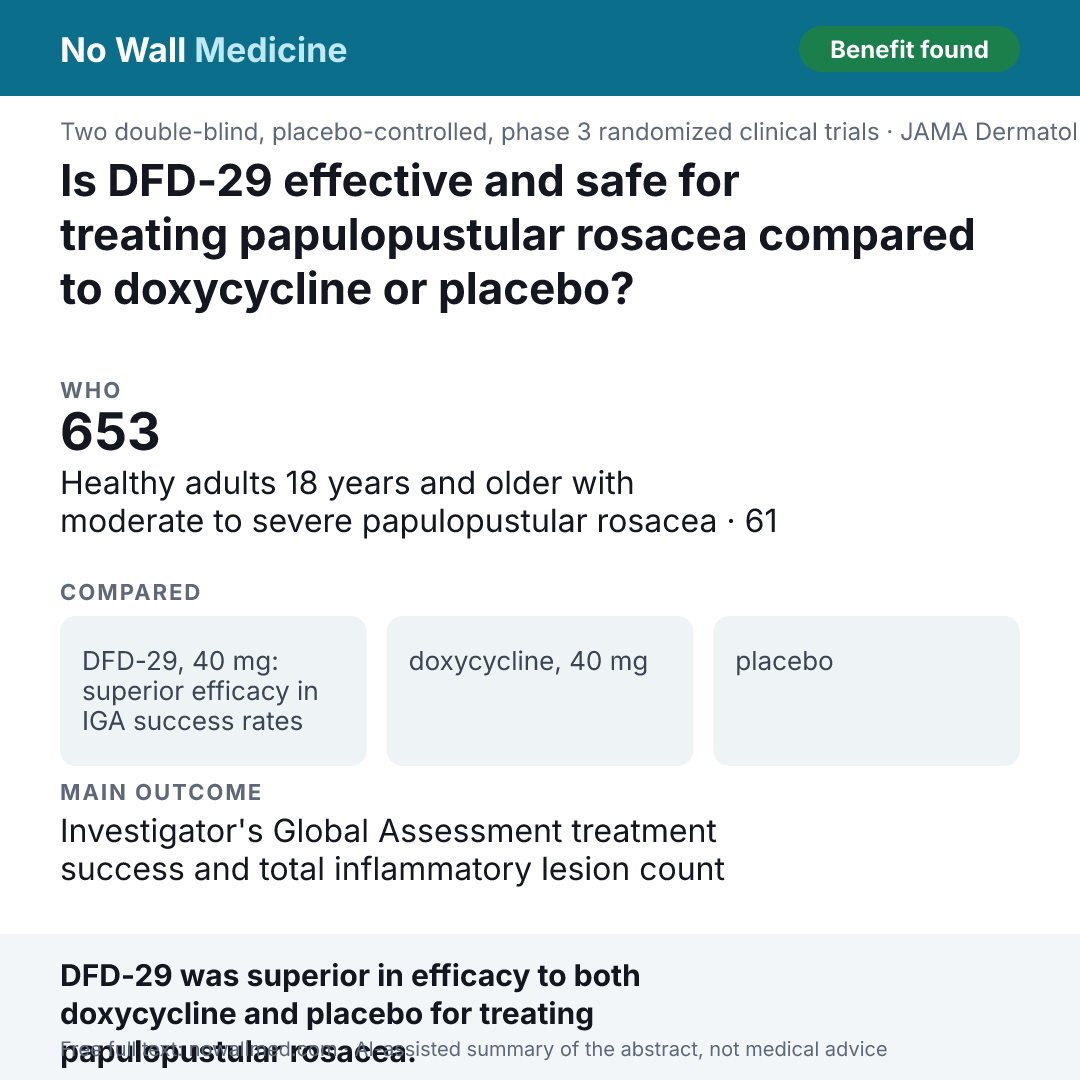
Clinical question: Is DFD-29 effective and safe for treating papulopustular rosacea compared to doxycycline or placebo?
Key points
- Researchers studied 653 adults with moderate to severe papulopustular rosacea across two randomized clinical trials comparing low-dose minocycline, doxycycline, and placebo.
- Low-dose minocycline achieved higher investigator's global assessment success rates than placebo in MVOR-1 (32.9% difference) and MVOR-2 (34.1% difference).
- Low-dose minocycline also showed greater reductions in total inflammatory lesion counts compared to both placebo and doxycycline across both trials.
Headline and key points written with AI from the paper’s abstract, with every number checked against it. Read the paper before relying on them.
Was this summary helpful?
Subject terms
Headline, design, result, key points, caveat and citation as plain text.
Cite this article
Bhatia N, Del Rosso J, Stein Gold L, et al. Efficacy, Safety, and Tolerability of Oral DFD-29, a Low-Dose Formulation of Minocycline, in Rosacea: Two Phase 3 Randomized Clinical Trials. JAMA Dermatol. 2025;161(5):499-507. doi:10.1001/jamadermatol.2024.6542
Spotted a mistake? Suggest a correction