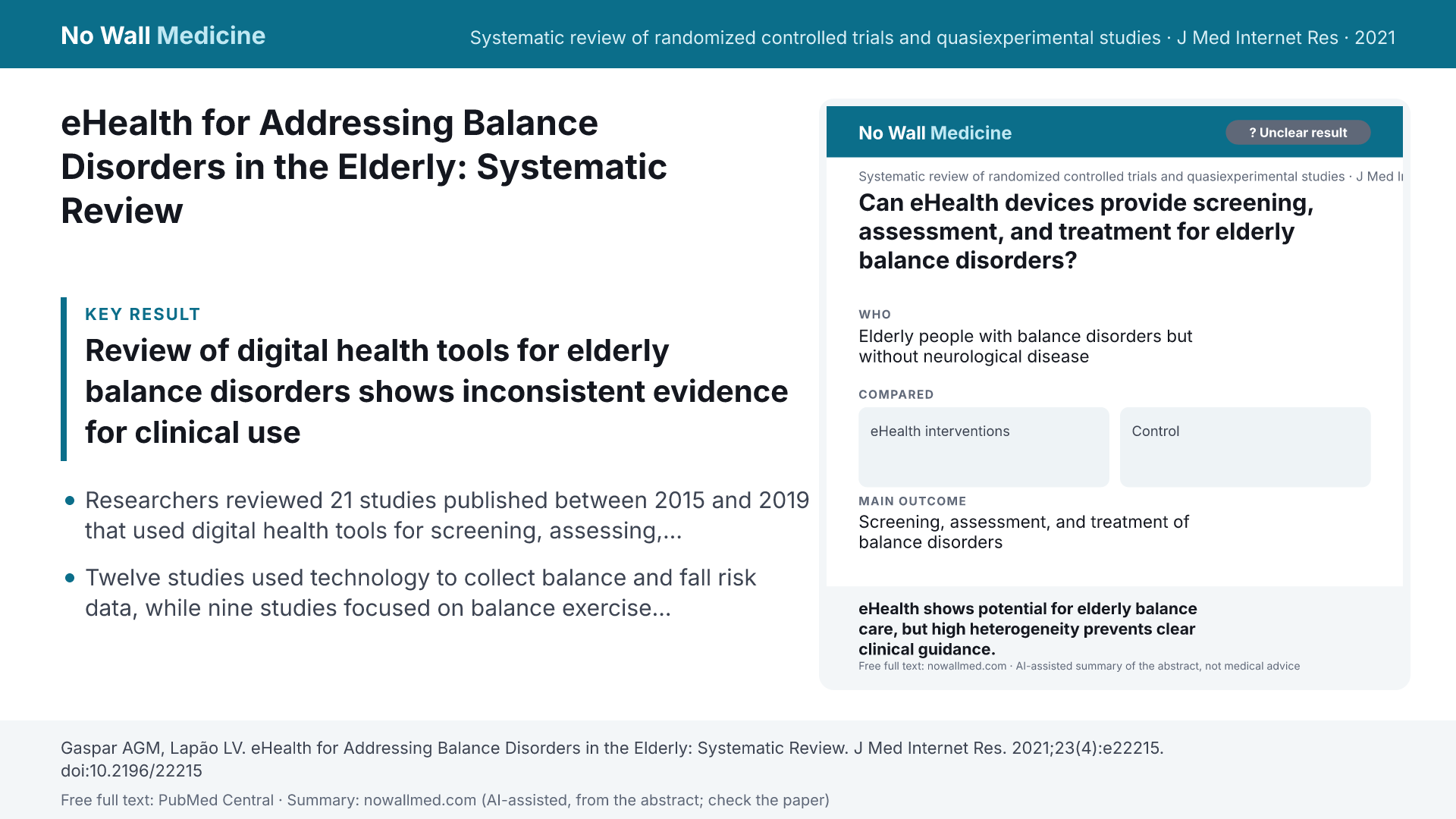
eHealth for Addressing Balance Disorders in the Elderly: Systematic Review
Key result: Review of digital health tools for elderly balance disorders shows inconsistent evidence for clinical use
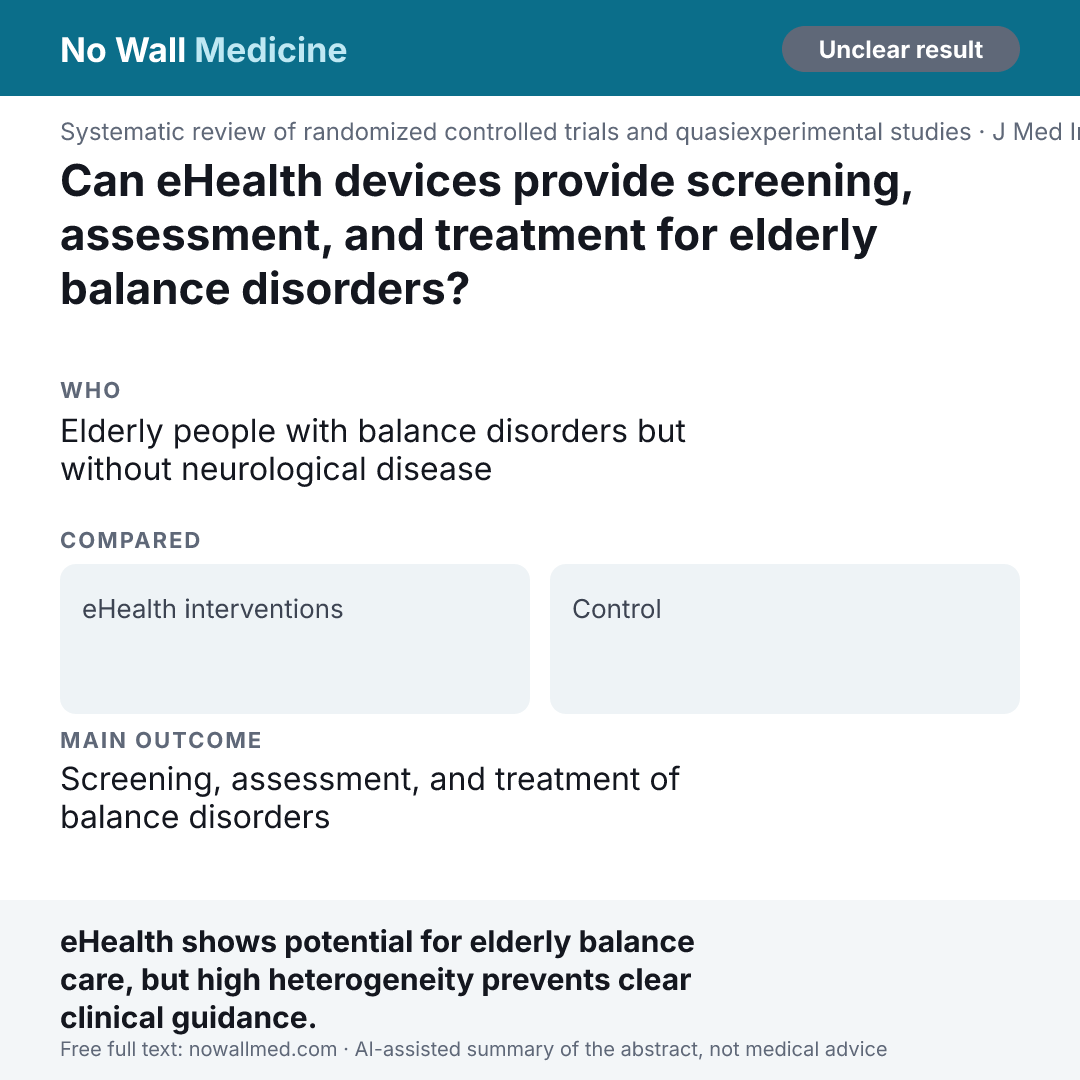
Systematic review of randomized controlled trials and quasiexperimental studiesUnclear result
Can eHealth devices provide screening, assessment, and treatment for elderly balance disorders?
Who
Elderly people with balance disorders but without neurological disease
Compared
eHealth interventions
Control
Main outcome
Screening, assessment, and treatment of balance disorders
Bottom line: eHealth shows potential for elderly balance care, but high heterogeneity prevents clear clinical guidance.
Limitation: Heterogeneity of populations, methodologies, devices, and follow-up times prevented clear comparison.
J Med Internet Res · 2021-04-28 · Save PNG
Key points
- Researchers reviewed 21 studies published between 2015 and 2019 that used digital health tools for screening, assessing, or treating balance in older adults without neurological disease.
- Twelve studies used technology to collect balance and fall risk data, while nine studies focused on balance exercise training through digital platforms.
- The wide variety of study populations, methods, devices, and follow-up times prevented a clear comparison to guide how these tools should be used in clinics.
Limitation the authors note: The heterogeneity of populations, methodologies, eHealth devices, and follow-up times in the included studies prevented clear comparisons.
Discussion prompts
- Would these patients look like yours? Who was left out?
- Is the main outcome one that matters to patients?
- Is the difference large enough to change what you do?
Cite: Gaspar AGM, Lapão LV. eHealth for Addressing Balance Disorders in the Elderly: Systematic Review. J Med Internet Res. 2021;23(4):e22215. doi:10.2196/22215
Free full text: PubMed Central · Summary and visual abstract: nowallmed.com/a/ehealth-for-addressing-balance-disorders-in-the-elderly-systematic-194xsin/ (AI-assisted from the abstract; check the paper before relying on it).