ClinicalAge biomarker associated with mortality and disease risk in UK datasets
ClinicalAge, a framework for modelling ageing trajectories from longitudinal electronic health records in the UK: a model development and validation study
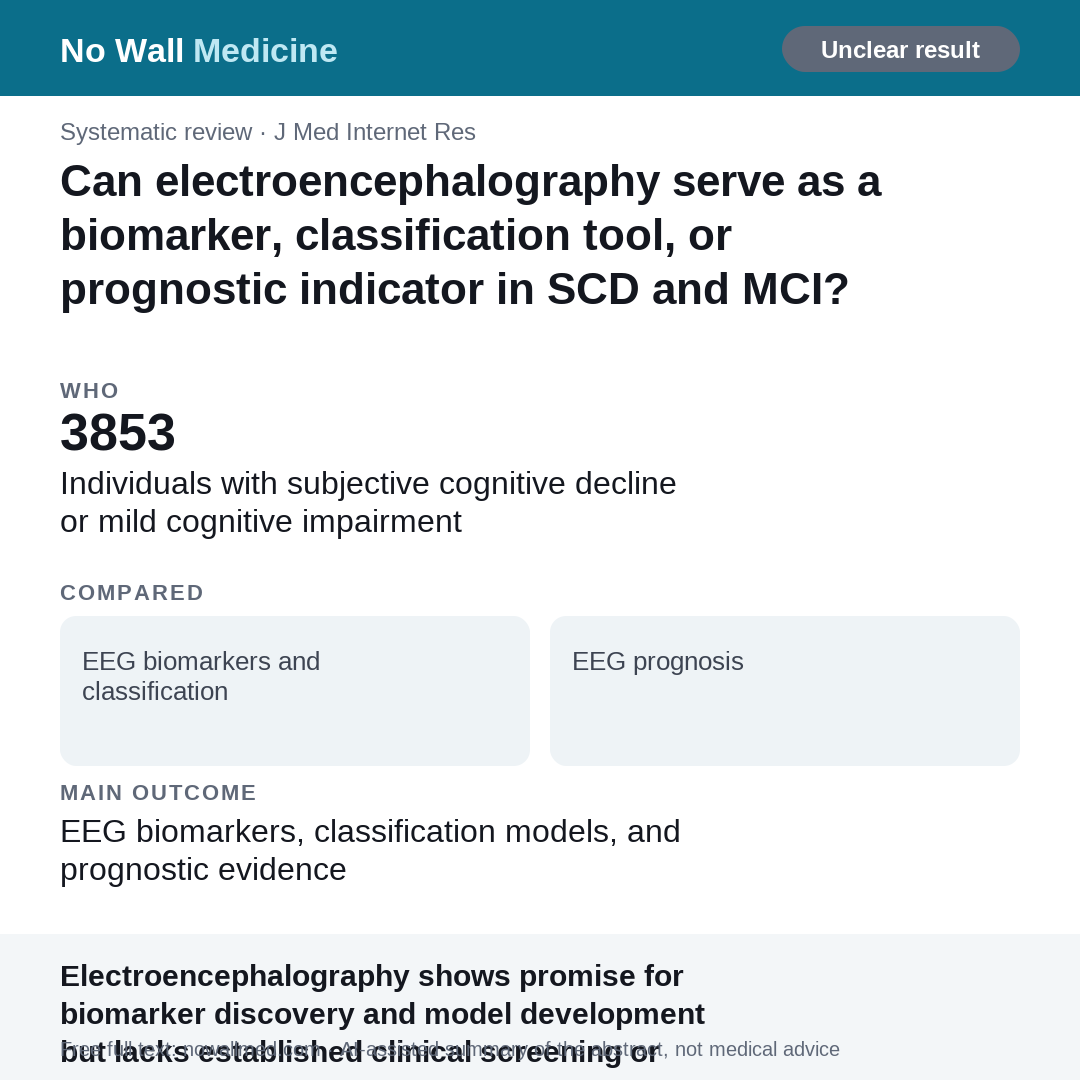
Electroencephalography in Subjective Cognitive Decline and Mild Cognitive Impairment: Systematic Review of Biomarkers, Classification, and Prognostic Evidence
Clinical question: Can electroencephalography serve as a biomarker, classification tool, or prognostic indicator in SCD and MCI?
Why it matters: Doctors need better ways to characterize and stratify the risk of dementia in people with subjective cognitive decline and mild cognitive impairment.
Limitation the authors note: The authors state that current evidence supports biomarker discovery and model development rather than established clinical screening or diagnosis.
Headline and key points written with AI from the paper’s abstract, with every number checked against it. Read the paper before relying on them.
Spotted a mistake? Suggest a correction
ClinicalAge, a framework for modelling ageing trajectories from longitudinal electronic health records in the UK: a model development and validation study
Foundation artificial intelligence models for health recognition by use of face photographs (FAHR-Face): a model development and validation study
A prognostic model for use at labour onset to estimate the risk of severe fetal compromise at birth: a retrospective, model development and validation study
ECG foundation models for cardiovascular screening in a cohort of young competitive athletes
Medical Reasoning in Large Language Models: Development and Evaluation of the MedEvalArena Benchmark