Electromagnetic stimulation did not significantly reduce disability after ischemic stroke in a randomized trial
Electromagnetic Stimulation to Reduce Disability After Ischemic Stroke: The EMAGINE Randomized Clinical Trial
Multicenter, double-blind, sham-controlled, randomized clinical trialNo clear difference
Does electromagnetic network targeting field stimulation reduce global disability after ischemic stroke?
Who
100
Subacute ischemic stroke patients with moderate to severe disability and upper-extremity impairment · 15 US-based acute care and inpatient rehabilitation facilities
Compared
-1.96Active electromagnetic stimulation (0.12)
-1.72Sham electromagnetic stimulation (0.12)
Main outcome
Change in global disability assessed with modified Rankin Scale
Result: odds ratio 2.99 (95% CI 0.96-9.30)
Bottom line: Electromagnetic network targeting field therapy was safe but did not significantly reduce global disability compared to sham stimulation.
Limitation: The trial was stopped early after enrollment of 100 participants.
JAMA Netw Open · 2025-10-01Download image
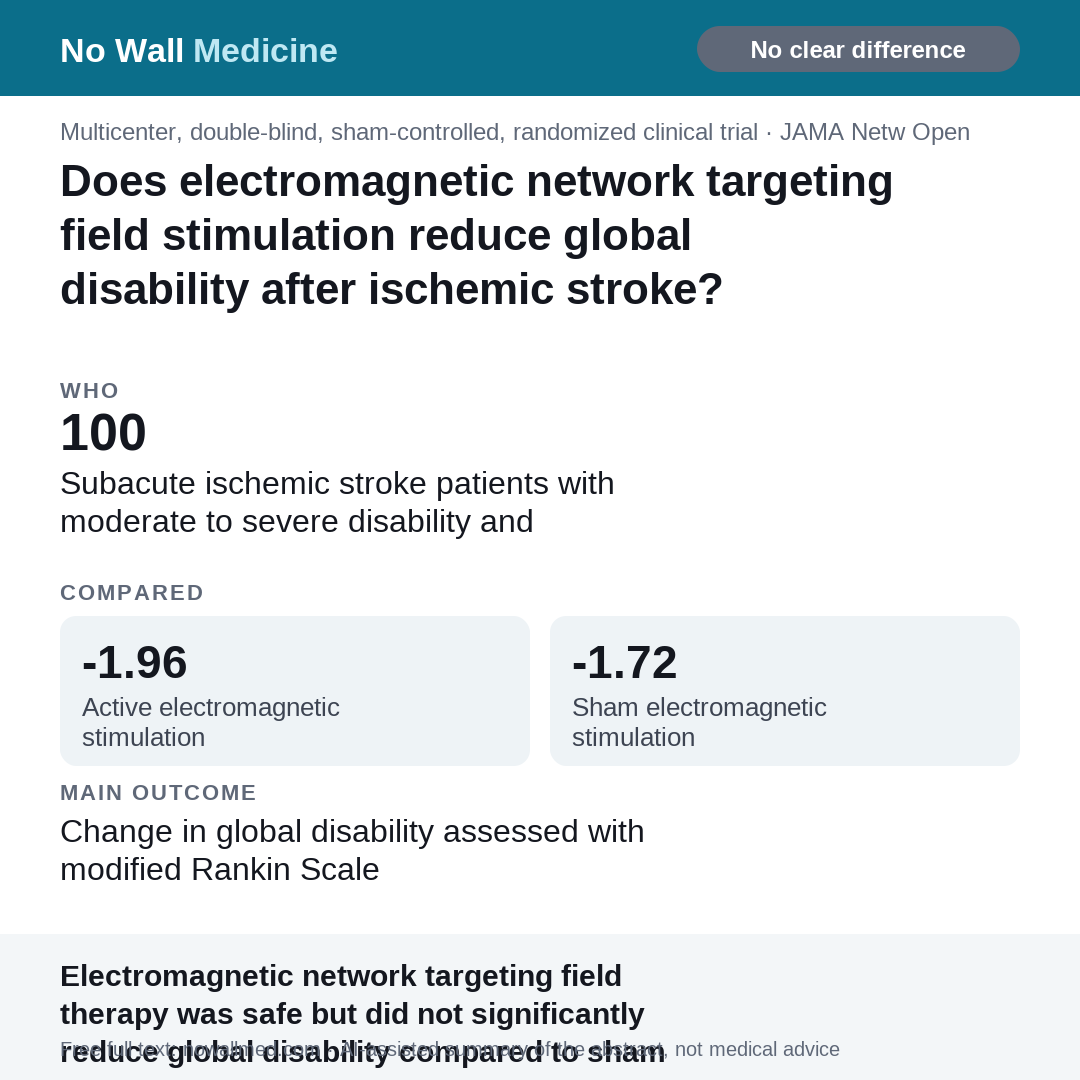
Clinical question: Does electromagnetic network targeting field stimulation reduce global disability after ischemic stroke?
Why it matters: It is unclear if noninvasive, frequency-tuned, low-intensity electromagnetic network targeting field stimulation can improve recovery for patients in the subacute phase of ischemic stroke.
Key points
- The study enrolled 100 participants with moderate to severe disability after an ischemic stroke to compare active electromagnetic stimulation with a sham treatment.
- The mean reduction in the modified Rankin Scale disability score at day 90 was -1.96 [0.12] for the active group versus -1.72 [0.12] for the sham group.
- While 26.0% of the active group attained a disability score of 0 to 1 compared to 10.0% of the sham group, the difference was not statistically significant.
Limitation the authors note: The trial was stopped early after enrollment of 100 participants when a promising zone threshold was not attained at a planned interim analysis.
Headline and key points written with AI from the paper’s abstract, with every number checked against it. Read the paper before relying on them.
Topics
Cite this article
Saver JL, Duncan PW, Stein J, Cramer SC, Fox EJ, Zorowitz RD. Electromagnetic Stimulation to Reduce Disability After Ischemic Stroke: The EMAGINE Randomized Clinical Trial. JAMA Netw Open. 2025. doi:10.1001/jamanetworkopen.2025.37880
Spotted a mistake? Suggest a correction