Electromyography (EMG)-triggered transcutaneous spinal cord and hip stimulation for gait rehabilitation in persons with chronic stroke: a randomized, controlled trial
Randomized, controlled trialMixed results
Does FAST walk improve gait rehabilitation in persons with chronic stroke?
Who
17
Persons with chronic stroke
Compared
FAST walk: improved significantly at post and post-4w
spinal stimulation: no significant improvements
treadmill training: no significant improvements
Main outcome
10-m walking time
Bottom line: FAST walk may improve gait speed, but no significant between-group differences were found among the three groups.
J Neuroeng Rehabil · 2025-07-07Download image
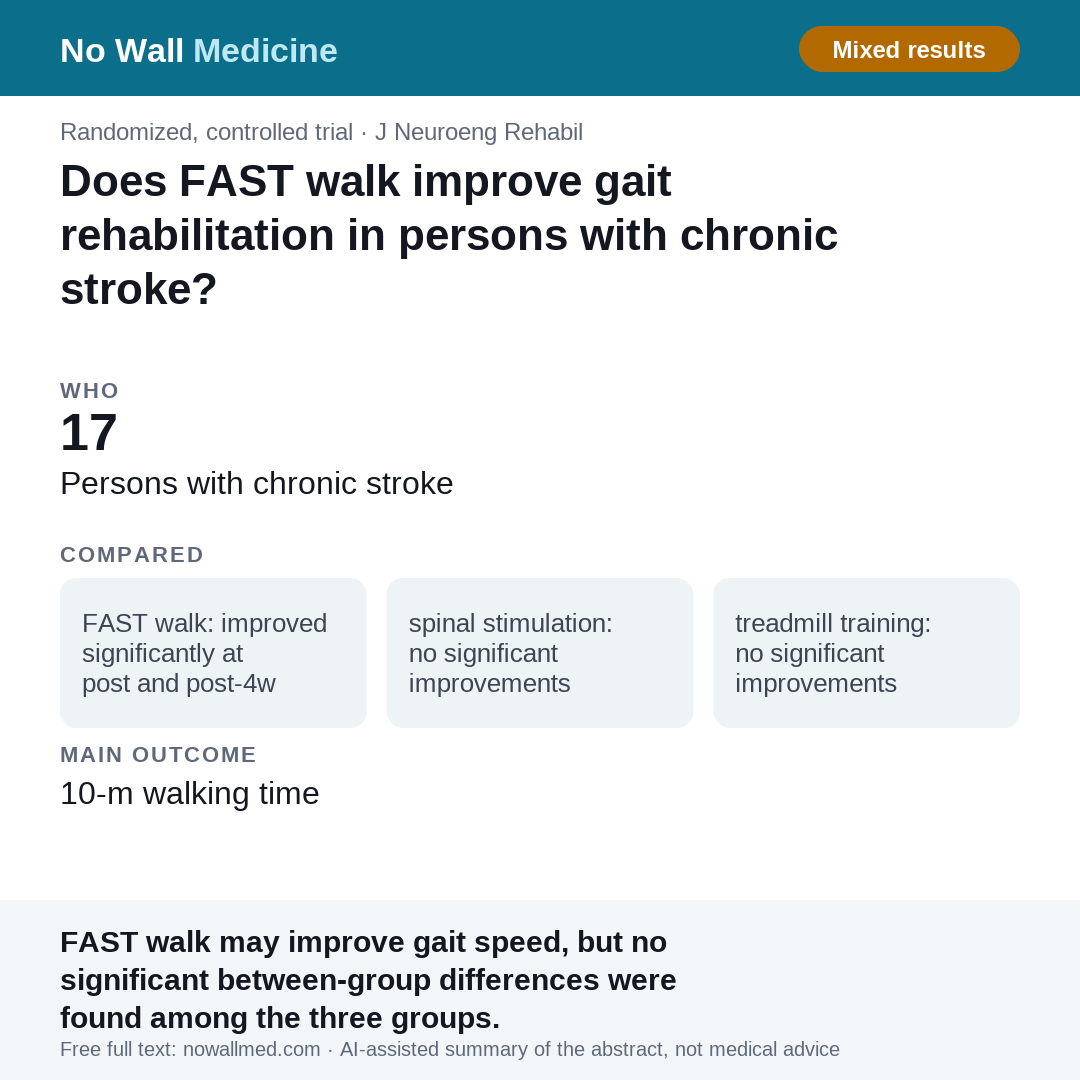
Clinical question: Does FAST walk improve gait rehabilitation in persons with chronic stroke?
Abstract
Background
Transcutaneous spinal stimulation has been applied to gait rehabilitation for persons with neurological diseases. The authors developed electromyography-triggered transcutaneous spinal cord and hip stimulation for gait rehabilitation and called this system FAST walk. This study aimed to assess the effect of FAST walk in a randomized, controlled trial. Methods
All participants were randomly allocated to three groups: FAST walk combined with treadmill gait training (FAST walk); spinal stimulation combined with treadmill gait training (spinal stim); and treadmill gait training (treadmill). Participants performed two sets of 15-min treadmill gait training with 5-min intervals in the FAST walk, spinal stim, and treadmill groups. Gait training was performed twice weekly for a total of 10 sessions. The primary outcome was 10-m walking time. The secondary outcomes were the time symmetry index (TSI) with gait analysis and spinal reciprocal inhibition on the conditioned-test H reflex study. Results
Twenty persons with chronic stroke participated in this study, and 17 persons completed this study. For the primary outcome, there was no significant interaction between time and intervention in 10-m walking time on two-way analysis of covariance (ANCOVA) (P = 0.382, η2 = 0.064). For the FAST walk group, 10-m walking time improved significantly at post and post-4w (P = 0.024 and 0.022, respectively). In the other groups, no significant improvements in 10-m walking time were seen at post and post-4w compared with before. There was also no significant between-group difference in the 10-m walking time. Conclusions
The newly developed electromyography-triggered transcutaneous spinal cord and hip stimulation, FAST walk, is safe and may improve the gait speed of persons with chronic stroke. We did not, however, find a significant between-group difference among the FAST walk, spinal stim, and treadmill gait groups. Trial registration
Japan Registry of Clinical Trial (JRCT registration ID: jRCTs032180289).
Topics
Cite this article
Tani M, Yamaguchi T, Honaga K, Takahashi Y, Kono H, Murakami Y. Electromyography (EMG)-triggered transcutaneous spinal cord and hip stimulation for gait rehabilitation in persons with chronic stroke: a randomized, controlled trial. J Neuroeng Rehabil. 2025. doi:10.1186/s12984-025-01690-0
Spotted a mistake? Suggest a correction
Top studies every Monday
The week’s key trials and guidelines in your specialties, plus any topics you follow. By email, free.
Get the weekly digest