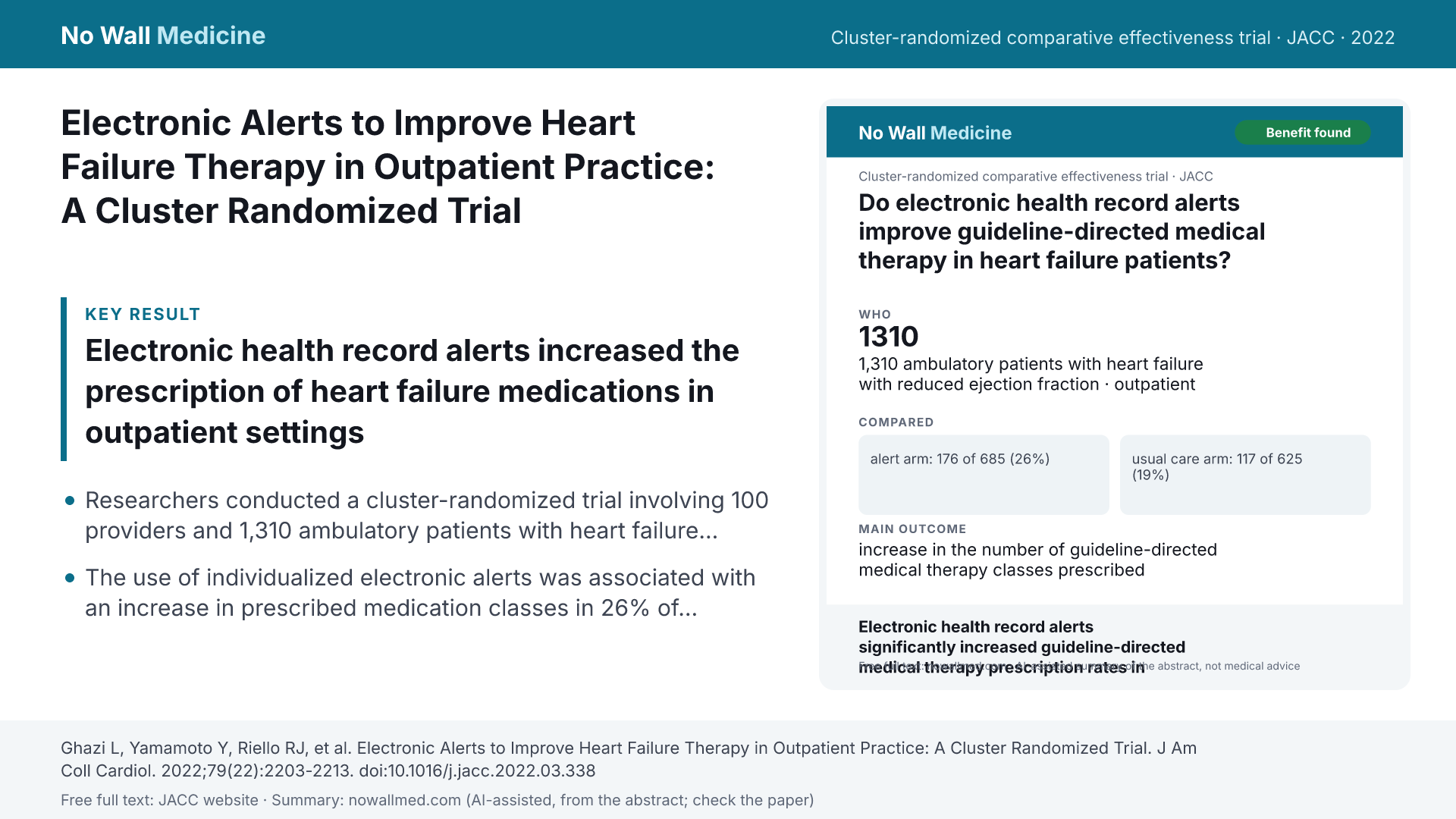
Electronic health record alerts increased the prescription of heart failure medications in outpatient settings
Electronic Alerts to Improve Heart Failure Therapy in Outpatient Practice: A Cluster Randomized Trial
Cluster-randomized comparative effectiveness trialBenefit found
Do electronic health record alerts improve guideline-directed medical therapy in heart failure patients?
Who
1310
1,310 ambulatory patients with heart failure with reduced ejection fraction · outpatient practice
Compared
alert arm: 176 of 685 (26%)
usual care arm: 117 of 625 (19%)
Main outcome
increase in the number of guideline-directed medical therapy classes prescribed
Result: adjusted relative risk 1.41 (95% CI 1.03-1.93)
Bottom line: Electronic health record alerts significantly increased guideline-directed medical therapy prescription rates in patients with heart failure.
JACC · 2022-04-03Download image
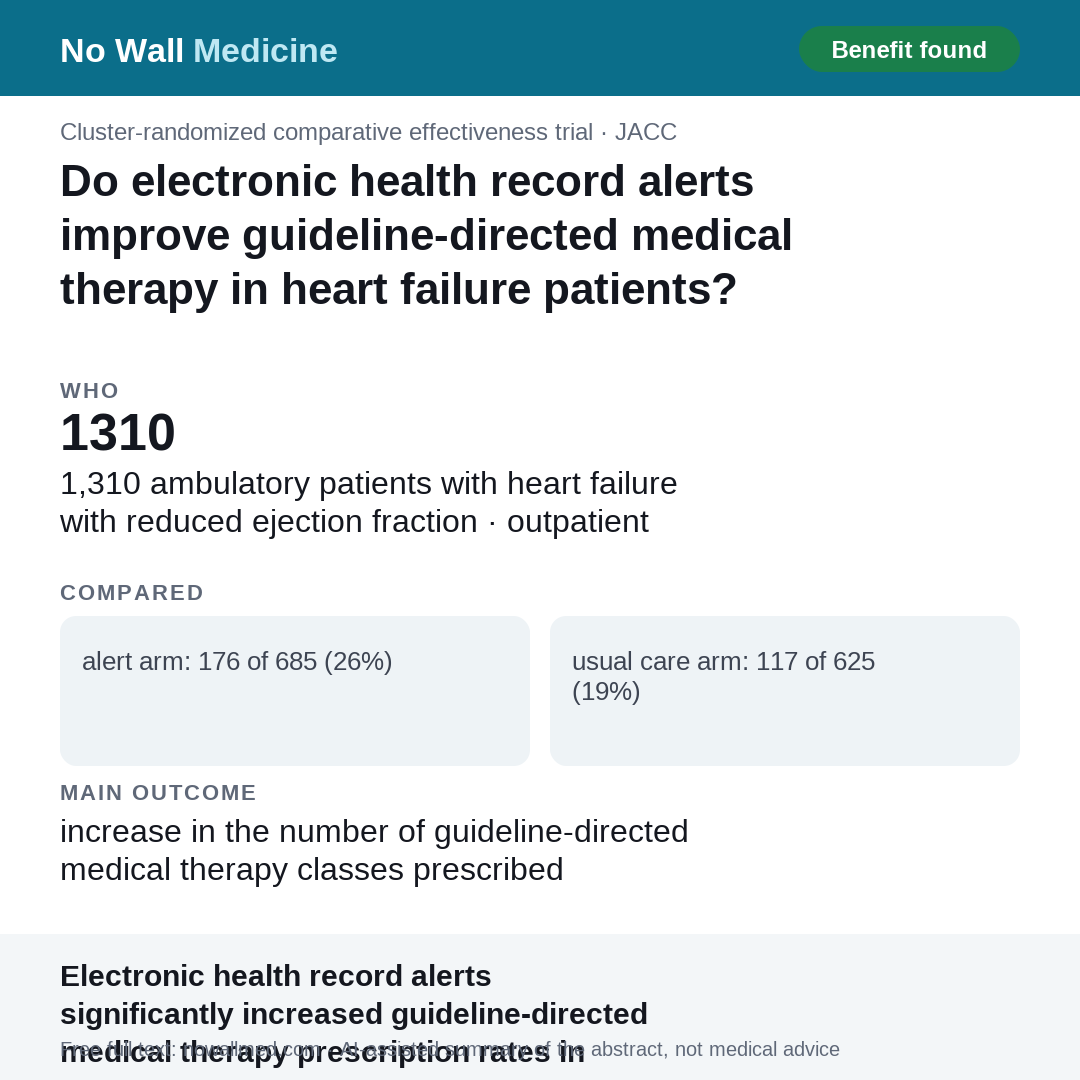
Clinical question: Do electronic health record alerts improve guideline-directed medical therapy in heart failure patients?
Why it matters: Guideline-directed medical therapy is currently underprescribed in patients living with heart failure with reduced ejection fraction.
Key points
- Researchers conducted a cluster-randomized trial involving 100 providers and 1,310 ambulatory patients with heart failure with reduced ejection fraction.
- The use of individualized electronic alerts was associated with an increase in prescribed medication classes in 26% of the alert group compared to 19% in the usual care group.
- Among providers receiving the alerts, 79% agreed that the system was effective at enabling improved prescription of medical therapy for heart failure.
Headline and key points written with AI from the paper’s abstract, with every number checked against it. Read the paper before relying on them.
Was this summary helpful?
Subject terms
Cite this article
Ghazi L, Yamamoto Y, Riello RJ, et al. Electronic Alerts to Improve Heart Failure Therapy in Outpatient Practice: A Cluster Randomized Trial. JACC. 2022. doi:10.1016/j.jacc.2022.03.338
Spotted a mistake? Suggest a correction