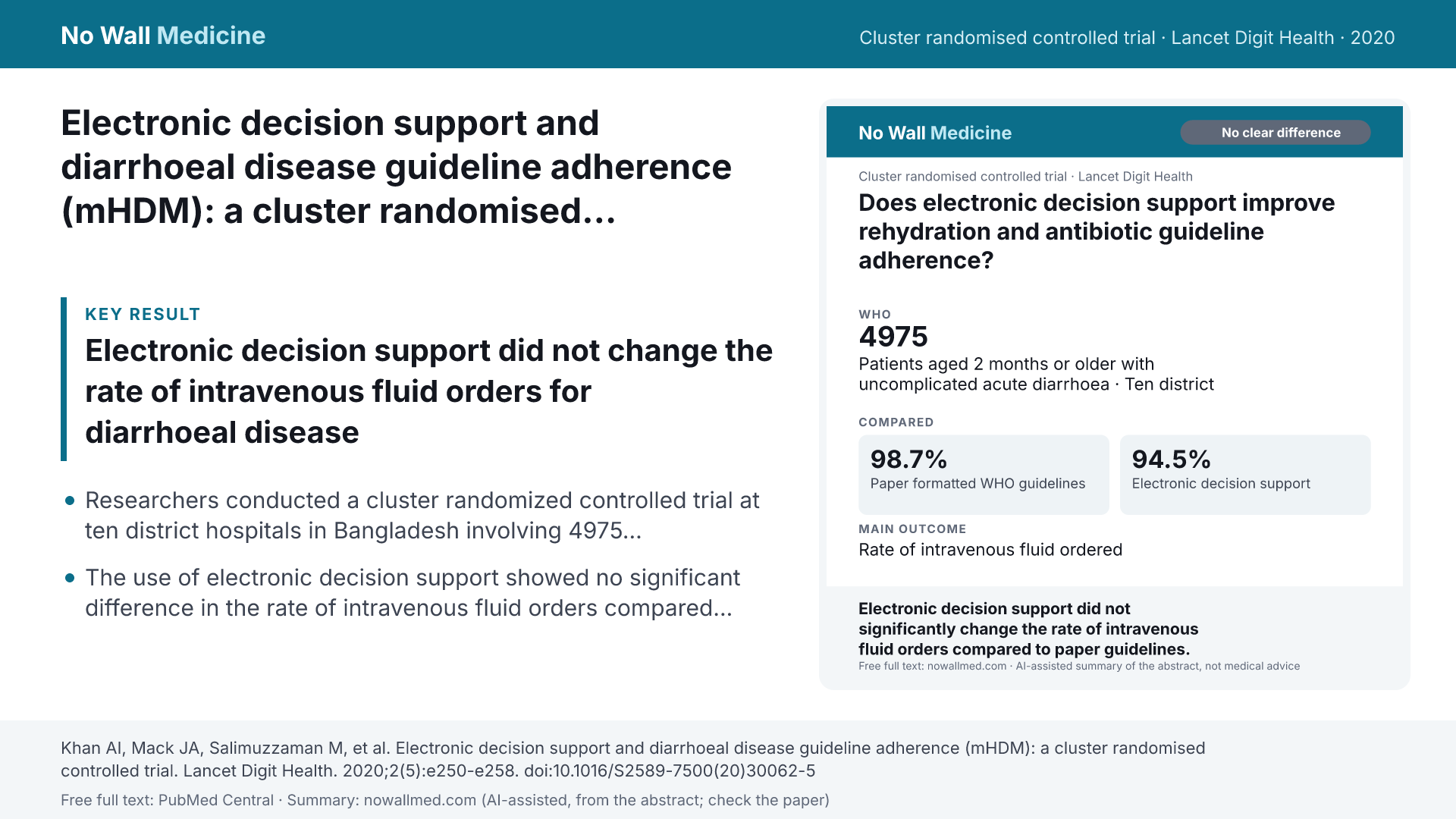
Electronic decision support did not change the rate of intravenous fluid orders for diarrhoeal disease
Electronic decision support and diarrhoeal disease guideline adherence (mHDM): a cluster randomised controlled trial
Cluster randomised controlled trialNo clear difference
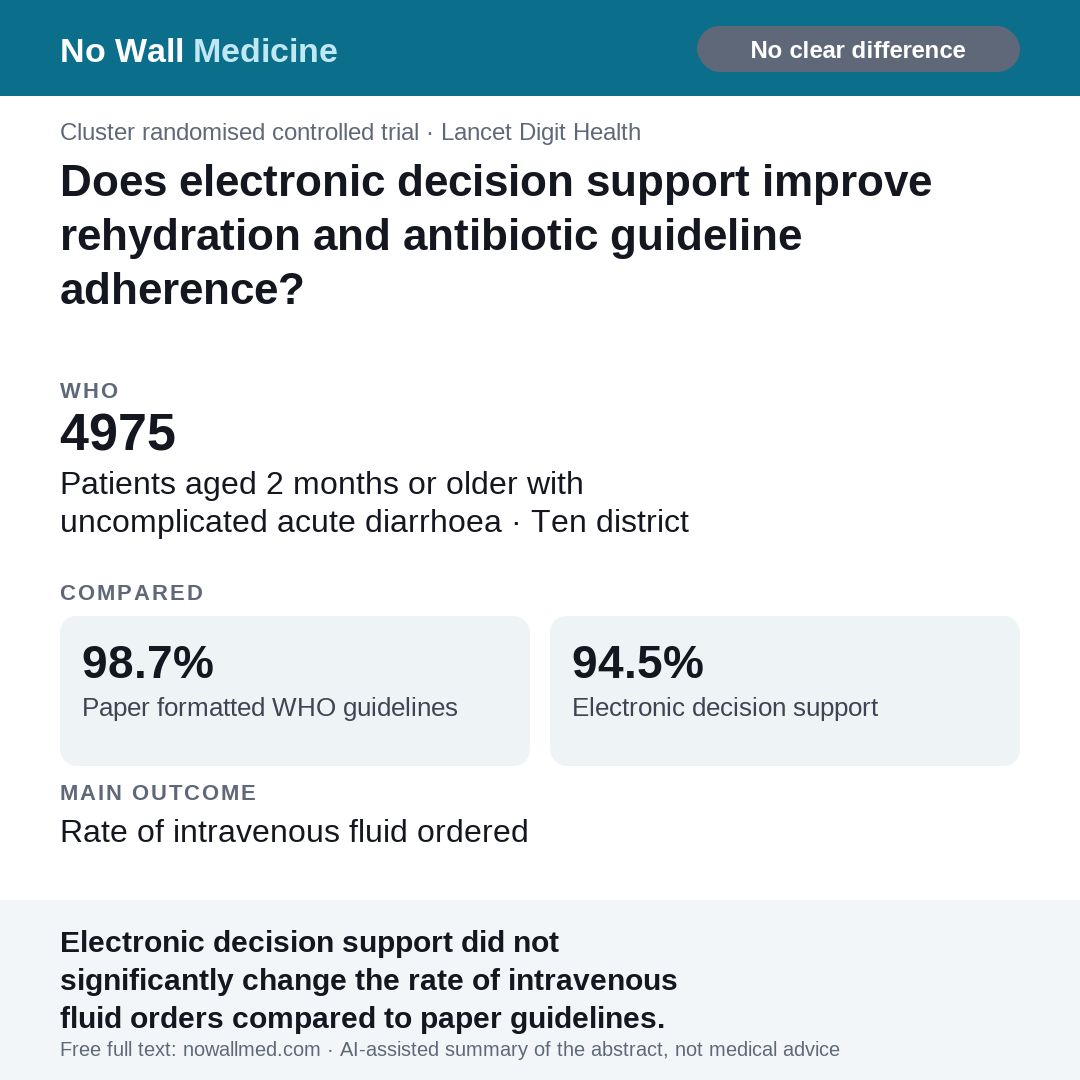
Does electronic decision support improve rehydration and antibiotic guideline adherence?
Who
4975
Patients aged 2 months or older with uncomplicated acute diarrhoea · Ten district hospitals in Bangladesh
Compared
98.7%Paper formatted WHO guidelines (95% CI 91.8-99.8)
94.5%Electronic decision support (72.2-99.1)
Main outcome
Rate of intravenous fluid ordered
Result: 4.2-point difference (pinteraction=0.31)
Bottom line: Electronic decision support did not significantly change the rate of intravenous fluid orders compared to paper guidelines.
Limitation: Adverse events such as complications and mortality events could not be statistically estimated.
Funded by: US National Institutes of Health
Lancet Digit Health · 2020-12-17Download image
Clinical question: Does electronic decision support improve rehydration and antibiotic guideline adherence?
Key points
- Researchers conducted a cluster randomized controlled trial at ten district hospitals in Bangladesh involving 4975 patients aged 2 months or older with uncomplicated acute diarrhoea.
- The use of electronic decision support showed no significant difference in the rate of intravenous fluid orders compared to paper-formatted World Health Organization guidelines.
- Electronic decision support was associated with increases in the volume of intravenous fluid ordered and decreases in antibiotics ordered.
Headline and key points written with AI from the paper’s abstract, with every number checked against it. Read the paper before relying on them.
Was this summary helpful?
Abstract
Background
Acute diarrhoeal disease management often requires rehydration alone without antibiotics. However, non-indicated antibiotics are frequently ordered and this is an important driver of antimicrobial resistance. The mHealth Diarrhoea Management (mHDM) trial aimed to establish whether electronic decision support improves rehydration and antibiotic guideline adherence in resource-limited settings. Methods
A cluster randomised controlled trial was done at ten district hospitals in Bangladesh. Inclusion criteria were patients aged 2 months or older with uncomplicated acute diarrhoea. Admission orders were observed without intervention in the pre-intervention period, followed by randomisation to electronic (rehydration calculator) or paper formatted WHO guidelines for the intervention period. The primary outcome was rate of intravenous fluid ordered as a binary variable. Generalised linear mixed-effect models, accounting for hospital clustering, served as the analytical framework; the analysis was intention to treat. The trial is registered with ClinicalTrials.gov (NCT03154229) and is completed. Findings
From March 11 to Sept 10, 2018, 4975 patients (75·6%) of 6577 screened patients were enrolled. The intervention effect for the primary outcome showed no significant differences in rates of intravenous fluids ordered as a function of decision-support type. Intravenous fluid orders decreased by 0·9 percentage points for paper electronic decision support and 4·2 percentage points for electronic decision support, with a 4·2-point difference between decision-support types in the intervention period (paper 98·7% [95% CI 91·8-99·8] vs electronic 94·5% [72·2-99·1]; pinteraction=0·31). Adverse events such as complications and mortality events were uncommon and could not be statistically estimated. Interpretation
Although intravenous fluid orders did not change, electronic decision support was associated with increases in the volume of intravenous fluid ordered and decreases in antibiotics ordered, which are consistent with WHO guidelines. Funding
US National Institutes of Health.
Abstract reproduced under the article’s CC BY NC ND licence.
Subject terms
Cite this article
Khan AI, Mack JA, Salimuzzaman M, et al. Electronic decision support and diarrhoeal disease guideline adherence (mHDM): a cluster randomised controlled trial. Lancet Digit Health. 2020;2(5):e250-e258. doi:10.1016/S2589-7500(20)30062-5
Spotted a mistake? Suggest a correction