Review of 70 studies identifies six main approaches to improve healthcare data interoperability
Electronic Health Record and Semantic Issues Using Fast Healthcare Interoperability Resources: Systematic Mapping Review
Systematic mapping reviewUnclear result
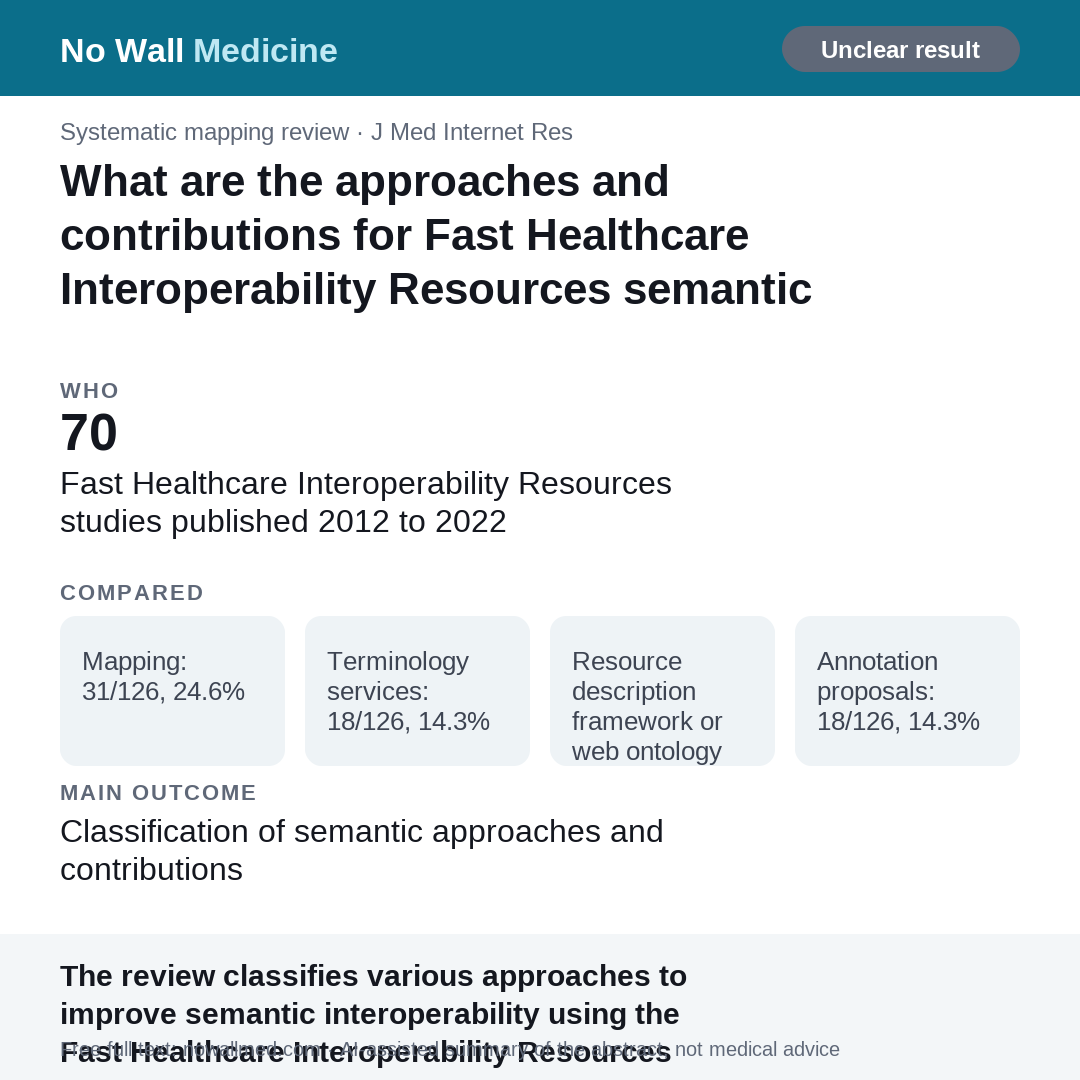
What are the approaches and contributions for Fast Healthcare Interoperability Resources semantic interoperability?
Who
70
Fast Healthcare Interoperability Resources studies published 2012 to 2022
Compared
Mapping: 31/126, 24.6%
Terminology services: 18/126, 14.3%
Resource description framework or web ontology language: 24/126, 19%
Annotation proposals: 18/126, 14.3%
Main outcome
Classification of semantic approaches and contributions
Bottom line: The review classifies various approaches to improve semantic interoperability using the Fast Healthcare Interoperability Resources standard.
J Med Internet Res · 2024-01-30Download image
Clinical question: What are the approaches and contributions for Fast Healthcare Interoperability Resources semantic interoperability?
Why it matters: It was unknown how various research approaches and contributions have been used to address semantic interoperability and data mapping using the Fast Healthcare Interoperability Resources standard.
Key points
- Researchers analyzed 70 studies published between 2012 and 2022 regarding the Fast Healthcare Interoperability Resources standard for exchanging and interpreting medical data.
- The most common approach was mapping at 24.6%, followed by web ontology language-based proposals at 19%, machine learning and natural language processing at 15.9%, and terminology services at 14.3%.
- The review found that most studies focused on proposing frameworks or architectures to enable semantic interoperability, which is the ability of different systems to correctly interpret shared data.
Headline and key points written with AI from the paper’s abstract, with every number checked against it. Read the paper before relying on them.
Was this summary helpful?
Subject terms
Cite this article
Amar F, April A, Abran A. Electronic Health Record and Semantic Issues Using Fast Healthcare Interoperability Resources: Systematic Mapping Review. J Med Internet Res. 2024. doi:10.2196/45209
Spotted a mistake? Suggest a correction
Top studies every Monday
The week’s key trials and guidelines in your specialties, plus any topics you follow. By email, free.
Get the weekly digest