Electronic reminders to clinicians increased counseling for patients after hypertensive pregnancy disorders
Electronic Reminder to Transition Care After Hypertensive Disorders of Pregnancy: A Randomized Controlled Trial
Randomized controlled trialBenefit found
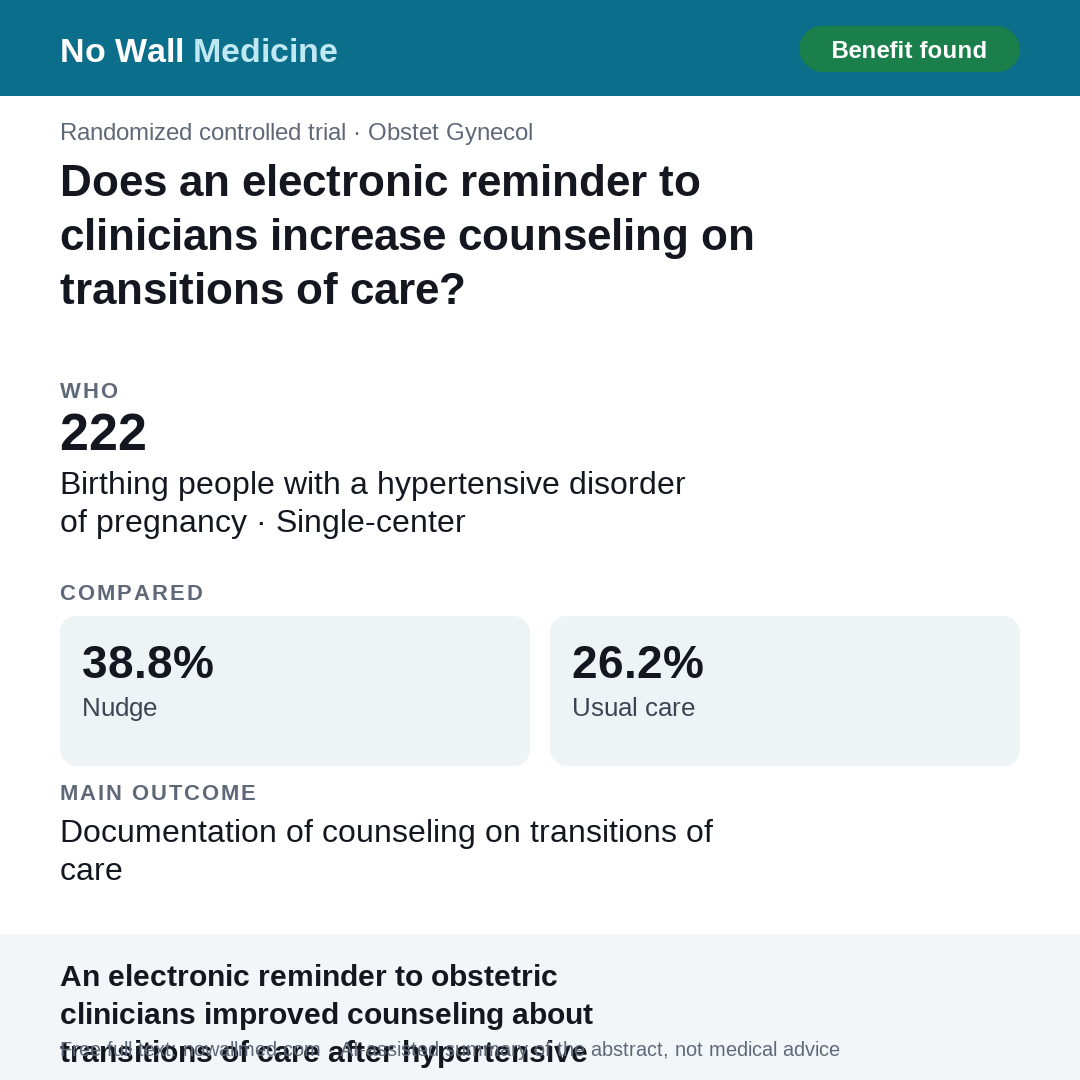
Does an electronic reminder to clinicians increase counseling on transitions of care?
Who
222
Birthing people with a hypertensive disorder of pregnancy · Single-center
Compared
38.8%Nudge
26.2%Usual care
Main outcome
Documentation of counseling on transitions of care
Result: adjusted relative risk 1.53 (95% CI 1.02-2.31)
Bottom line: An electronic reminder to obstetric clinicians improved counseling about transitions of care after hypertensive disorders of pregnancy.
Obstet Gynecol · 2023-06-07Download image
Clinical question: Does an electronic reminder to clinicians increase counseling on transitions of care?
Why it matters: Scalable interventions are needed to improve preventive care for individuals with increased cardiovascular disease risk identified during pregnancy.
In absolute numbers
Nudge: 38.8% · Usual care: 26.2% → a difference of 12.6 percentage points, so about 8 people would need the treatment for 1 more to benefit (number needed to treat) over the trial’s follow-up.
Worked out by us from the two group results above, not reported by the authors. Check the paper for the exact outcome and timing.
Key points
- Researchers conducted a randomized controlled trial with 222 birthing people who experienced hypertensive disorders of pregnancy to test an automated electronic medical record reminder.
- The nudge group had higher rates of documented counseling on transitions of care (38.8% vs 26.2%) and cardiovascular disease risk (21.4% vs 8.4%) compared to usual care.
- The electronic reminder did not result in a difference in preventive care visit attendance between the groups (22.1% vs 24.6%).
Headline and key points written with AI from the paper’s abstract, with every number checked against it. Read the paper before relying on them.
Was this summary helpful?
Subject terms
Cite this article
Triebwasser JE, Lewey J, Walheim L, Sehdev HM, Srinivas SK. Electronic Reminder to Transition Care After Hypertensive Disorders of Pregnancy: A Randomized Controlled Trial. Obstet Gynecol. 2023. doi:10.1097/AOG.0000000000005237
Spotted a mistake? Suggest a correction
Top studies every Monday
The week’s key trials and guidelines in your specialties, plus any topics you follow. By email, free.
Get the weekly digest