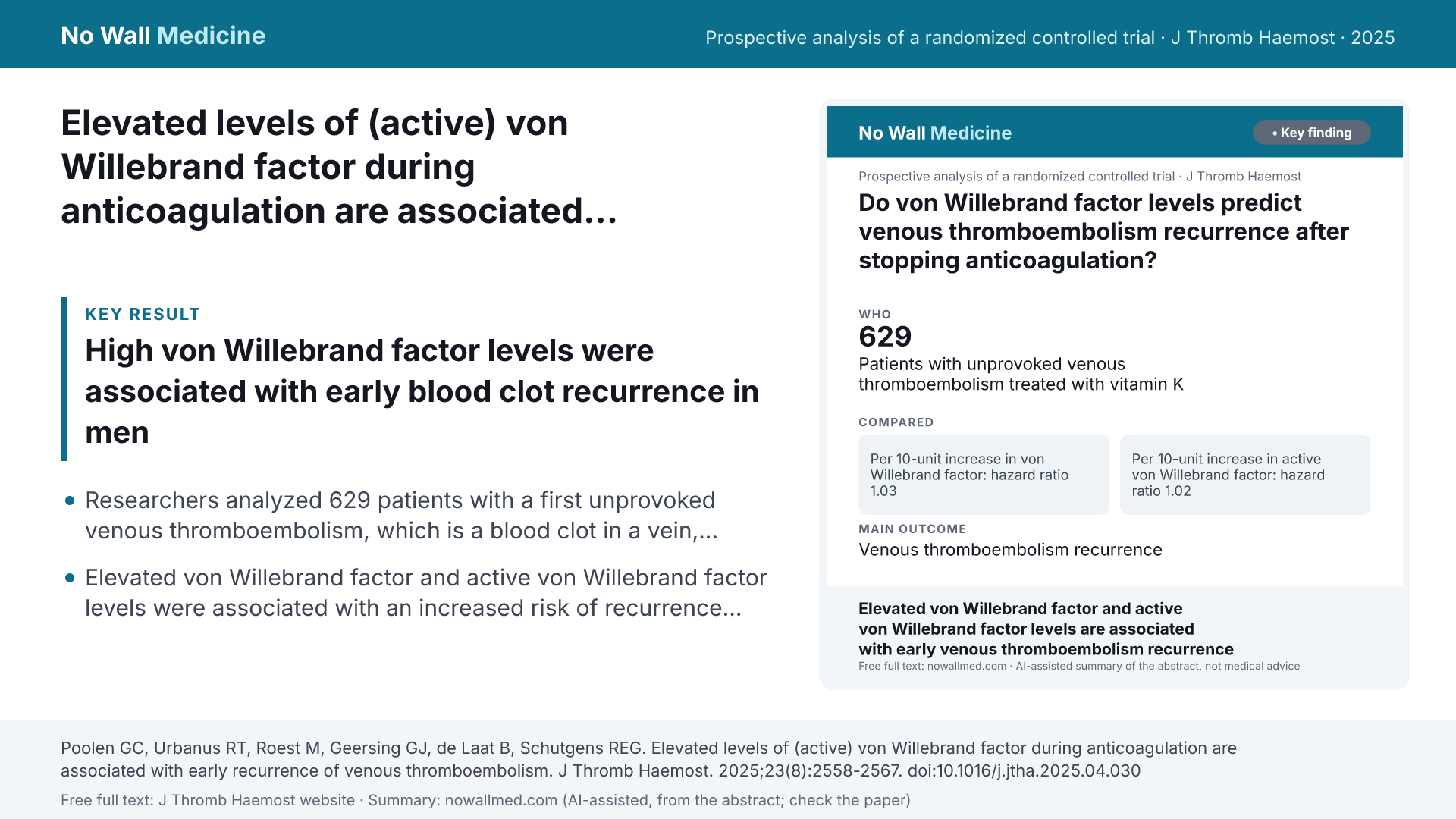
High von Willebrand factor levels were associated with early blood clot recurrence in men
Elevated levels of (active) von Willebrand factor during anticoagulation are associated with early recurrence of venous thromboembolism
Prospective analysis of a randomized controlled trialKey finding
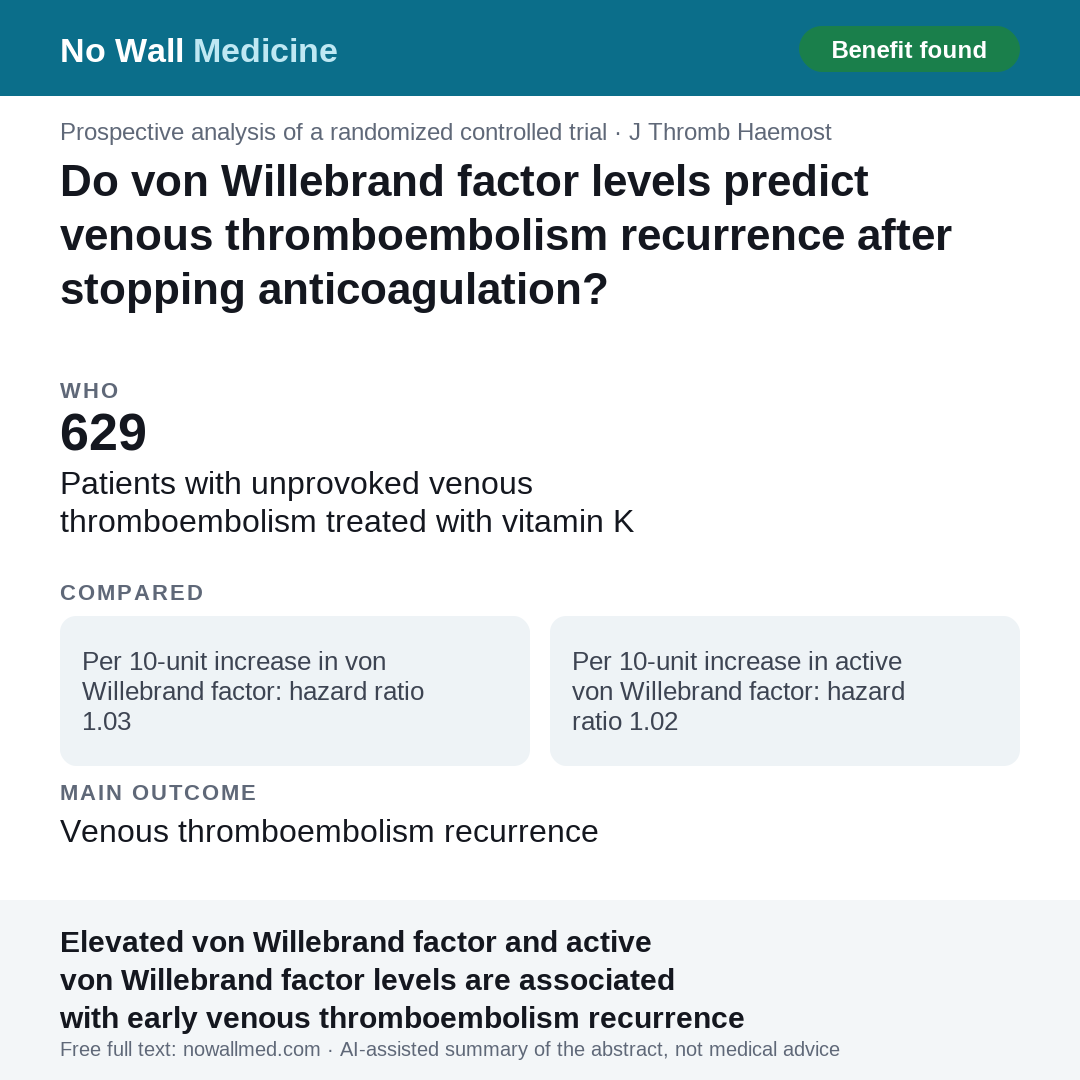
Do von Willebrand factor levels predict venous thromboembolism recurrence after stopping anticoagulation?
Who
629
Patients with unprovoked venous thromboembolism treated with vitamin K antagonists · VISTA trial
Compared
Per 10-unit increase in von Willebrand factor: hazard ratio 1.03
Per 10-unit increase in active von Willebrand factor: hazard ratio 1.02
Main outcome
Venous thromboembolism recurrence
Result: von Willebrand factor: hazard ratio 1.03 (95% CI 1.01-1.06); active von Willebrand factor: hazard ratio 1.02 (95% CI 1.00-1.05)
Bottom line: Elevated von Willebrand factor and active von Willebrand factor levels are associated with early venous thromboembolism recurrence in men.
J Thromb Haemost · 2025-05-13Download image
Clinical question: Do von Willebrand factor levels predict venous thromboembolism recurrence after stopping anticoagulation?
Why it matters: Reliable biomarkers are needed to identify patients at high risk for blood clot recurrence after they stop taking anticoagulation treatment.
Key points
- Researchers analyzed 629 patients with a first unprovoked venous thromboembolism, which is a blood clot in a vein, who stopped taking vitamin K antagonist blood thinners.
- Elevated von Willebrand factor and active von Willebrand factor levels were associated with an increased risk of recurrence per 10-unit increase (VWF: hazard ratio, 1.03; aVWF: hazard ratio, 1.02).
- These associations were stronger for recurrence occurring within 3 months and were associated with increased risk in men, but not in women.
Headline and key points written with AI from the paper’s abstract, with every number checked against it. Read the paper before relying on them.
Was this summary helpful?
Subject terms
Headline, design, result, key points, caveat and citation as plain text.
Cite this article
Poolen GC, Urbanus RT, Roest M, Geersing GJ, de Laat B, Schutgens REG. Elevated levels of (active) von Willebrand factor during anticoagulation are associated with early recurrence of venous thromboembolism. J Thromb Haemost. 2025. doi:10.1016/j.jtha.2025.04.030
Spotted a mistake? Suggest a correction