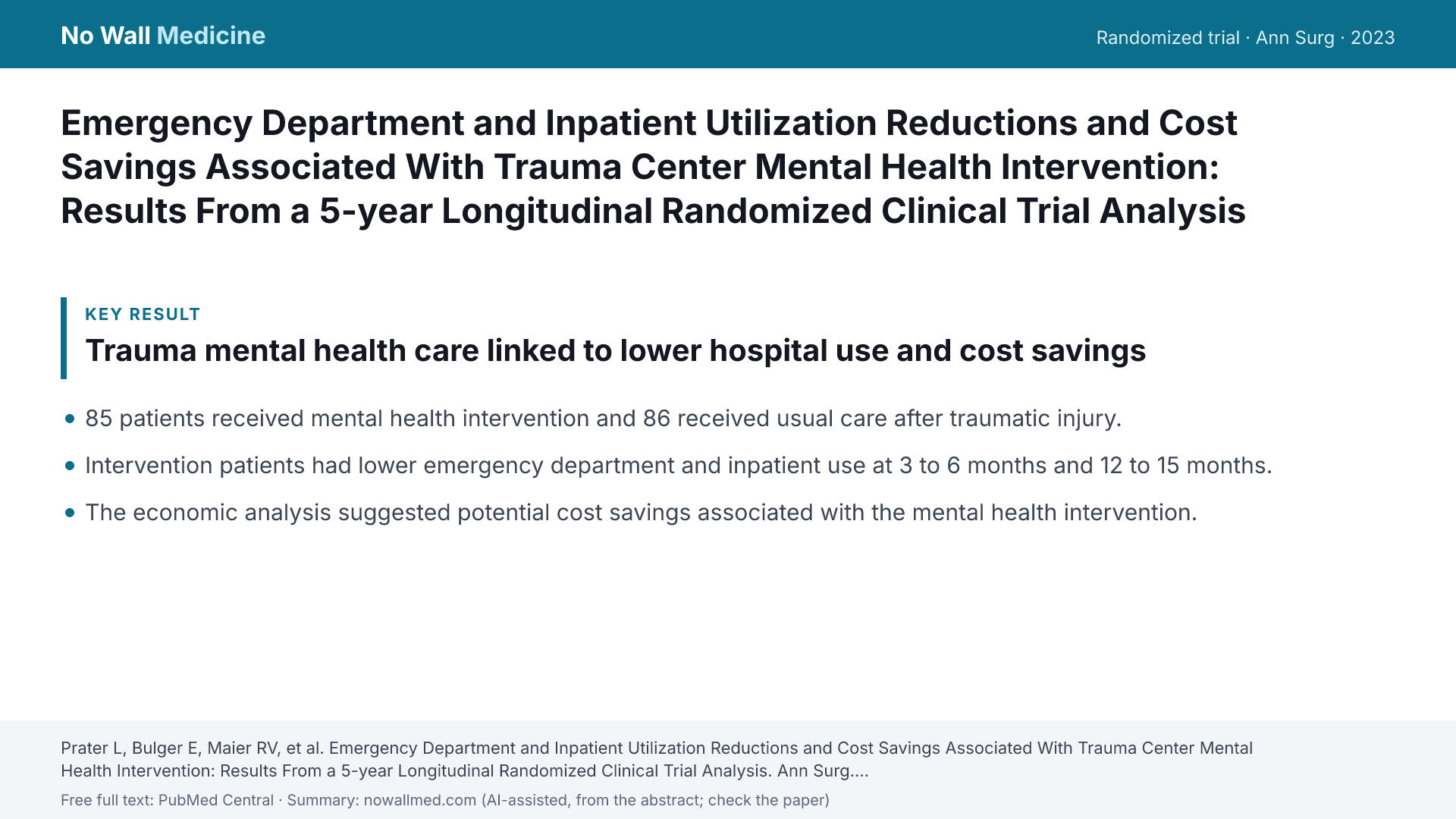
Emergency Department and Inpatient Utilization Reductions and Cost Savings Associated With Trauma Center Mental Health Intervention: Results From a 5-year Longitudinal Randomized Clinical Trial Analysis
Key result: Trauma mental health care linked to lower hospital use and cost savings
Key points
- 85 patients received mental health intervention and 86 received usual care after traumatic injury.
- Intervention patients had lower emergency department and inpatient use at 3 to 6 months and 12 to 15 months.
- The economic analysis suggested potential cost savings associated with the mental health intervention.
Why it matters: No prior investigations documented reductions in utilization and associated potential cost savings from trauma center mental health interventions.
Discussion prompts
- Would these patients look like yours? Who was left out?
- Is the main outcome one that matters to patients?
- Is the difference large enough to change what you do?
Cite: Prater L, Bulger E, Maier RV, et al. Emergency Department and Inpatient Utilization Reductions and Cost Savings Associated With Trauma Center Mental Health Intervention: Results From a 5-year Longitudinal Randomized Clinical Trial Analysis. Ann Surg. 2024;279(1):17-23. doi:10.1097/SLA.0000000000006102
Free full text: PubMed Central · Summary and visual abstract: nowallmed.com/a/emergency-department-and-inpatient-utilization-reductions-and-cost-nkbhcn/ (AI-assisted from the abstract; check the paper before relying on it).