Trial to compare emergency total life support versus standard rescue support for cardiac arrest
Emergency total extracorporeal life support versus standard advanced cardiac life support with rescue extracorporeal membrane oxygenation for refractory out-of-hospital cardiac arrest: protocol for the ECLS-OHCA randomized trial
Randomized trialUnclear result
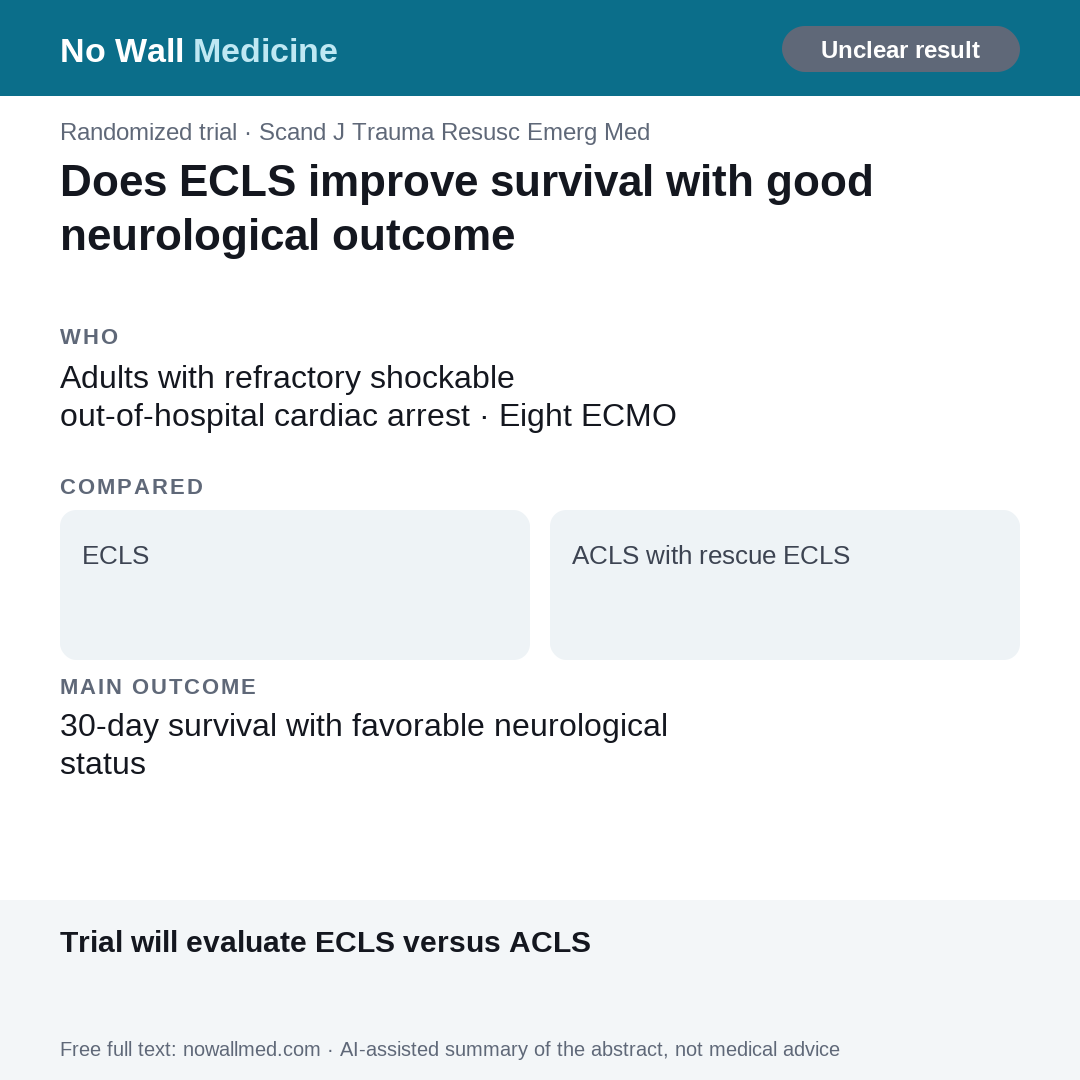
Does ECLS improve survival with good neurological outcome
Who
Adults with refractory shockable out-of-hospital cardiac arrest · Eight ECMO centers in Taipei
Compared
ECLS
ACLS with rescue ECLS
Main outcome
30-day survival with favorable neurological status
Bottom line: Trial will evaluate ECLS versus ACLS
Scand J Trauma Resusc Emerg Med · 2026-02-03Download image
Why it matters: Recent randomized trials have reported conflicting results regarding whether extracorporeal membrane oxygenation, a machine that provides heart and lung support, benefits patients with refractory cardiac arrest.
Key points
- The ECLS-OHCA trial will enroll adults aged 18-75 years with witnessed refractory shockable out-of-hospital cardiac arrest at eight specialized centers.
- Researchers will compare emergency total extracorporeal life support initiated within 60 min of an emergency call to standard advanced cardiac life support with rescue life support.
- The primary goal is to measure 30-day survival with a favorable neurological status, defined as a Cerebral Performance Category score of 1 or 2.
Headline and key points written with AI from the paper’s abstract, with every number checked against it. Read the paper before relying on them.
Topics
Cite this article
Fu HY, Liu YH, Li SJ, Chang HC, Liu CC, Lee CM. Emergency total extracorporeal life support versus standard advanced cardiac life support with rescue extracorporeal membrane oxygenation for refractory out-of-hospital cardiac arrest: protocol for the ECLS-OHCA randomized trial. Scand J Trauma Resusc Emerg Med. 2026. doi:10.1186/s13049-026-01557-w
Spotted a mistake? Suggest a correction