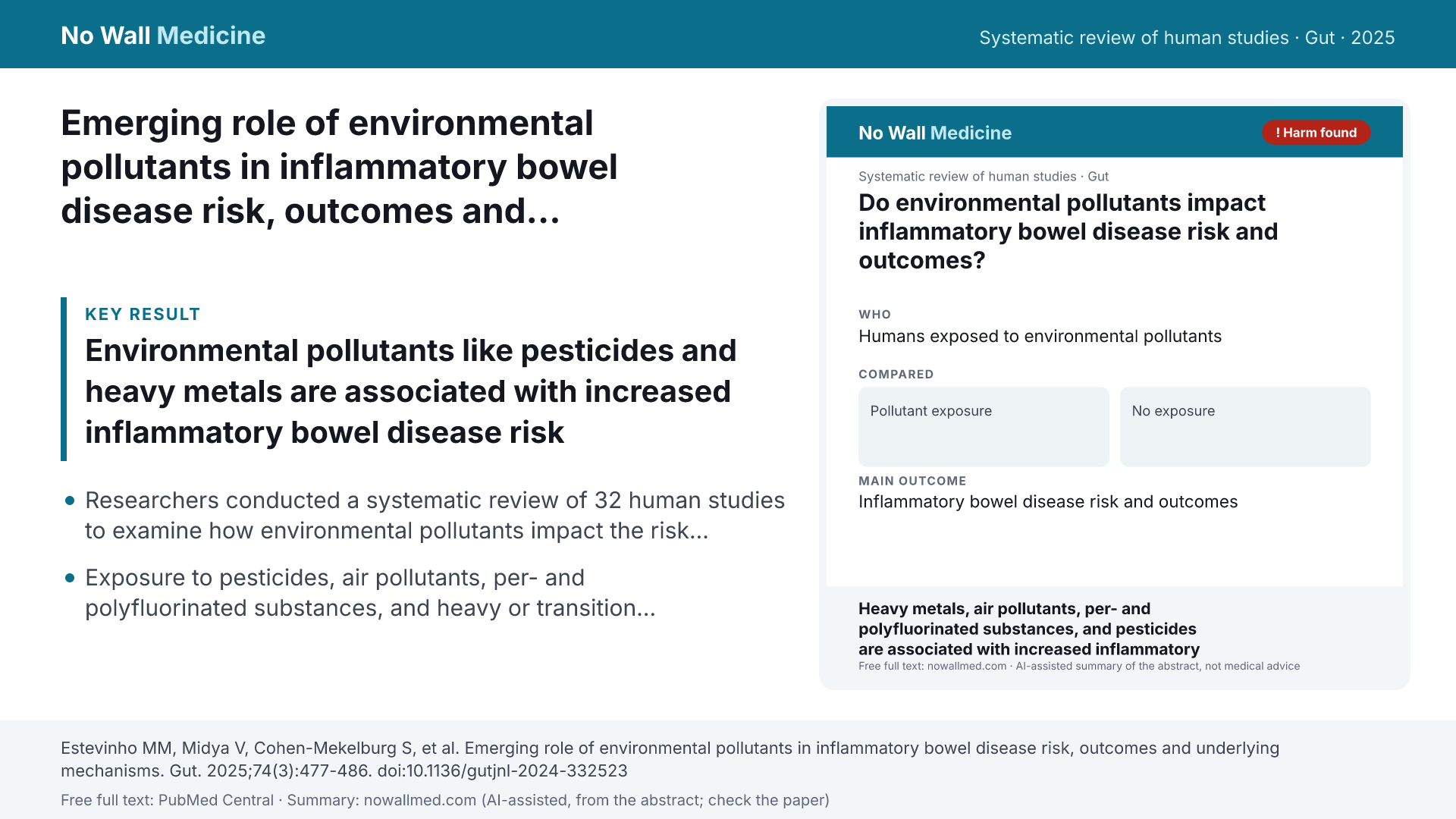
Environmental pollutants like pesticides and heavy metals are associated with increased inflammatory bowel disease risk
Emerging role of environmental pollutants in inflammatory bowel disease risk, outcomes and underlying mechanisms
Systematic review of human studiesHarm found
Do environmental pollutants impact inflammatory bowel disease risk and outcomes?
Who
Humans exposed to environmental pollutants
Compared
Pollutant exposure
No exposure
Main outcome
Inflammatory bowel disease risk and outcomes
Bottom line: Heavy metals, air pollutants, per- and polyfluorinated substances, and pesticides are associated with increased inflammatory bowel disease risk.
Gut · 2025-02-06 · Save PNG
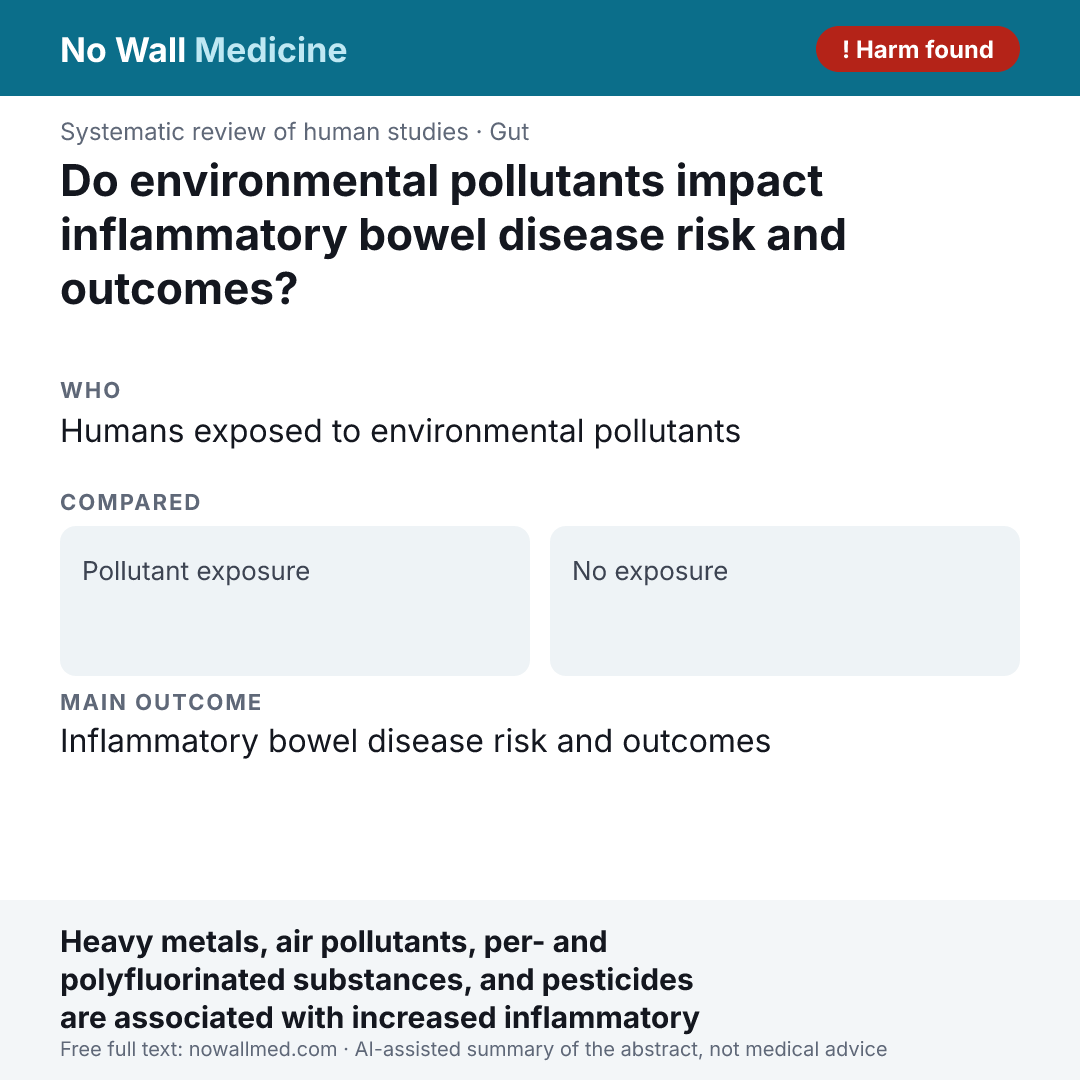
Clinical question: Do environmental pollutants impact inflammatory bowel disease risk and outcomes?
Why it matters: The rising global incidence of inflammatory bowel disease occurs alongside increasing chemical use and pollution, but the specific impact of these pollutants remains to be synthesized.
Key points
- Researchers conducted a systematic review of 32 human studies to examine how environmental pollutants impact the risk and outcomes of inflammatory bowel disease.
- Exposure to pesticides, air pollutants, per- and polyfluorinated substances, and heavy or transition metals, excluding zinc, was associated with an increased risk of inflammatory bowel disease.
- Air pollutant exposure was also associated with adverse outcomes related to the disease.
Headline and key points written with AI from the paper’s abstract, with every number checked against it. Read the paper before relying on them.
Was this summary helpful?
Subject terms
Headline, design, result, key points, caveat and citation as plain text.
Cite this article
Estevinho MM, Midya V, Cohen-Mekelburg S, et al. Emerging role of environmental pollutants in inflammatory bowel disease risk, outcomes and underlying mechanisms. Gut. 2025;74(3):477-486. doi:10.1136/gutjnl-2024-332523
Spotted a mistake? Suggest a correction