Osseointegrated prostheses were associated with improved function and range of motion in transhumeral amputees
Emerging Value of Osseointegration for Intuitive Prosthetic Control after Transhumeral Amputations: A Systematic Review
Systematic reviewBenefit found
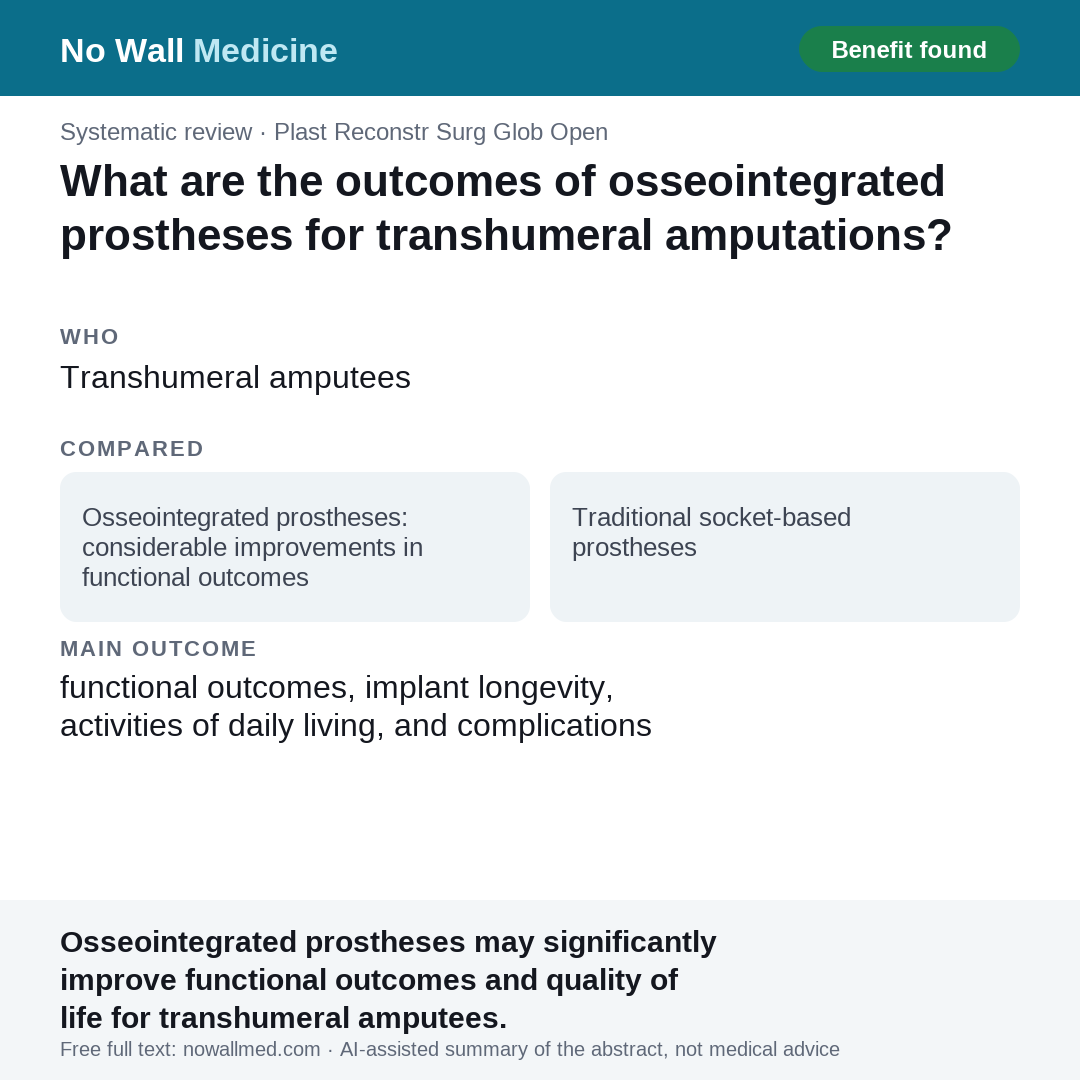
What are the outcomes of osseointegrated prostheses for transhumeral amputations?
Who
Transhumeral amputees
Compared
Osseointegrated prostheses: considerable improvements in functional outcomes
Traditional socket-based prostheses
Main outcome
functional outcomes, implant longevity, activities of daily living, and complications
Bottom line: Osseointegrated prostheses may significantly improve functional outcomes and quality of life for transhumeral amputees.
Plast Reconstr Surg Glob Open · 2024-05-28Download image
Clinical question: What are the outcomes of osseointegrated prostheses for transhumeral amputations?
Why it matters: It was unknown how osseointegrated prosthetic embodiment affects functional outcomes, implant longevity, and complications for individuals with transhumeral amputations.
Key points
- Researchers reviewed eight studies, including case series and retrospective analyses, regarding osseointegrated implants for people with upper arm amputations.
- The use of osseointegrated prostheses was associated with enhanced range of motion and improved performance of activities compared to traditional socket-based prostheses.
- One study showed that an osseointegrated implant could act as a bidirectional gateway for signal transmission to allow intuitive control of a bionic hand.
Limitation the authors note: The review was limited to eight studies consisting of retrospective analyses and case series.
Headline and key points written with AI from the paper’s abstract, with every number checked against it. Read the paper before relying on them.
Was this summary helpful?
Cite this article
Tereshenko V, Giorgino R, Eberlin KR, Valerio IL, Souza JM, Alessandri-Bonetti M. Emerging Value of Osseointegration for Intuitive Prosthetic Control after Transhumeral Amputations: A Systematic Review. Plast Reconstr Surg Glob Open. 2024. doi:10.1097/GOX.0000000000005850
Spotted a mistake? Suggest a correction
Top studies every Monday
The week’s key trials and guidelines in your specialties, plus any topics you follow. By email, free.
Get the weekly digest