Three different mobile phone apps showed no difference in promoting mental wellbeing in young adults
Emotional competence self-help mobile phone app versus cognitive behavioural self-help app versus self-monitoring app to promote mental wellbeing in healthy young adults (ECoWeB PROMOTE): an international, multicentre, parallel, open-label, randomised controlled trial
International, multicentre, parallel, open-label, randomised controlled trialNo clear difference
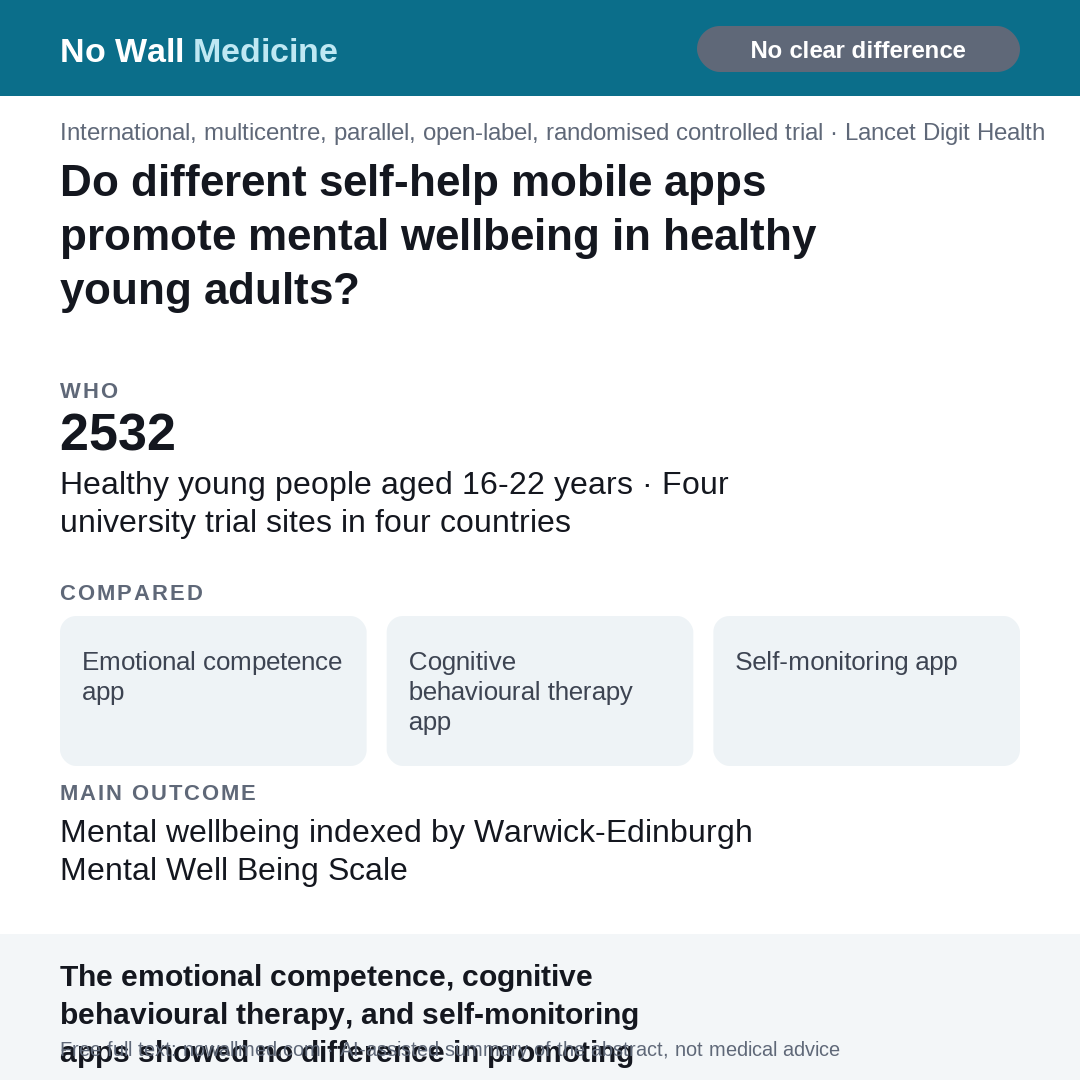
Do different self-help mobile apps promote mental wellbeing in healthy young adults?
Who
2532
Healthy young people aged 16-22 years · Four university trial sites in four countries
Compared
Emotional competence app
Cognitive behavioural therapy app
Self-monitoring app
Main outcome
Mental wellbeing indexed by Warwick-Edinburgh Mental Well Being Scale
Result: no difference (global p=0·47)
Bottom line: The emotional competence, cognitive behavioural therapy, and self-monitoring apps showed no difference in promoting mental wellbeing.
Limitation: Low intensity of interventions and difficulty improving wellbeing in low-risk populations.
Funded by: European Commission
Lancet Digit Health · 2024-10-04Download image
Clinical question: Do different self-help mobile apps promote mental wellbeing in healthy young adults?
Why it matters: It is unknown if personalized digital interventions based on emotional functioning can effectively promote mental wellbeing in healthy, low-risk young populations.
Key points
- The trial included 2532 participants aged 16-22 years randomized to use an emotional competence app, a cognitive behavioural therapy app, or a self-monitoring app.
- At the 3-month follow-up, there was no difference in mental wellbeing scores between the three app groups (p=0.47).
- Among 1315 participants, 14 were admitted to or treated in hospital for mental health reasons, which were considered unrelated to the interventions.
Headline and key points written with AI from the paper’s abstract, with every number checked against it. Read the paper before relying on them.
Abstract
Background
Based on evidence that mental health is more than an absence of mental disorders, there have been calls to find ways to promote flourishing at a population level, especially in young people, which requires effective and scalable interventions. Despite their potential for scalability, few mental wellbeing apps have been rigorously tested in high-powered trials, derived from models of healthy emotional functioning, or tailored to individual profiles. We aimed to test a personalised emotional competence self-help app versus a cognitive behavioural therapy (CBT) self-help app versus a self-monitoring app to promote mental wellbeing in healthy young people. Methods
This international, multicentre, parallel, open-label, randomised controlled trial within a cohort multiple randomised trial (including a parallel trial of depression prevention) was done at four university trial sites in four countries (the UK, Germany, Spain, and Belgium). Participants were recruited from schools and universities and via social media from the four respective countries. Eligible participants were aged 16-22 years with well adjusted emotional competence profiles and no current or past diagnosis of major depression. Participants were randomised (1:1:1) to usual practice plus either the emotional competence app, the CBT app or the self-monitoring app, by an independent computerised system, minimised by country, age, and self-reported gender, and followed up for 12 months post-randomisation. The primary outcome was mental wellbeing (indexed by the Warwick-Edinburgh Mental Well Being Scale [WEMWBS]) at 3-month follow-up, analysed in participants who completed the 3-month follow-up assessment. Outcome assessors were masked to group allocation. The study is registered with ClinicalTrials.gov, NCT04148508, and is closed. Findings
Between Oct 15, 2020, and Aug 3, 2021, 2532 participants were enrolled, and 847 were randomly assigned to the emotional competence app, 841 to the CBT app, and 844 to the self-monitoring app. Mean age was 19·2 years (SD 1·8). Of 2532 participants self-reporting gender, 1896 (74·9%) were female, 613 (24·2%) were male, 16 (0·6%) were neither, and seven (0·3%) were both. 425 participants in the emotional competence app group, 443 in the CT app group, and 447 in the self-monitoring app group completed the follow-up assessment at 3 months. There was no difference in mental wellbeing between the groups at 3 months (global p=0·47). The emotional competence app did not differ from the CBT app (mean difference in WEMWBS -0·21 [95% CI -1·08 to 0·66]) or the self-monitoring app (0·32 [-0·54 to 1·19]) and the CBT app did not differ from the self-monitoring app (0·53 [-0·33 to 1·39]). 14 of 1315 participants were admitted to or treated in hospital (or both) for mental health-related reasons, which were considered unrelated to the interventions (five participants in the emotional competence app group, eight in the CBT app group, and one in the self-monitoring app group). No deaths occurred. Interpretation
The emotional competence app and the CBT app provided limited benefit in promoting mental wellbeing in healthy young people. This finding might reflect the low intensity of these interventions and the difficulty improving mental wellbeing via universal digital interventions implemented in low-risk populations. Funding
European Commission.
Abstract reproduced under the article’s CC BY licence.
Topics
Cite this article
Watkins ER, Warren FC, Newbold A, Hulme C, Cranston T, Aas B. Emotional competence self-help mobile phone app versus cognitive behavioural self-help app versus self-monitoring app to promote mental wellbeing in healthy young adults (ECoWeB PROMOTE): an international, multicentre, parallel, open-label, randomised controlled trial. Lancet Digit Health. 2024. doi:10.1016/S2589-7500(24)00149-3
Spotted a mistake? Suggest a correction
Top studies every Monday
The week’s key trials and guidelines in your specialties, plus any topics you follow. By email, free.
Get the weekly digest