Empagliflozin reduced lung vessel remodeling in rats but showed no clinical benefit in humans
Empagliflozin Ameliorates Experimental Pulmonary Vascular Remodeling, but May Not Benefit Patients With Pulmonary Arterial Hypertension
Phase IIa proof-of-concept trial and animal studiesHarm found
Does empagliflozin impact pulmonary arterial hypertension in cells, rats, and patients?
Who
8
Patients with idiopathic and heritable pulmonary arterial hypertension
Compared
Empagliflozin: right ventricular ejection fraction 38%±12%
Baseline: right ventricular ejection fraction 45%±10%
Main outcome
clinical parameters and right ventricular ejection fraction
Result: P=0.031
Bottom line: Empagliflozin reduces vascular remodeling in rats but may cause right ventricular deterioration in pulmonary arterial hypertension patients.
Limitation: Small phase IIa proof-of-concept trial with eight patients.
J Am Heart Assoc · 2026-07-25Download image
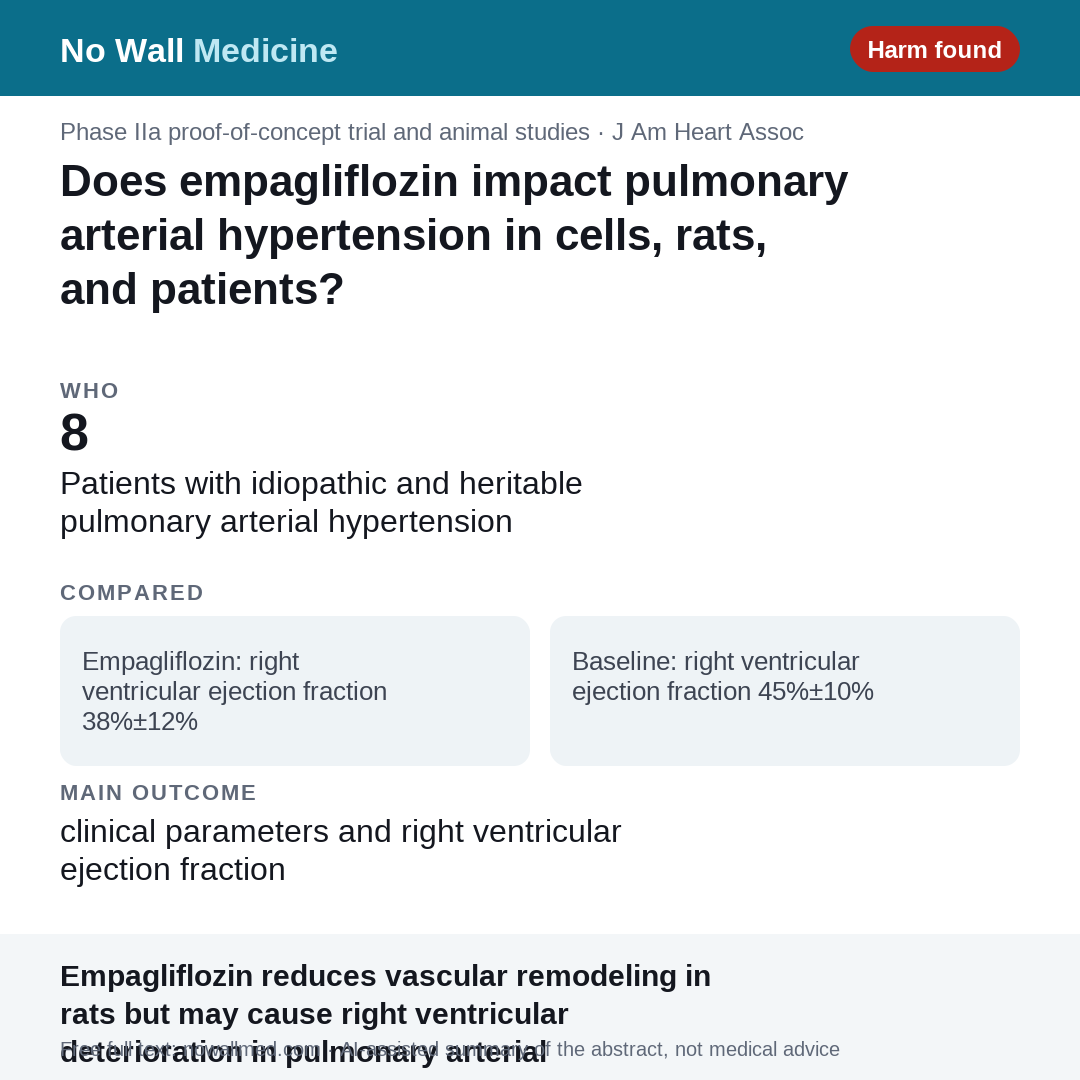
Clinical question: Does empagliflozin impact pulmonary arterial hypertension in cells, rats, and patients?
Why it matters: It is unknown if sodium glucose cotransporter 2 inhibitors can improve mitochondrial function and reduce lung vessel remodeling in patients with pulmonary arterial hypertension.
Key points
- Researchers studied lung microvascular endothelial cells, 12 rats with experimental pulmonary arterial hypertension, and 8 patients with idiopathic or heritable pulmonary arterial hypertension.
- In rats, empagliflozin reduced pulmonary vascular resistance and thickening of the small pulmonary artery intima, but in humans, it did not change functional scores or walking distance.
- In the human trial, right ventricular ejection fraction, a measure of heart pump strength, slightly worsened from 45%±10% to 38%±12% (P=0.031).
Limitation the authors note: The human phase IIa proof-of-concept trial was limited by a small sample size of 8 patients.
Headline and key points written with AI from the paper’s abstract, with every number checked against it. Read the paper before relying on them.
Topics
Cite this article
Yoshida K, Toth E, Duijvelaar E, Neep B, Agarwal S, Pan X. Empagliflozin Ameliorates Experimental Pulmonary Vascular Remodeling, but May Not Benefit Patients With Pulmonary Arterial Hypertension. J Am Heart Assoc. 2026. doi:10.1161/JAHA.125.047945
Spotted a mistake? Suggest a correction