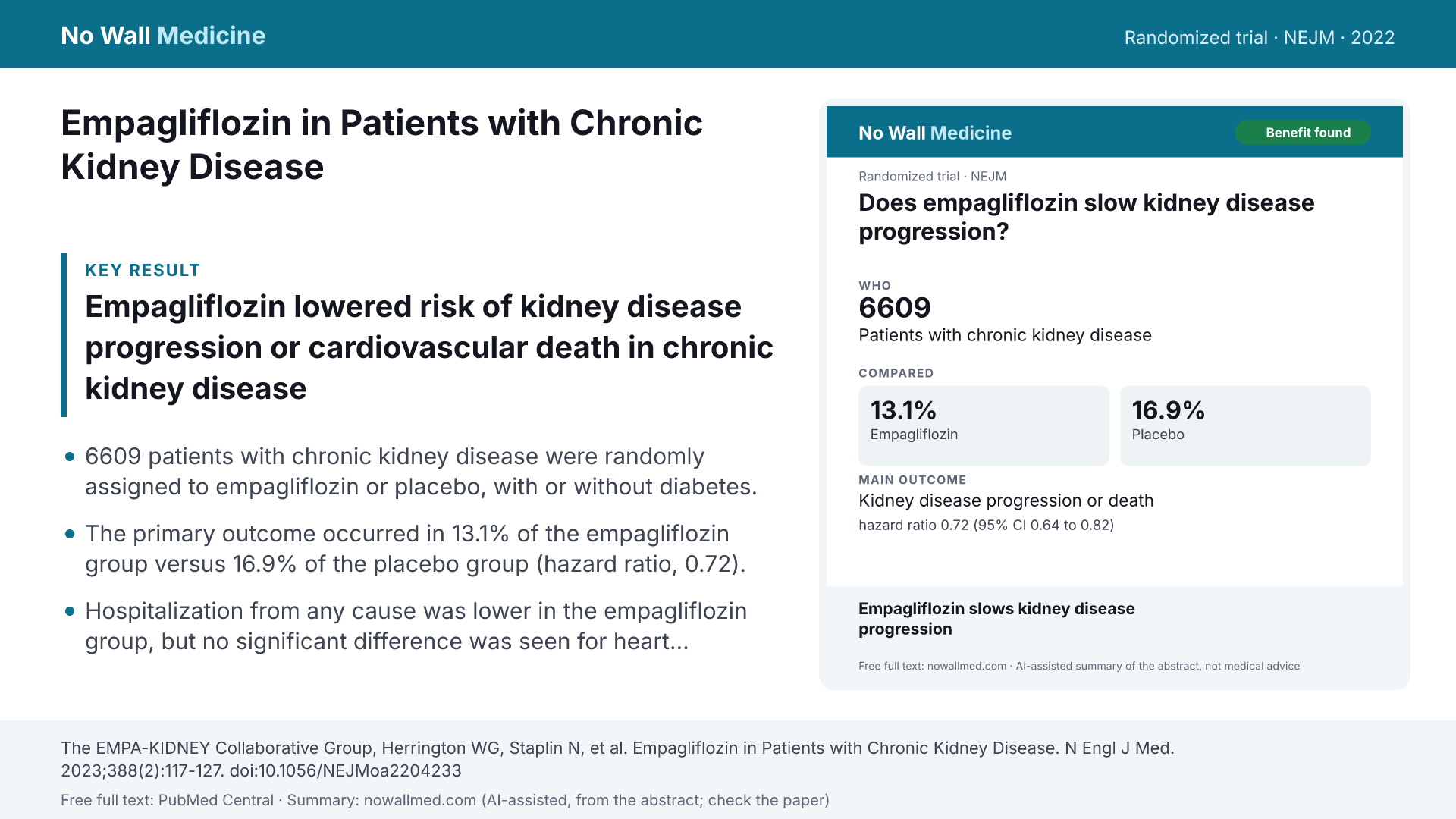
Empagliflozin lowered risk of kidney disease progression or cardiovascular death in chronic kidney disease
Empagliflozin in Patients with Chronic Kidney Disease
Why it matters: Extended SGLT2-inhibitor kidney benefits to a broad range of people with chronic kidney disease, including many without diabetes.
Related landmark trials: CREDENCE · DAPA-CKD
Context written by the No Wall Medicine team.
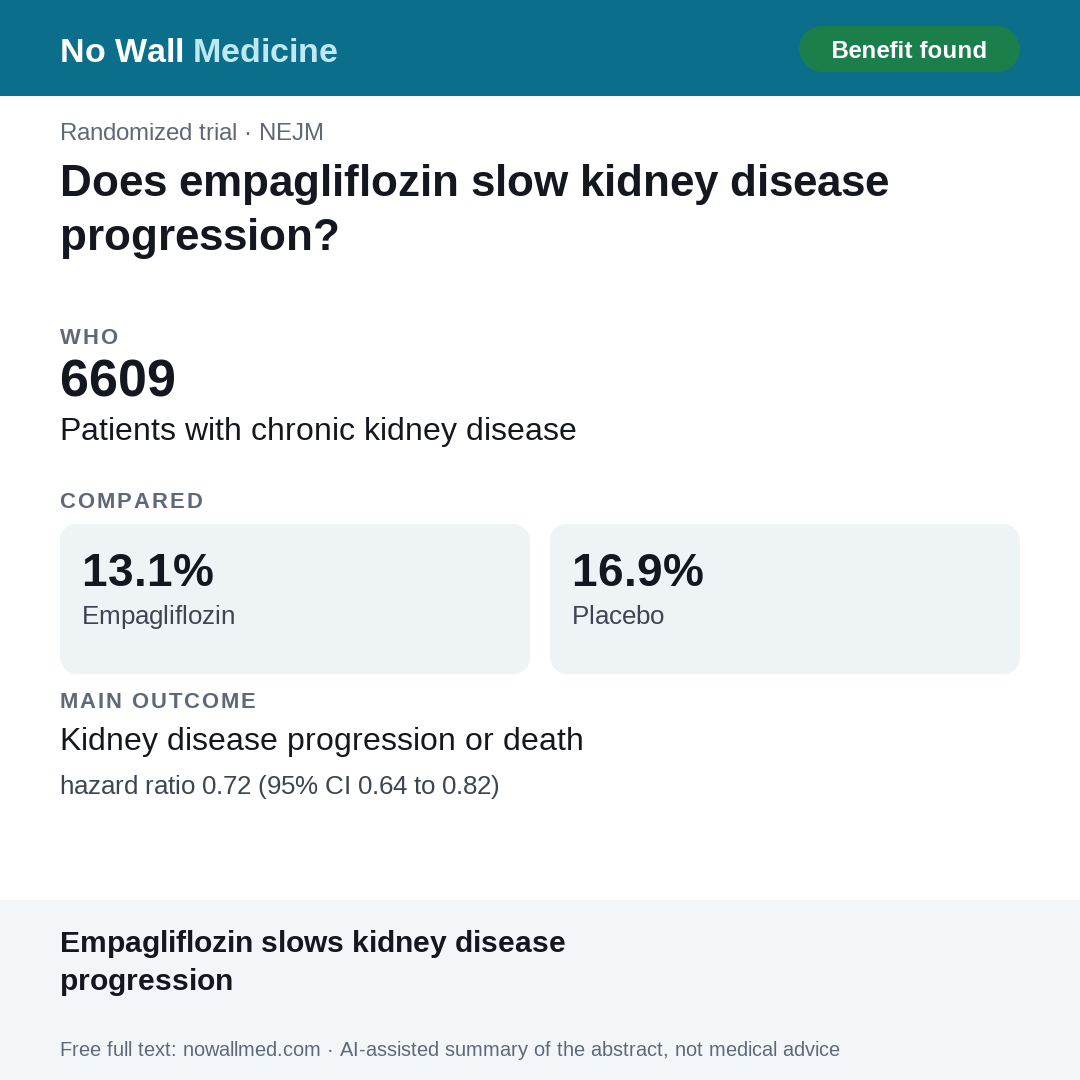
Randomized trialBenefit found
Does empagliflozin slow kidney disease progression?
Who
6609
Patients with chronic kidney disease
Compared
13.1%Empagliflozin (432/3304)
16.9%Placebo (558/3305)
Main outcome
Kidney disease progression or death
Result: hazard ratio 0.72 (95% CI 0.64 to 0.82)
Bottom line: Empagliflozin slows kidney disease progression
Funded by: Boehringer Ingelheim and others
NEJM · 2022-11-04Download image
Trial at a glance
Bottom line: Empagliflozin reduced the risk of kidney disease progression or cardiovascular death with a hazard ratio of 0.72.
Clinical question
Does empagliflozin reduce kidney disease progression or cardiovascular death in patients with chronic kidney disease?
Design
Randomized, double-blind, placebo-controlled trial. Eight countries, 241 centers
Who was studied
6609 adults with chronic kidney disease
Key inclusion criteria
- eGFR ≥20 to <45 ml/minute/1.73m 2
- eGFR ≥45 to <90 ml/minute/1.73m 2 with urinary ACR ≥200 mg/g
- with or without diabetes
- prescribed a clinically appropriate dose of single-agent RAS-inhibitor
Key exclusion criteria
- polycystic kidney disease
- kidney transplant
Interventions
- empagliflozin: 10mg once daily
- placebo: matching placebo
Primary outcome
kidney disease progression or cardiovascular death. hazard ratio 0.72; 95% CI 0.64 to 0.82; P<0.001
Secondary outcomes
- hospitalization for heart failure or cardiovascular death: hazard ratio 0.84; 95% CI 0.67 to 1.07; P=0.15
- all-cause hospitalizations: hazard ratio 0.86; 95% CI 0.78 to 0.95, P=0.003
- death from any cause: hazard ratio 0.87; 95% CI 0.70 to 1.08; P=0.21
Harms
ketoacidosis occurred in 6 patients in the empagliflozin group versus 1 patient in the placebo group
Limitations reported by the authors
- lower-than-expected cardiovascular event rate
Funding
Boehringer Ingelheim, Eli Lilly and others
Written with AI from the full paper; every number was checked against it. Read the paper before relying on it.
In absolute numbers
Empagliflozin: 13.1% · Placebo: 16.9% → a difference of 3.8 percentage points, so about 27 people would need the treatment for 1 more to benefit (number needed to treat) over the trial’s follow-up.
Worked out by us from the two group results above, not reported by the authors. Check the paper for the exact outcome and timing.
Key points
- 6609 patients with chronic kidney disease were randomly assigned to empagliflozin or placebo, with or without diabetes.
- The primary outcome occurred in 13.1% of the empagliflozin group versus 16.9% of the placebo group (hazard ratio, 0.72).
- Hospitalization from any cause was lower in the empagliflozin group, but no significant difference was seen for heart failure hospitalization or death.
Headline and key points written with AI from the paper’s abstract, with every number checked against it. Read the paper before relying on them.
Was this summary helpful?
Subject terms
Cite this article
The EMPA-KIDNEY Collaborative Group, Herrington WG, Staplin N, et al. Empagliflozin in Patients with Chronic Kidney Disease. NEJM. 2022. doi:10.1056/NEJMoa2204233
Spotted a mistake? Suggest a correction