Background
Effective communication between healthcare providers and parents facing their child's end of life is critical yet complex. A comprehensive synthesis of how empathic communication influences clinical and bereavement outcomes in pediatric palliative care is lacking. Objective
To synthesize qualitative and quantitative evidence on parent-provider empathic communication in pediatric palliative care and to develop an integrative theoretical-conceptual model explaining its proposed mediating role in symptom management and family bereavement. Methods
A mixed-methods systematic review was conducted following Joanna Briggs Institute (JBI) methodology for convergent segregated synthesis. We searched PubMed/MEDLINE, Scopus, CINAHL, PsycINFO, and LILACS (June-July 2025, updated January 2026). Studies reporting parental experiences of empathic communication in pediatric palliative care were eligible. Methodological quality was assessed using JBI checklists. Qualitative findings were synthesized via JBI meta-aggregation; quantitative data were analyzed through narrative synthesis; findings were integrated configurationally. Results
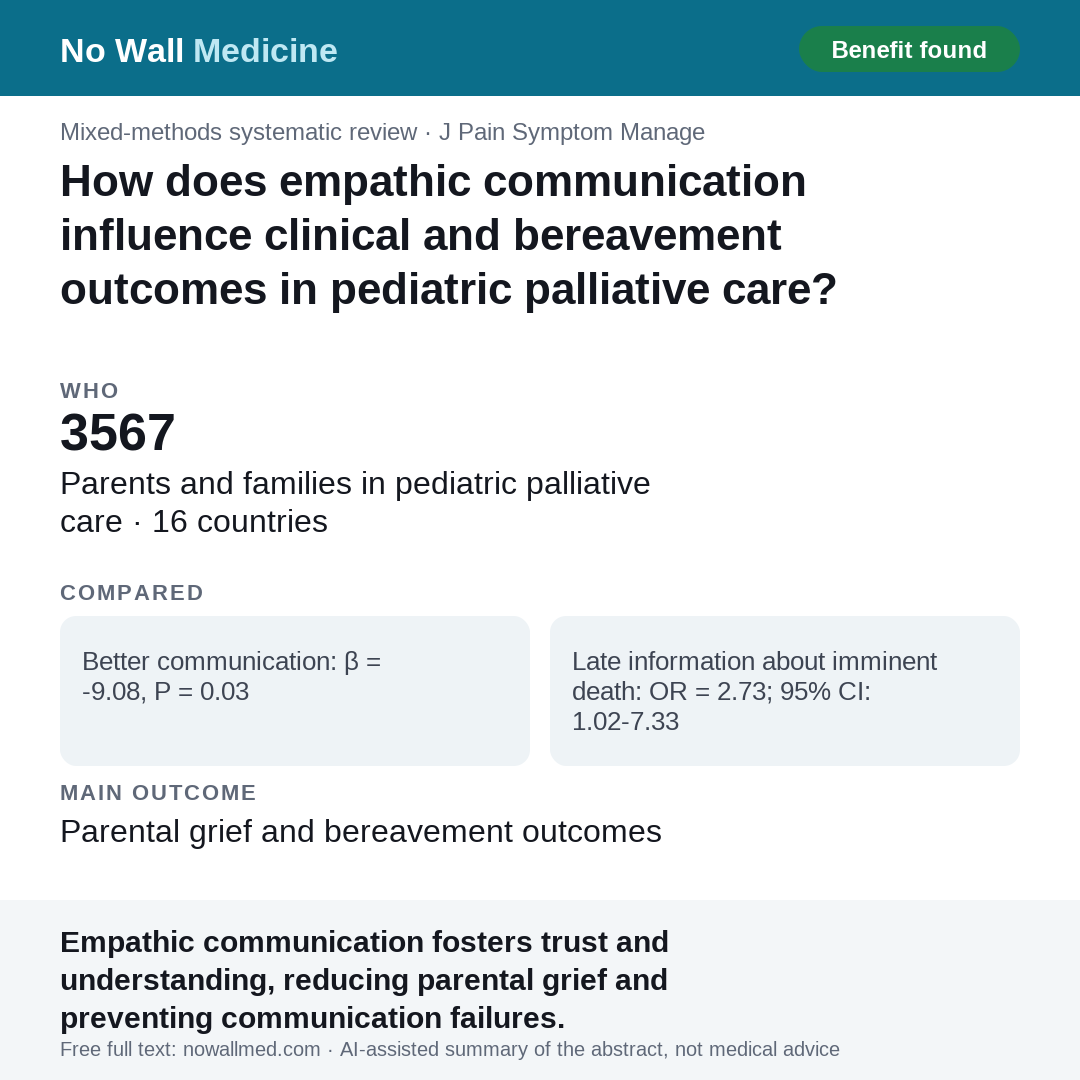
Fifty-four studies (28 qualitative, 15 quantitative, 11 mixed-methods) involving approximately 3567 participants across 16 countries were included. Meta-aggregation yielded eight synthesized findings, including that empathic communication fosters relational trust (S1, S3), enhances prognostic understanding (S2), supports meaning-making (S7), and prevents communication failures that increase complicated grief risk (S5). Narrative synthesis showed that better communication (β = -9.08, P = 0.03) and continuity of care (β = -11.74, P = 0.01) were associated with lower parental grief, while late information about imminent death increased unresolved grief risk (OR = 2.73; 95% CI: 1.02-7.33). Perception of a nonpeaceful death was the strongest factor associated with unresolved grief among siblings (OR = 9.86; 95% CI: 2.39-40.65). Integration of findings generated the "Relational Layered Care Model," which proposes that empathic communication activates four theoretical mechanisms-relational trust, prognostic understanding, meaning-making, and care alignment-that influence bereavement adaptation and symptom-related outcomes. Conclusions
Empathic communication in pediatric palliative care operates through specific psychosocial mechanisms rather than merely a communication style. The proposed theoretical model provides a framework for clinical practice, education, and future interventions. Systematic review registration
PROSPERO CRD420251083662.