Minimal residual disease and progression-free survival show varying links to overall survival in leukemia
End Point Surrogacy in First-Line Chronic Lymphocytic Leukemia
Patient-level analysis and meta-analysisMixed results
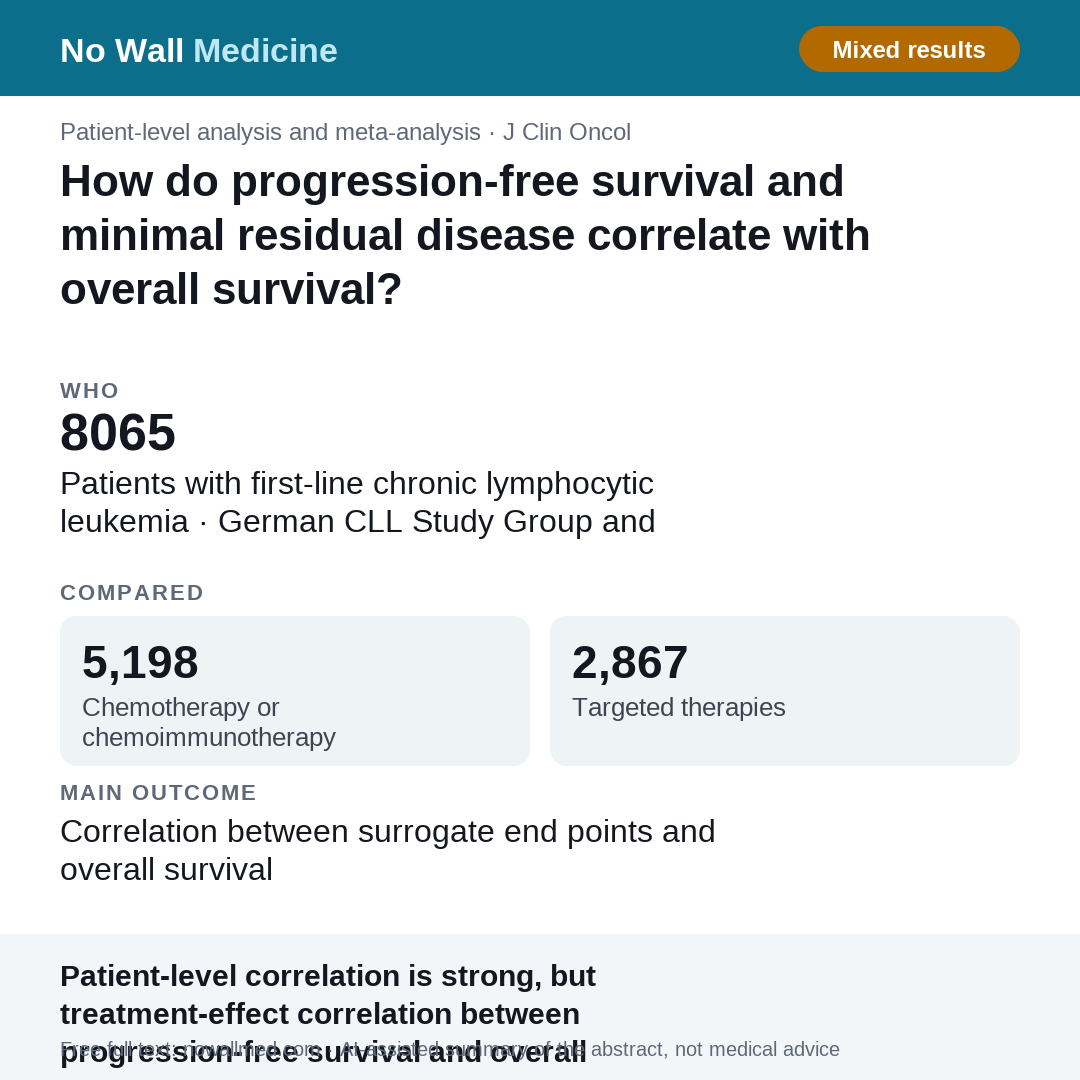
How do progression-free survival and minimal residual disease correlate with overall survival?
Who
8065
Patients with first-line chronic lymphocytic leukemia · German CLL Study Group and published trials
Compared
5,198Chemotherapy or chemoimmunotherapy (64%)
2,867Targeted therapies (36%)
Main outcome
Correlation between surrogate end points and overall survival
Result: R = 0.75 (95% CI 0.74 to 0.76) for PFS and OS
Bottom line: Patient-level correlation is strong, but treatment-effect correlation between progression-free survival and overall survival remains uncertain.
Limitation: Limited number of randomized trials with available minimal residual disease data.
J Clin Oncol · 2024-08-23Download image
Clinical question: How do progression-free survival and minimal residual disease correlate with overall survival?
Why it matters: It is unknown if surrogate end points like progression-free survival or minimal residual disease accurately reflect overall survival in first-line chronic lymphocytic leukemia treatments.
Key points
- Researchers analyzed 4,237 patients from German trials and 8,065 patients from a meta-analysis of first-line chronic lymphocytic leukemia trials.
- Minimal residual disease, or the presence of tiny amounts of cancer cells, showed a treatment-effect correlation of R = 0.88 with progression-free survival and 0.71 with overall survival.
- The correlation between progression-free survival and overall survival in the meta-analysis was R = 0.75.
Limitation the authors note: There was a limited number of randomized trials with available minimal residual disease data.
Headline and key points written with AI from the paper’s abstract, with every number checked against it. Read the paper before relying on them.
Topics
Cite this article
Simon F, Ligtvoet R, Robrecht S, Cramer P, Kutsch N, Fürstenau M. End Point Surrogacy in First-Line Chronic Lymphocytic Leukemia. J Clin Oncol. 2024. doi:10.1200/JCO.24.01192
Spotted a mistake? Suggest a correction
Top studies every Monday
The week’s key trials and guidelines in your specialties, plus any topics you follow. By email, free.
Get the weekly digest