Fulvestrant or combination therapy did not increase endocrine-sensitive disease rates in early-stage breast cancer
Endocrine-Sensitive Disease Rate in Postmenopausal Patients With Estrogen Receptor-Rich/ERBB2-Negative Breast Cancer Receiving Neoadjuvant Anastrozole, Fulvestrant, or Their Combination: A Phase 3 Randomized Clinical Trial
Phase 3 randomized clinical trialNo clear difference
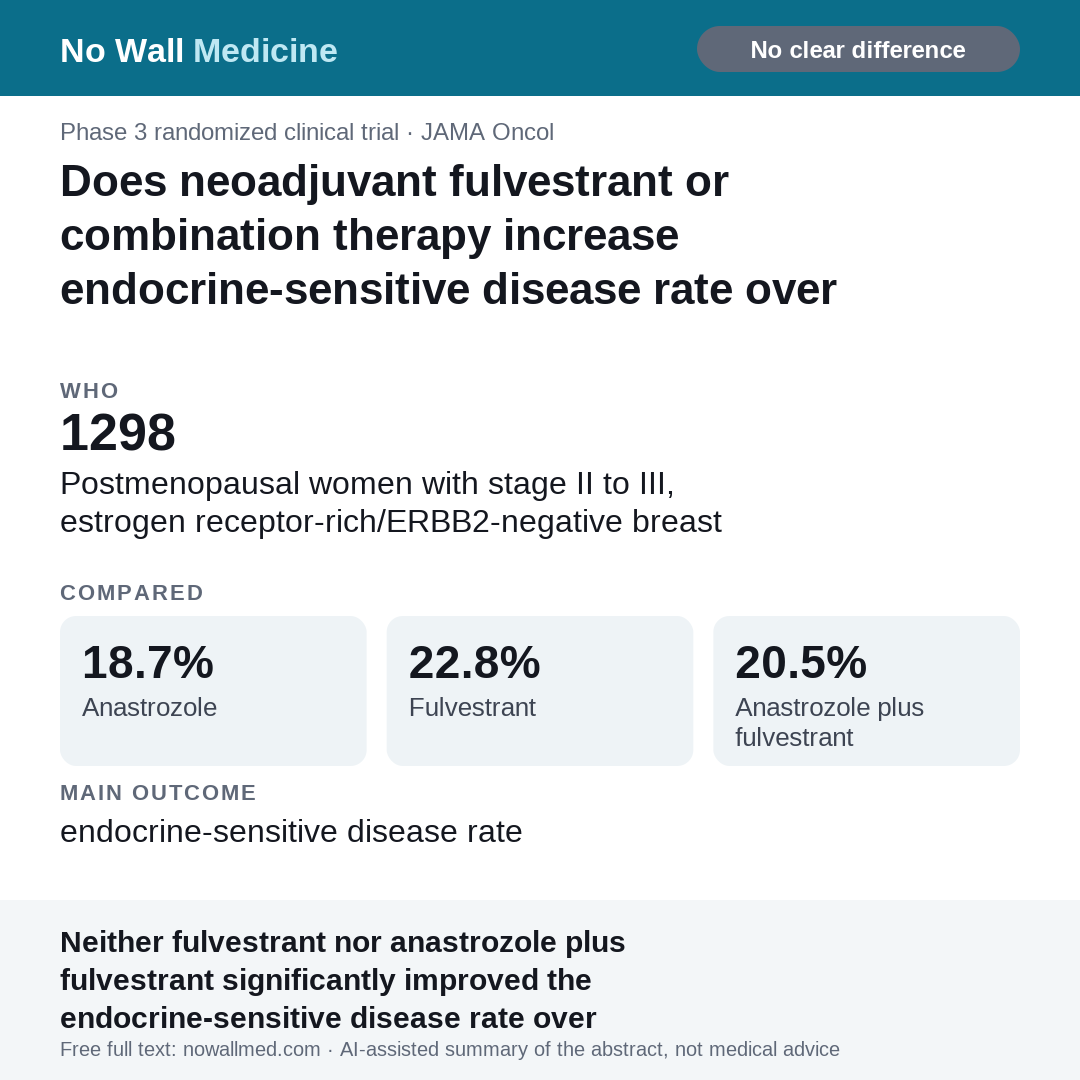
Does neoadjuvant fulvestrant or combination therapy increase endocrine-sensitive disease rate over anastrozole alone?
Who
1298
Postmenopausal women with stage II to III, estrogen receptor-rich/ERBB2-negative breast cancer
Compared
18.7%Anastrozole (95% CI, 15.1%-22.7%)
22.8%Fulvestrant (95% CI, 18.9%-27.1%)
20.5%Anastrozole plus fulvestrant (95% CI, 16.8%-24.6%)
Main outcome
endocrine-sensitive disease rate
Bottom line: Neither fulvestrant nor anastrozole plus fulvestrant significantly improved the endocrine-sensitive disease rate over anastrozole alone.
Limitation: Differential response by PAM50 subtype in exploratory analyses warrants further investigation.
JAMA Oncol · 2024-01-18Download image
Clinical question: Does neoadjuvant fulvestrant or combination therapy increase endocrine-sensitive disease rate over anastrozole alone?
Why it matters: It was unknown if adding fulvestrant to anastrozole improves the rate of endocrine-sensitive disease in patients with early-stage, estrogen receptor-rich breast cancer.
Key points
- The trial studied 1298 postmenopausal women with stage II to III estrogen receptor-rich/HER2-negative breast cancer receiving anastrozole, fulvestrant, or a combination for 6 months.
- The endocrine-sensitive disease rate was 18.7% for anastrozole, 22.8% for fulvestrant, and 20.5% for the combination, showing no significant improvement over anastrozole alone.
- In luminal B tumors, the combination led to a greater week 4 Ki67 suppression, a marker of cell proliferation, compared to anastrozole alone.
Headline and key points written with AI from the paper’s abstract, with every number checked against it. Read the paper before relying on them.
Topics
Cite this article
Ma CX, Suman VJ, Sanati S, Vij K, Anurag M, Leitch AM. Endocrine-Sensitive Disease Rate in Postmenopausal Patients With Estrogen Receptor-Rich/ERBB2-Negative Breast Cancer Receiving Neoadjuvant Anastrozole, Fulvestrant, or Their Combination: A Phase 3 Randomized Clinical Trial. JAMA Oncol. 2024. doi:10.1001/jamaoncol.2023.6038
Spotted a mistake? Suggest a correction
Top studies every Monday
The week’s key trials and guidelines in your specialties, plus any topics you follow. By email, free.
Get the weekly digest