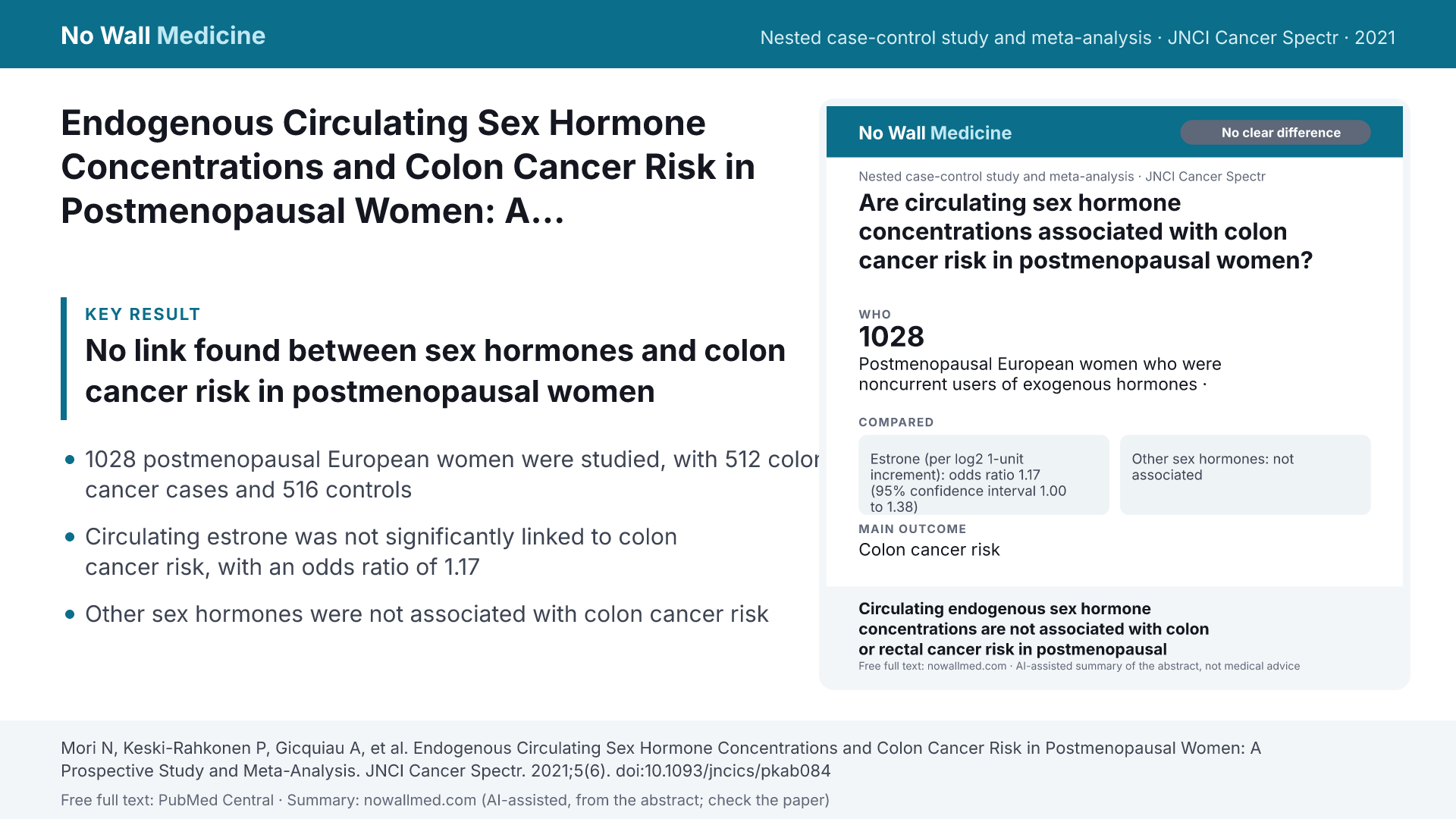
Endogenous Circulating Sex Hormone Concentrations and Colon Cancer Risk in Postmenopausal Women: A Prospective Study and Meta-Analysis
Key result: No link found between sex hormones and colon cancer risk in postmenopausal women
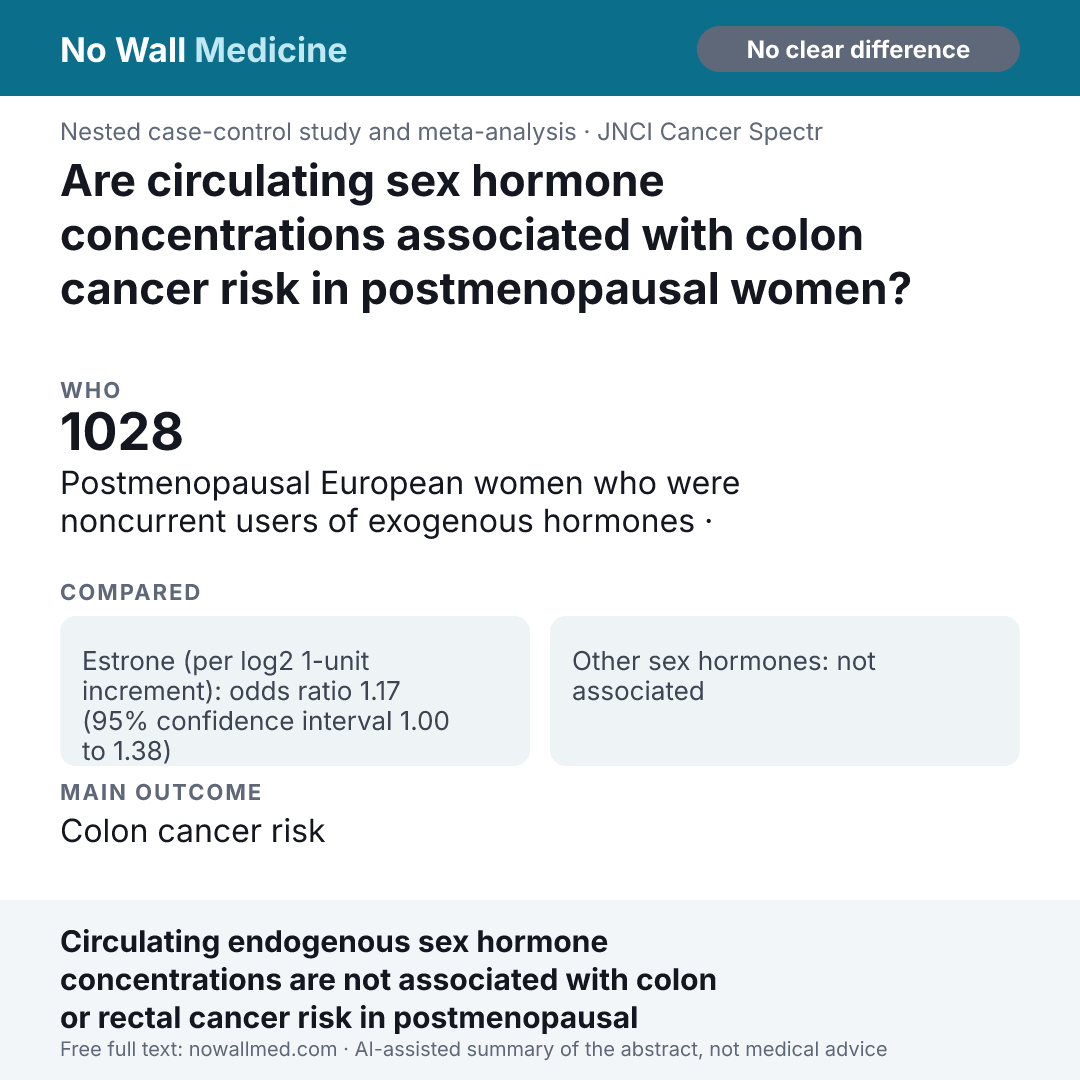
Nested case-control study and meta-analysisNo clear difference
Are circulating sex hormone concentrations associated with colon cancer risk in postmenopausal women?
Who
1028
Postmenopausal European women who were noncurrent users of exogenous hormones · Europe
Compared
Estrone (per log2 1-unit increment): odds ratio 1.17 (95% confidence interval 1.00 to 1.38)
Other sex hormones: not associated
Main outcome
Colon cancer risk
Bottom line: Circulating endogenous sex hormone concentrations are not associated with colon or rectal cancer risk in postmenopausal women.
JNCI Cancer Spectr · 2021-09-28 · Save PNG
Key points
- 1028 postmenopausal European women were studied, with 512 colon cancer cases and 516 controls.
- Circulating estrone was not significantly linked to colon cancer risk, with an odds ratio of 1.17.
- Other sex hormones were not associated with colon cancer risk.
Why it matters: Epidemiologic studies had reported inconsistent results on endogenous sex hormones and colon cancer
Limitation the authors note: The study had an observational design
Discussion prompts
- Would these patients look like yours? Who was left out?
- Is the main outcome one that matters to patients?
- Is the difference large enough to change what you do?
Cite: Mori N, Keski-Rahkonen P, Gicquiau A, et al. Endogenous Circulating Sex Hormone Concentrations and Colon Cancer Risk in Postmenopausal Women: A Prospective Study and Meta-Analysis. JNCI Cancer Spectr. 2021;5(6). doi:10.1093/jncics/pkab084
Free full text: PubMed Central · Summary and visual abstract: nowallmed.com/a/endogenous-circulating-sex-hormone-concentrations-and-colon-cancer-jpb6bb/ (AI-assisted from the abstract; check the paper before relying on it).