Endolymphatic duct blockage was not more effective than sac decompression for Ménière's disease
Endolymphatic duct blockage for Ménière's disease: a double-blind, randomised controlled trial
Double-blind, randomised, multicentre trialNo clear difference
Is endolymphatic duct blockage more effective than endolymphatic sac decompression for Ménière's disease?
Who
75
Patients with unilateral, active Ménière's disease despite corticosteroid injections · Seven hospitals in the Netherlands
Compared
Endolymphatic duct blockage: 23/39 (59%)
Endolymphatic sac decompression: 24/36 (67%)
Main outcome
Freedom from vertigo attacks at 12 months
Result: OR 0.72, 95% CI 0.28-1.84
Bottom line: Endolymphatic duct blockage did not demonstrate a benefit over endolymphatic sac decompression for refractory Ménière's disease.
Funded by: Dutch National Healthcare Institute and ZonMw
Lancet Reg Health Eur · 2026-07-06Download image
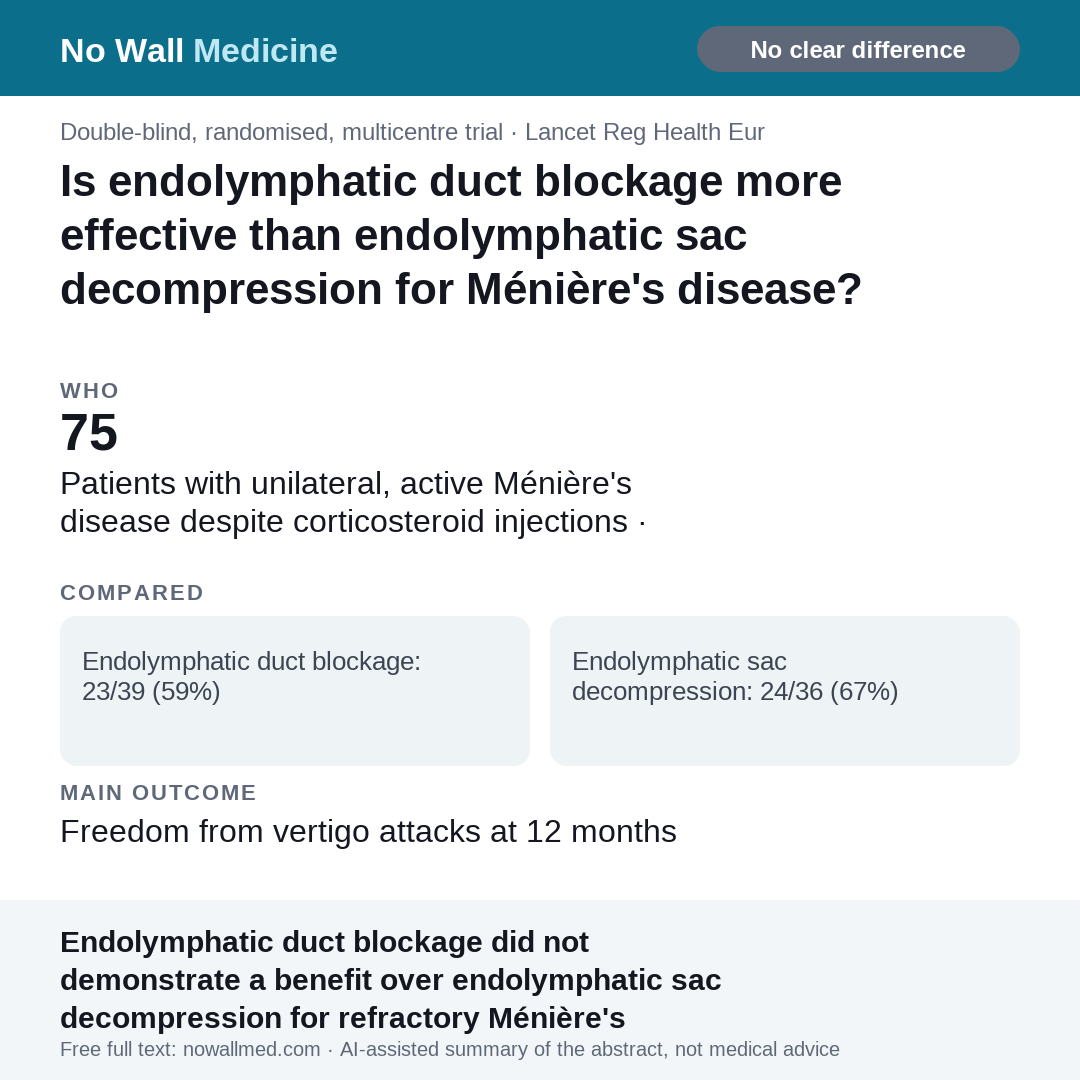
Clinical question: Is endolymphatic duct blockage more effective than endolymphatic sac decompression for Ménière's disease?
Why it matters: A double-blind trial was lacking to determine if blocking the endolymphatic duct is more effective than sac decompression for patients with intractable Ménière's disease.
Key points
- Researchers studied 75 patients with Ménière's disease, comparing endolymphatic duct blockage to endolymphatic sac decompression over one year.
- At 12 months, 59% of the duct blockage group and 67% of the sac decompression group were free from vertigo attacks.
- Secondary outcomes including quality of life, dizziness, tinnitus, and hearing function showed no difference between the two surgical groups.
Headline and key points written with AI from the paper’s abstract, with every number checked against it. Read the paper before relying on them.
Spotted a mistake? Suggest a correction