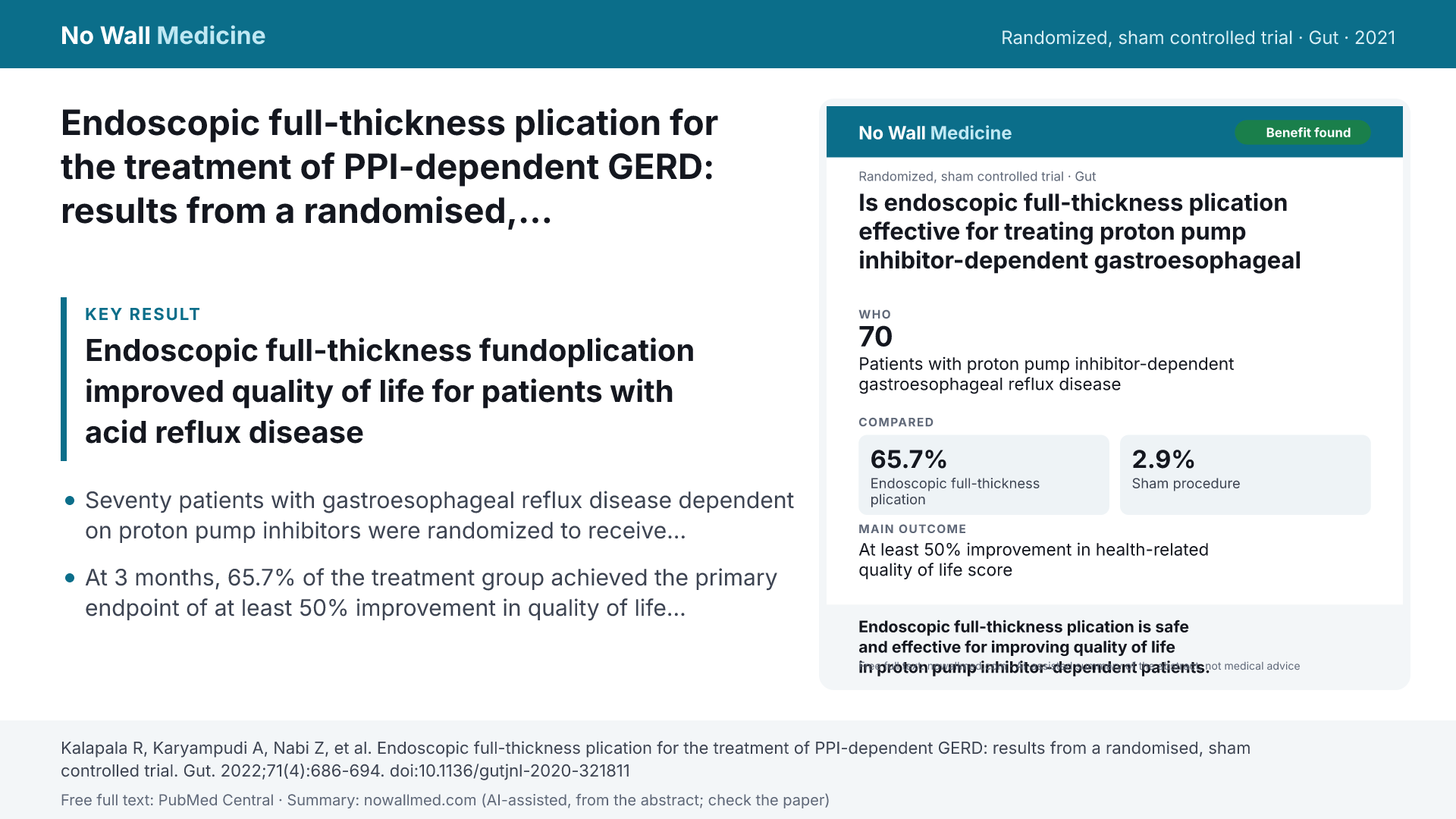
Endoscopic full-thickness fundoplication improved quality of life for patients with acid reflux disease
Endoscopic full-thickness plication for the treatment of PPI-dependent GERD: results from a randomised, sham controlled trial
Randomized, sham controlled trialBenefit found
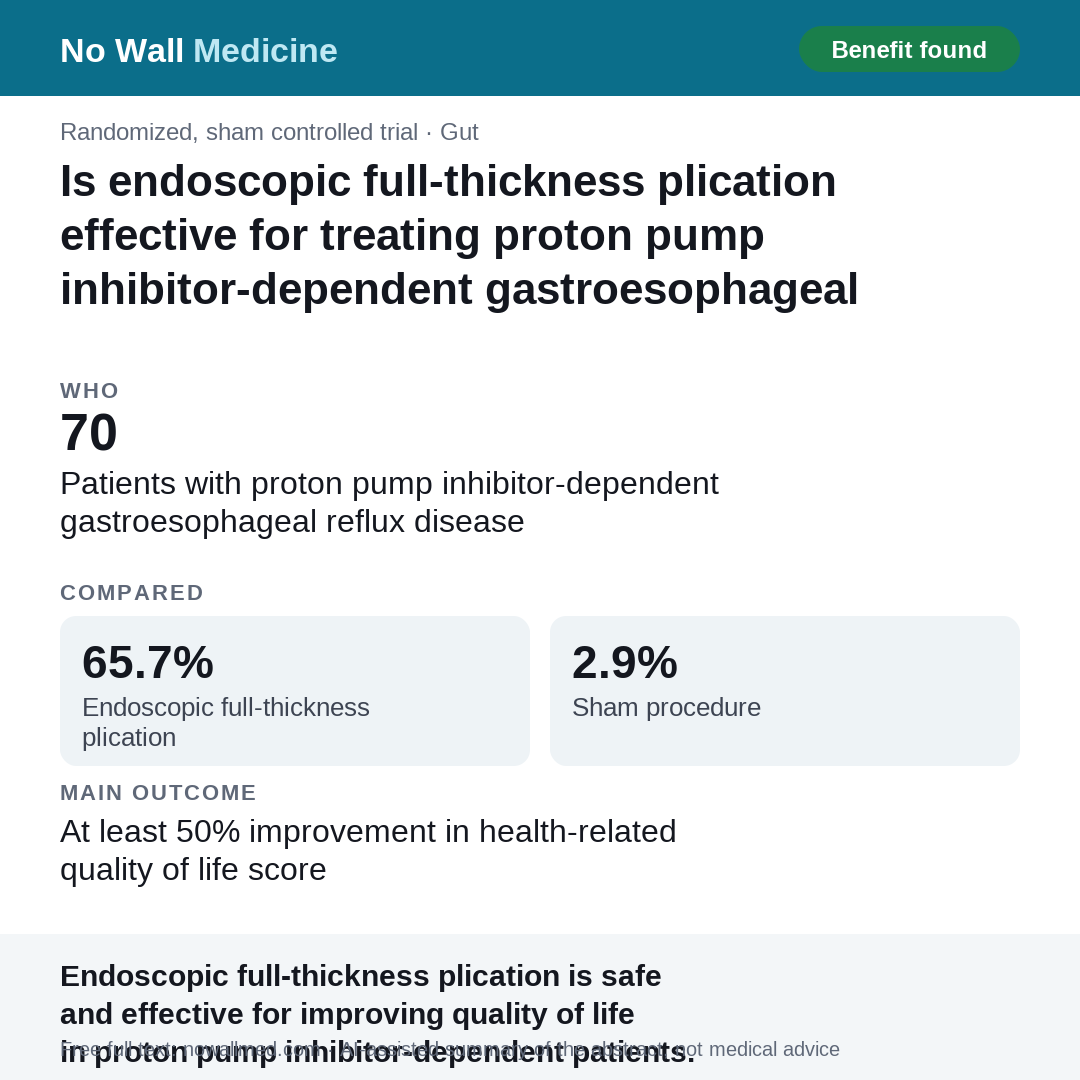
Is endoscopic full-thickness plication effective for treating proton pump inhibitor-dependent gastroesophageal reflux disease?
Who
70
Patients with proton pump inhibitor-dependent gastroesophageal reflux disease
Compared
65.7%Endoscopic full-thickness plication
2.9%Sham procedure
Main outcome
At least 50% improvement in health-related quality of life score
Bottom line: Endoscopic full-thickness plication is safe and effective for improving quality of life in proton pump inhibitor-dependent patients.
Limitation: Objective parameters showed a limited response rate.
Gut · 2021-04-13Download image
Clinical question: Is endoscopic full-thickness plication effective for treating proton pump inhibitor-dependent gastroesophageal reflux disease?
Why it matters: Long-term data are sparse regarding the efficacy and safety of easy-to-use endoscopic antireflux procedures for gastroesophageal reflux disease.
Key points
- Seventy patients with gastroesophageal reflux disease dependent on proton pump inhibitors were randomized to receive either endoscopic full-thickness fundoplication or a sham procedure.
- At 3 months, 65.7% of the treatment group achieved the primary endpoint of at least 50% improvement in quality of life scores compared to 2.9% in the sham group.
- By 12 months, 62.8% of patients in the treatment group were off proton pump inhibitor medication compared to 11.4% in the sham group.
Headline and key points written with AI from the paper’s abstract, with every number checked against it. Read the paper before relying on them.
Was this summary helpful?
Abstract
Background
The majority of endoscopic antireflux procedures for GERD are cumbersome to use and randomised long-term data are sparse. We conducted such a trial to determine the efficacy and safety of a novel, easy to use endoscopic full-thickness fundoplication (EFTP) device in patients with GERD. Design
Patients with proton pump inhibitor (PPI)-dependent GERD were randomised to either EFTP or a sham procedure in 1:1 ratio. The primary endpoint was ≥50% improvement in the health-related quality of life (GERD-HRQL) score at 3 months. Secondary end points included improvement in GERD-HRQL, reflux symptom scores, PPI usage, oesophageal acid exposure and reflux episodes and endoscopic findings at 3, 6 and 12 months. Results
Seventy patients were randomised; 35 in each group with a median (IQR) age of 36 (29-42) years, 71.4% males. 70% had non-erosive reflux disease on endoscopy with a mean DeMeester score of 18.9 (±19.93). The mean (±SD) duration of EFTP procedure was 17.4 (±4) min. The primary end point was more frequently achieved in the EFTP group (65.7% vs 2.9%; p<0.001). Median (IQR) % improvement in GERD-HRQL was significantly higher in the EFTP group at 6 (81.4 (60.9-100.0) versus 8.0 (2.2-21.6); p<0.001) and 12 (92.3 (84.4-100.0) versus 9.1 (4.8-36.0); p<0.001) months. In the EFTP group, 62.8% patients were off-PPI at 12 months compared with 11.4% in the sham group (p<0.001). pH-metry parameters partially improved at 3 months, (n=70; total reflux episodes in EFTP arm and non-acid reflux episodes for EFTP vs sham) but not at 12 months (n=27); endoscopic oesophagitis was seen in 0% in the treatment (n=18) and 5 (29.4%) in the control group (n=17) at 12 months. No major procedure-related adverse events were encountered in either group. Conclusion
EFTP using a novel device is safe and effective in improving quality of life in patients with PPI dependent mostly non-erosive reflux disease at short and long terms; objective parameters showed a limited response rate. Trial registration number
NCT03322553.
Abstract reproduced under the article’s CC BY NC licence.
Subject terms
Cite this article
Kalapala R, Karyampudi A, Nabi Z, et al. Endoscopic full-thickness plication for the treatment of PPI-dependent GERD: results from a randomised, sham controlled trial. Gut. 2021. doi:10.1136/gutjnl-2020-321811
Spotted a mistake? Suggest a correction