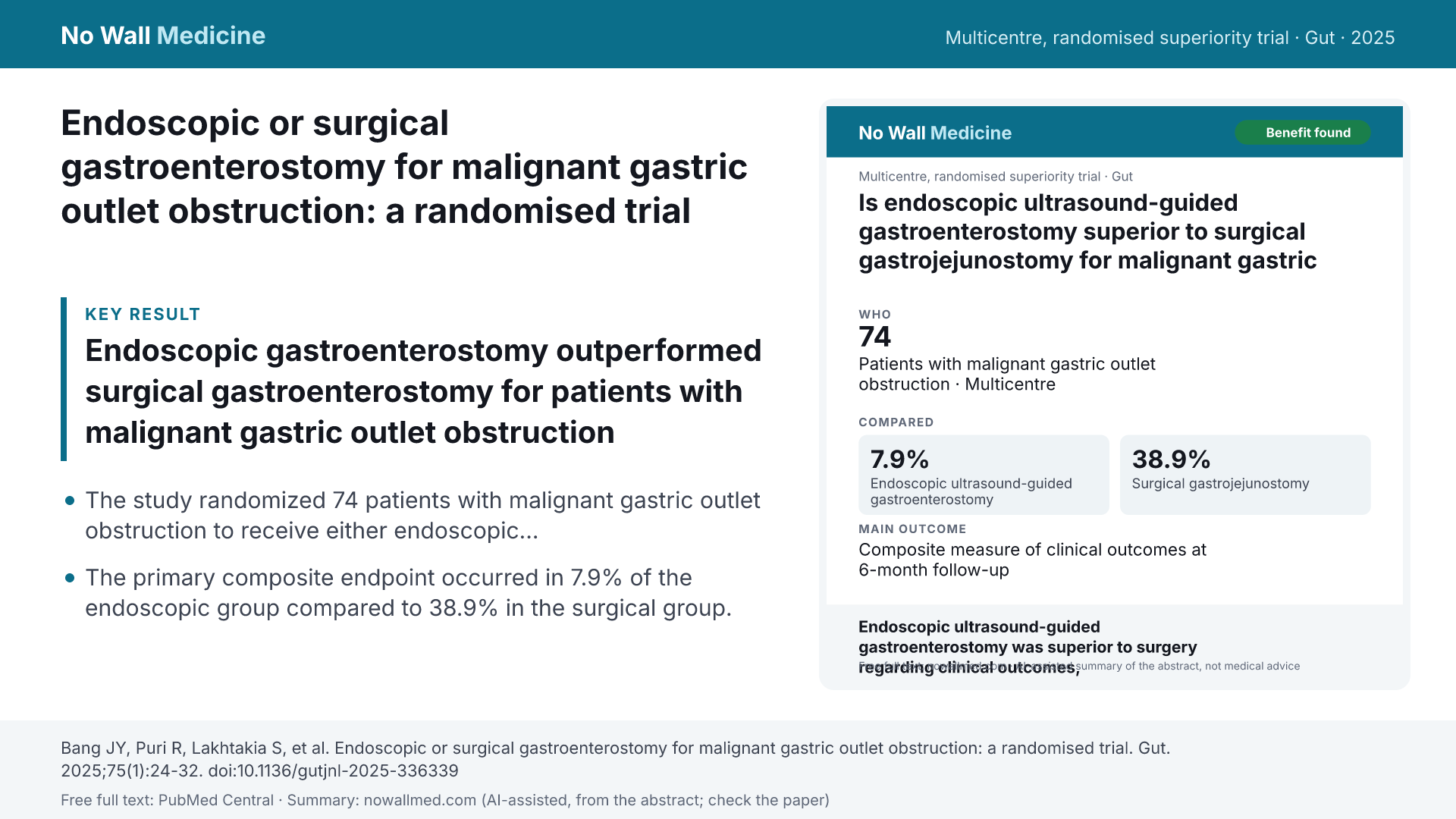
Endoscopic gastroenterostomy outperformed surgical gastroenterostomy for patients with malignant gastric outlet obstruction
Endoscopic or surgical gastroenterostomy for malignant gastric outlet obstruction: a randomised trial
Multicentre, randomised superiority trialBenefit found
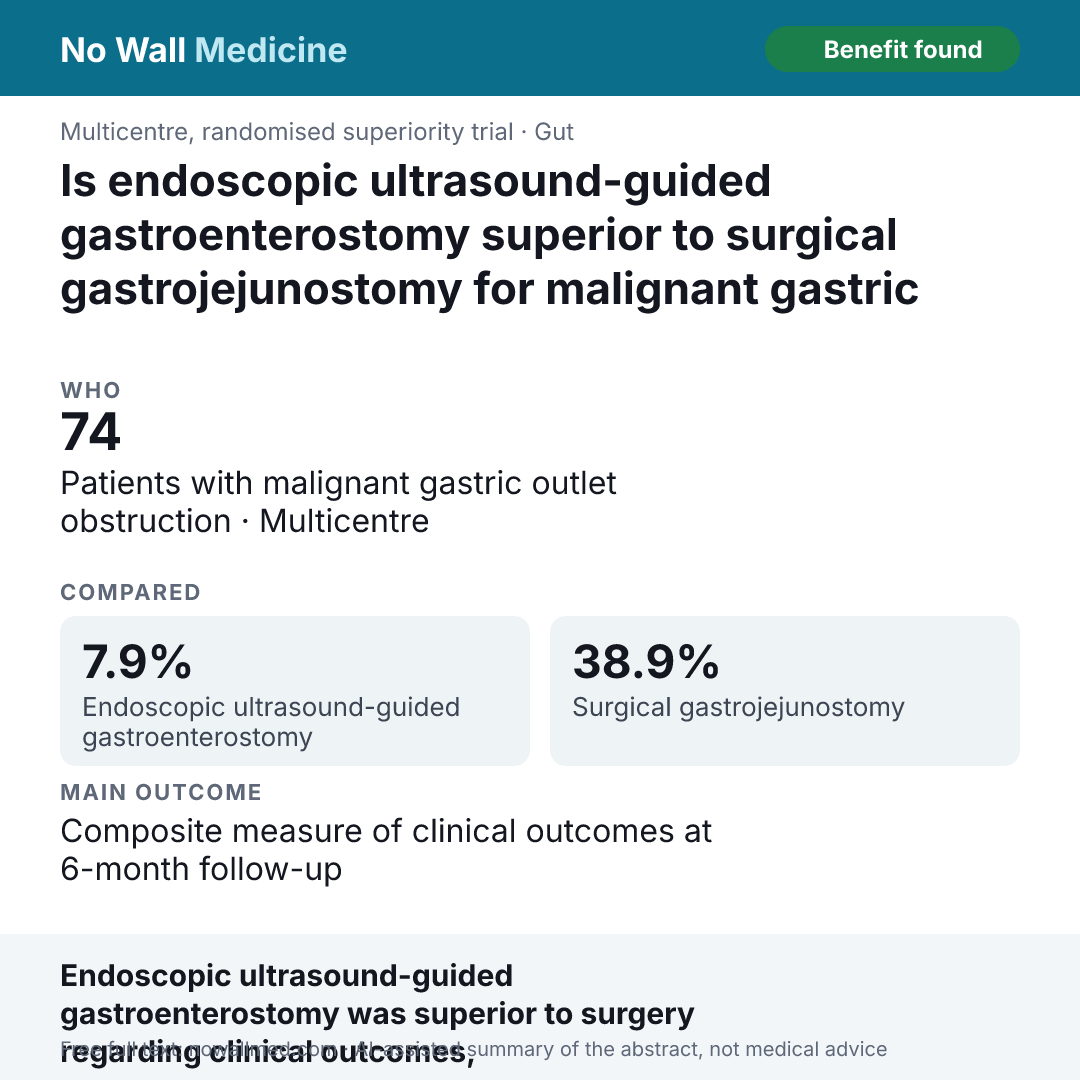
Is endoscopic ultrasound-guided gastroenterostomy superior to surgical gastrojejunostomy for malignant gastric outlet obstruction?
Who
74
Patients with malignant gastric outlet obstruction · Multicentre
Compared
7.9%Endoscopic ultrasound-guided gastroenterostomy
38.9%Surgical gastrojejunostomy
Main outcome
Composite measure of clinical outcomes at 6-month follow-up
Result: risk difference -31.0%, 95% CI -47.6% to -11.4%
Bottom line: Endoscopic ultrasound-guided gastroenterostomy was superior to surgery regarding clinical outcomes, hospitalisation, quality of life, and costs.
Gut · 2025-12-05 · Save PNG
Clinical question: Is endoscopic ultrasound-guided gastroenterostomy superior to surgical gastrojejunostomy for malignant gastric outlet obstruction?
Why it matters: Clinicians need to determine if the less invasive endoscopic ultrasound-guided gastroenterostomy provides better clinical outcomes than the standard surgical gastrojejunostomy for gastric outlet obstruction.
Key points
- The study randomized 74 patients with malignant gastric outlet obstruction to receive either endoscopic ultrasound-guided gastroenterostomy or surgical gastrojejunostomy.
- The primary composite endpoint occurred in 7.9% of the endoscopic group compared to 38.9% in the surgical group.
- Endoscopic treatment was associated with a median hospital stay of 3 days versus 9 days for surgery and lower treatment costs.
Headline and key points written with AI from the paper’s abstract, with every number checked against it. Read the paper before relying on them.
Was this summary helpful?
Abstract
Background
Although surgical gastrojejunostomy (SGJ) is the standard method for palliation of gastric outlet obstruction (GOO), an endoscopic method-endoscopic ultrasound-guided gastroenterostomy (EUS-GE)-has been proposed as a novel, less invasive approach. Objective
We compared both methods to determine whether clinical outcomes for EUS-GE are superior to surgery. Design
We conducted a multicentre, randomised superiority trial of patients with malignant GOO to receive either EUS-GE or SGJ. Primary endpoint was composite measure, consisting of Gastric Outlet Obstruction Scoring System (GOOSS) score of 0 or 1 at hospital discharge, need for reinterventions or supplemental nutrition, or procedure-related adverse events during 6-month follow-up or until death. Secondary endpoints were time to solid diet, length of hospitalisation, health-related quality of life (HRQoL) and treatment costs. Results
74 patients were randomly assigned to EUS-GE (38 patients) or SGJ (36 patients). Primary endpoint occurred in 7.9% of patients who received EUS-GE and 38.9% in SGJ (risk difference -31.0%, 95% CI -47.6% to -11.4%, p=0.002). EUS-GE was associated with more rapid advancement to solid diet (median 2 days (P25-P75, 2-3) vs 5 days (P25-P75, 3.5-9)), shorter hospitalisation (median 3 days (P25-P75, 3-6) vs 9 days (P25-P75, 6-12.5)), better HRQoL for physical (p=0.0016) and social functioning (p=0.011) and lower treatment costs (US$33 934 vs US$51 437, difference -US$17 503 (95% CI -US$27 807 to -US$7920)). Conclusion
In this randomised trial, EUS-GE was superior to SGJ with regards to oral intake, need for reinterventions or supplemental nutrition, length of hospitalisation, quality of life and treatment costs. Trial registration number
NCT05548114.
Abstract reproduced under the article’s CC BY NC licence.
Subject terms
Headline, design, result, key points, caveat and citation as plain text.
Cite this article
Bang JY, Puri R, Lakhtakia S, et al. Endoscopic or surgical gastroenterostomy for malignant gastric outlet obstruction: a randomised trial. Gut. 2025;75(1):24-32. doi:10.1136/gutjnl-2025-336339
Spotted a mistake? Suggest a correction