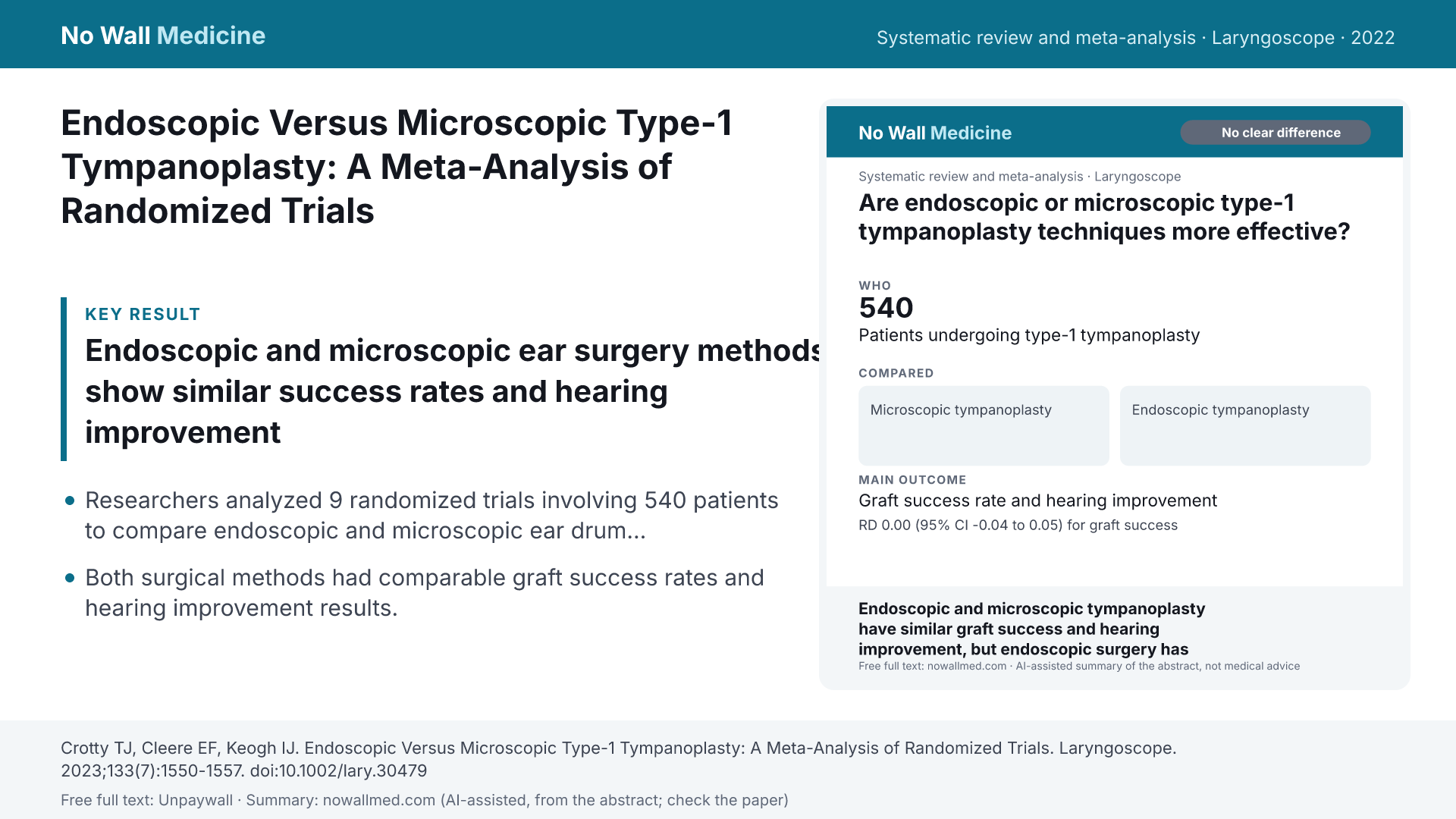
Endoscopic and microscopic ear surgery methods show similar success rates and hearing improvement
Endoscopic Versus Microscopic Type-1 Tympanoplasty: A Meta-Analysis of Randomized Trials
Systematic review and meta-analysisNo clear difference
Are endoscopic or microscopic type-1 tympanoplasty techniques more effective?
Who
540
Patients undergoing type-1 tympanoplasty
Compared
Microscopic tympanoplasty
Endoscopic tympanoplasty
Main outcome
Graft success rate and hearing improvement
Result: RD 0.00 (95% CI -0.04 to 0.05) for graft success
Bottom line: Endoscopic and microscopic tympanoplasty have similar graft success and hearing improvement, but endoscopic surgery has shorter operative time.
Laryngoscope · 2022-11-09Download image
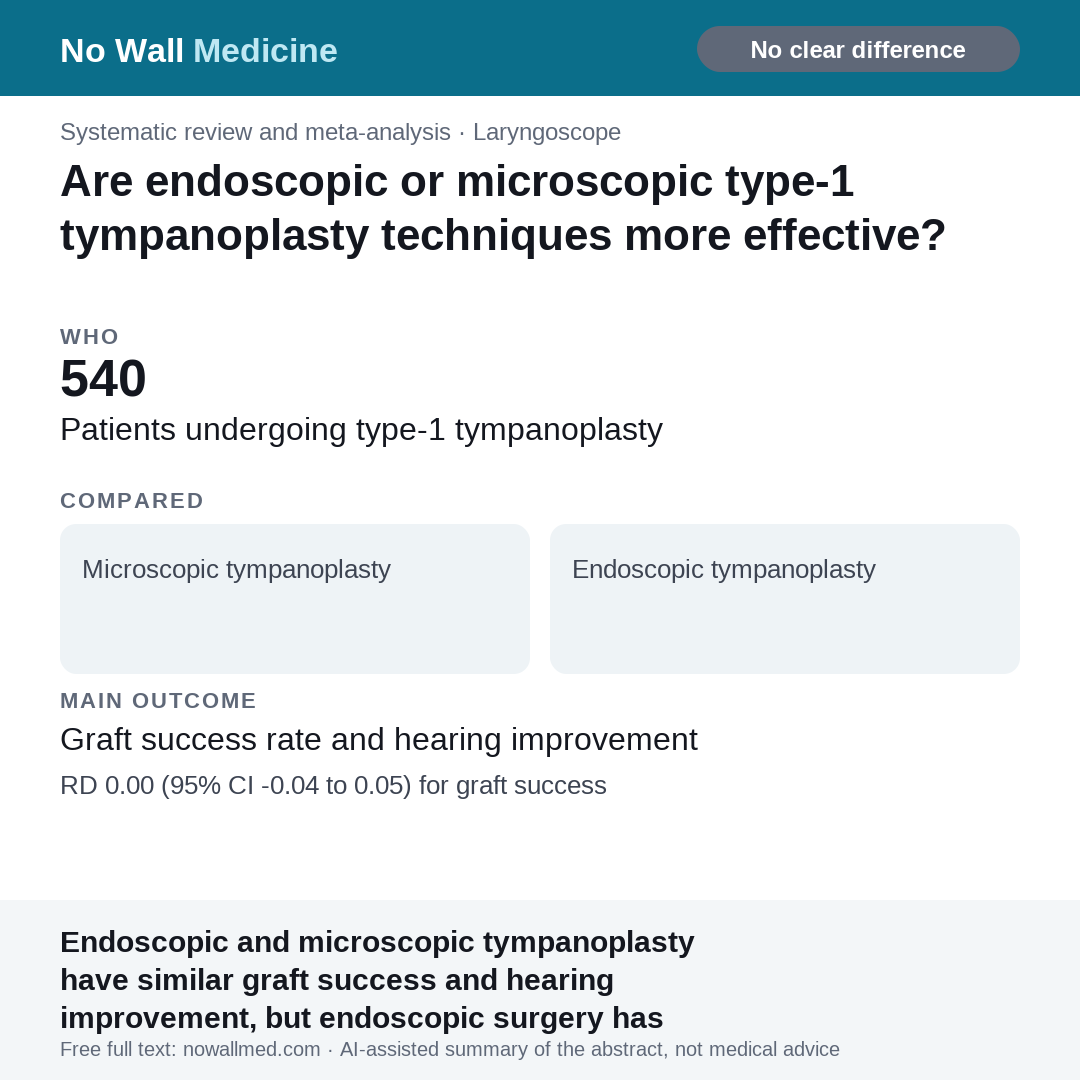
Clinical question: Are endoscopic or microscopic type-1 tympanoplasty techniques more effective?
Key points
- Researchers analyzed 9 randomized trials involving 540 patients to compare endoscopic and microscopic ear drum repair techniques.
- Both surgical methods had comparable graft success rates and hearing improvement results.
- The endoscopic approach was associated with a significantly shorter operative time by a mean difference of -24.73 min.
Headline and key points written with AI from the paper’s abstract, with every number checked against it. Read the paper before relying on them.
Was this summary helpful?
Abstract
Objectives
Totally endoscopic ear surgery is becoming increasingly utilized in otologic practice. Although the well-established microscope-assisted tympanoplasty remains the most common technique to repair a tympanic membrane defect, the merits of endoscopic approaches have been well-documented. This systematic review and meta-analysis compares the outcomes of endoscopic to microscopic tympanoplasty incorporating only randomized trials.Study design
Systematic review and meta-analysis.Methods
A comprehensive search of PubMed/MEDLINE, Scopus, Cochrane Library, and EMBASE was conducted. All randomized studies comparing endoscopic to microscopic tympanoplasty were collected according to the Preferred Reporting Items for Systematic Reviews and Meta-Analysis guidelines. Quality assessment was carried out utilizing the Risk of Bias 2.Results
The initial search identified 1711 studies, of which 9 met the inclusion criteria comprising of 540 patients (microscopic tympanoplasty 51.5%; endoscopic tympanoplasty 49.5%). The mean age was 32.5 years with a similar number of males (50.1%) and females (49.9%). Both endoscopic and microscopic groups had comparable outcomes with regards to graft success rate (RD 0.00; 95% confidence interval [CI], -0.04 to. 0.05; p = 0.87) and hearing improvement (MD 0.57 dB; 95% CI, -1.23 to 2.36; p = 0.54). A significantly shorter operative time was noted in the endoscopic group (MD, -24.73 min; 95% CI, -38.56 to -10.89; p = 0.0005).Conclusion
Our results, assimilating level 1 evidence, demonstrates that endoscopic and microscopic-assisted type-1 tympanoplasty have similar outcomes in both graft success and hearing improvement, with endoscopic approaches yielding a shorter operative time.Level of evidence
1 Laryngoscope, 133:1550-1557, 2023.
Abstract reproduced under the article’s CC BY-NC-ND licence.
Subject terms
Cite this article
Crotty TJ, Cleere EF, Keogh IJ. Endoscopic Versus Microscopic Type-1 Tympanoplasty: A Meta-Analysis of Randomized Trials. Laryngoscope. 2022. doi:10.1002/lary.30479
Spotted a mistake? Suggest a correction