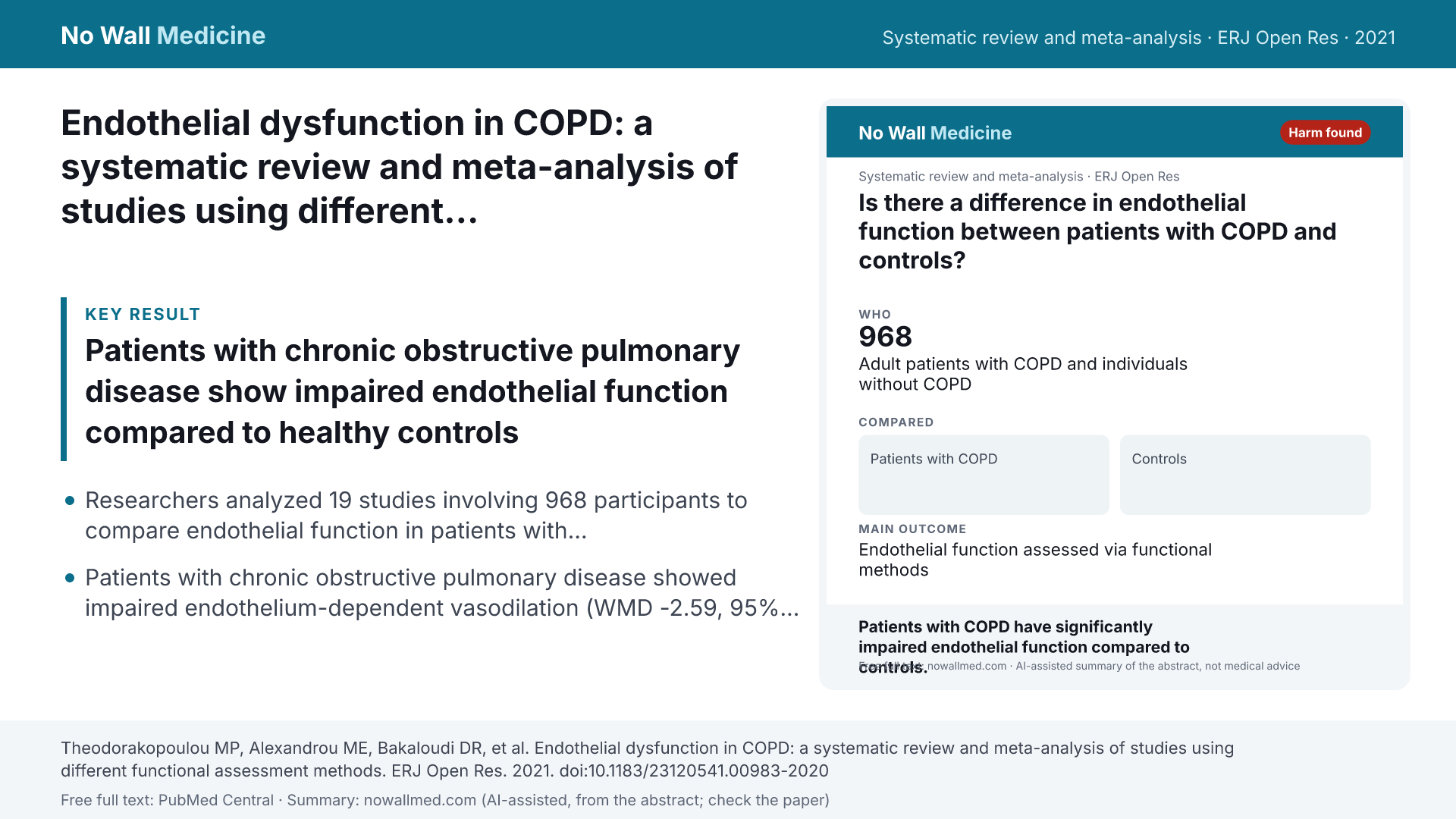
Endothelial dysfunction in COPD: a systematic review and meta-analysis of studies using different functional assessment methods
Key result: Patients with chronic obstructive pulmonary disease show impaired endothelial function compared to healthy controls
Systematic review and meta-analysisHarm found
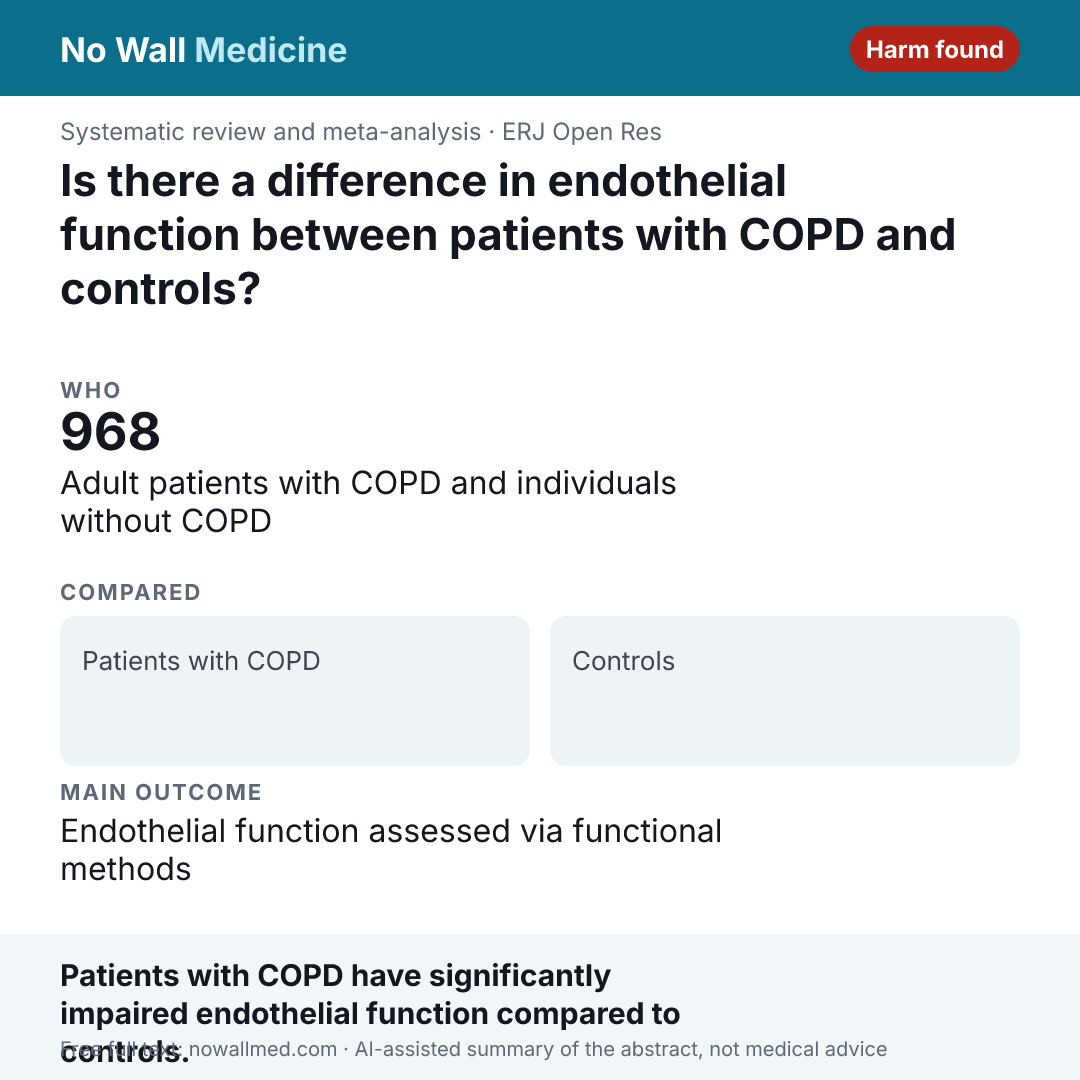
Is there a difference in endothelial function between patients with COPD and controls?
Who
968
Adult patients with COPD and individuals without COPD
Compared
Patients with COPD
Controls
Main outcome
Endothelial function assessed via functional methods
Result: standardised mean difference -1.19 (95% CI -1.69 to -0.68)
Bottom line: Patients with COPD have significantly impaired endothelial function compared to controls.
ERJ Open Res · 2021-06-28 · Save PNG
Key points
- Researchers analyzed 19 studies involving 968 participants to compare endothelial function in patients with chronic obstructive pulmonary disease and healthy controls.
- Patients with chronic obstructive pulmonary disease showed impaired endothelium-dependent vasodilation (WMD -2.59, 95% CI -3.75 to -1.42) and endothelium-independent vasodilation (WMD -3.13, 95% CI -5.18 to -1.09).
- The difference in endothelial function was larger when comparing patients with chronic obstructive pulmonary disease to nonsmoking controls (SMD -1.75, 95% CI -2.58 to -0.92).
Discussion prompts
- Would these patients look like yours? Who was left out?
- Is the main outcome one that matters to patients?
- Is the difference large enough to change what you do?
Cite: Theodorakopoulou MP, Alexandrou ME, Bakaloudi DR, et al. Endothelial dysfunction in COPD: a systematic review and meta-analysis of studies using different functional assessment methods. ERJ Open Res. 2021. doi:10.1183/23120541.00983-2020
Free full text: PubMed Central · Summary and visual abstract: nowallmed.com/a/endothelial-dysfunction-in-copd-a-systematic-review-and-meta-analysis-1w2yw4t/ (AI-assisted from the abstract; check the paper before relying on it).