Endovascular therapy for superior vena cava syndrome: A systematic review and meta-analysis
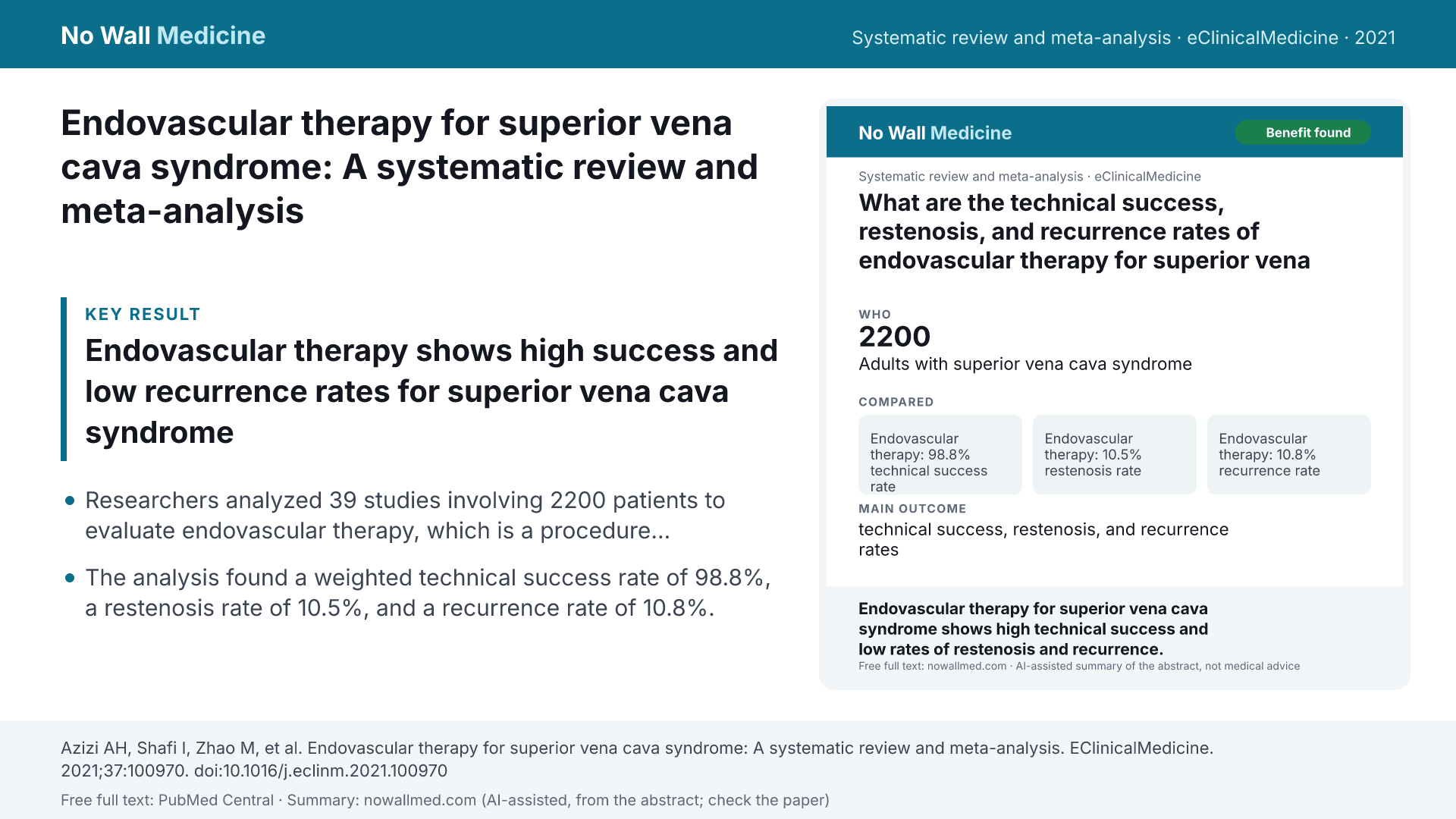
Key result: Endovascular therapy shows high success and low recurrence rates for superior vena cava syndrome
Systematic review and meta-analysisBenefit found
What are the technical success, restenosis, and recurrence rates of endovascular therapy for superior vena cava syndrome?
Who
2200
Adults with superior vena cava syndrome
Compared
Endovascular therapy: 98.8% technical success rate
Endovascular therapy: 10.5% restenosis rate
Endovascular therapy: 10.8% recurrence rate
Main outcome
technical success, restenosis, and recurrence rates
Bottom line: Endovascular therapy for superior vena cava syndrome shows high technical success and low rates of restenosis and recurrence.
eClinicalMedicine · 2021-06-28
Key points
- Researchers analyzed 39 studies involving 2200 patients to evaluate endovascular therapy, which is a procedure using catheters and stents to treat blocked veins.
- The analysis found a weighted technical success rate of 98.8%, a restenosis rate of 10.5%, and a recurrence rate of 10.8%.
- The total complication rate was 8.6% with a mean complication rate of 7.5% among the studied patients.
Why it matters: The effectiveness, technical success, and recurrence rates of endovascular therapy for superior vena cava syndrome required systematic evaluation.
Discussion prompts
- Would these patients look like yours? Who was left out?
- Is the main outcome one that matters to patients?
- Is the difference large enough to change what you do?
Cite: Azizi AH, Shafi I, Zhao M, et al. Endovascular therapy for superior vena cava syndrome: A systematic review and meta-analysis. EClinicalMedicine. 2021;37:100970. doi:10.1016/j.eclinm.2021.100970
Free full text: PubMed Central · Summary and visual abstract: nowallmed.com/a/endovascular-therapy-for-superior-vena-cava-syndrome-a-systematic-j6r04z/ (AI-assisted from the abstract; check the paper before relying on it).