Mechanical clot removal is associated with better outcomes in acute stroke with large ischemic cores
Endovascular thrombectomy in acute stroke with a large ischemic core: A systematic review and meta-analysis of randomized controlled trials
Meta-analysis of 6 randomized controlled trialsBenefit found
Does endovascular thrombectomy plus medical care improve outcomes versus medical care alone in large ischemic core stroke?
Who
1870
Nondisabled patients with acute stroke and large ischemic core
Compared
Endovascular thrombectomy plus medical care
Medical care alone
Main outcome
Functional independence at 90 days post-stroke
Result: risk ratio 2.53 (95% CI 1.95 to 3.29)
Bottom line: Endovascular thrombectomy plus medical care improves functional independence and reduces disability in acute stroke with large ischemic cores.
Limitation: Variability in imaging definitions of large core and inclusion of both larger moderate and large cores.
PLOS Med · 2025-04-17Download image
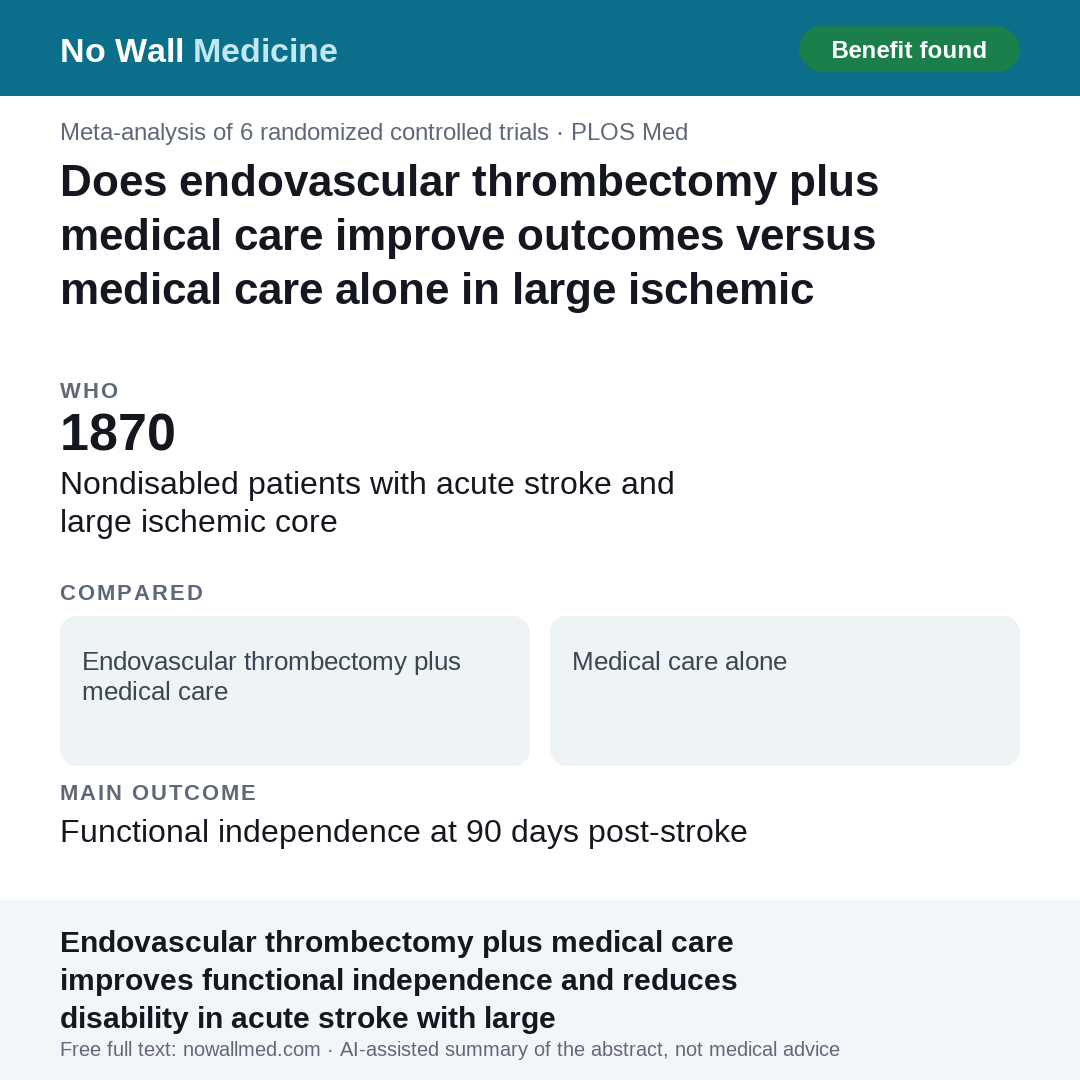
Clinical question: Does endovascular thrombectomy plus medical care improve outcomes versus medical care alone in large ischemic core stroke?
Why it matters: The effect of endovascular thrombectomy on patients with acute stroke and a large ischemic core remains unclear.
Key points
- Researchers analyzed six randomized controlled trials involving 1870 patients with acute stroke and large ischemic cores from internal carotid or middle cerebral artery occlusions.
- Endovascular thrombectomy, or mechanical clot removal, plus medical care was associated with greater functional independence (RR 2.53) and reduced disability (common odds ratio 1.63) at 90 days.
- The treatment was associated with a lower risk of requiring constant care or death (RR 0.74), though death rates were not significantly different between groups (RR 0.86).
Limitation the authors note: The authors noted variability in imaging definitions of large core and the inclusion of both larger moderate and large cores in the analysis.
Headline and key points written with AI from the paper’s abstract, with every number checked against it. Read the paper before relying on them.
Topics
Cite this article
Lin CH, Lee M, Ovbiagele B, Liebeskind DS, Sanz-Cuesta B, Saver JL. Endovascular thrombectomy in acute stroke with a large ischemic core: A systematic review and meta-analysis of randomized controlled trials. PLOS Med. 2025. doi:10.1371/journal.pmed.1004484
Spotted a mistake? Suggest a correction
Top studies every Monday
The week’s key trials and guidelines in your specialties, plus any topics you follow. By email, free.
Get the weekly digest