Endovascular treatment shows no difference in disability or death for medium or distal vessel stroke
Endovascular treatment for medium or distal vessel occlusion stroke (DISTAL): 12-month outcomes of a multicentre, open-label, randomised trial
Open-label, randomised trial with blinded endpoint assessmentNo clear difference
Does endovascular treatment plus medical treatment improve 12-month outcomes in medium or distal vessel occlusion stroke?
Who
543
Adults with acute ischaemic stroke due to medium or distal vessel occlusion · 55 hospitals in Europe and the Middle East
Compared
Endovascular treatment plus best medical treatment: median mRS score 2 (IQR 1-4)
Best medical treatment alone: median mRS score 2 (1-4)
Main outcome
Disability measured by ordinal modified Rankin Scale at 12 months
Result: adjusted common odds ratio 0·81 (95% CI 0·59-1·12)
Bottom line: Endovascular treatment plus medical treatment did not reduce disability or death at 12 months compared to medical treatment alone.
Funded by: Swiss National Science Foundation and others
Lancet Neurol · 2026-05-06Download image
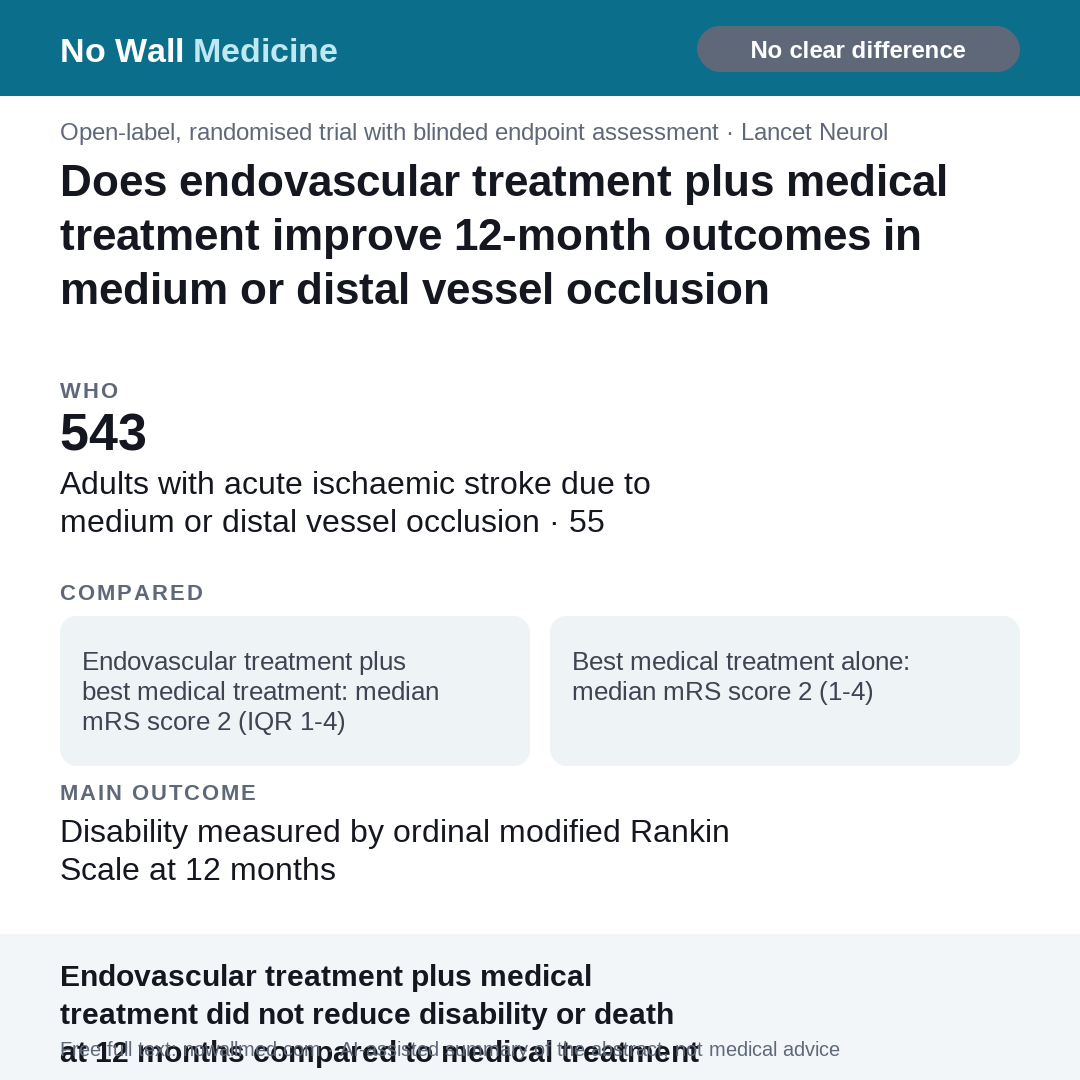
Clinical question: Does endovascular treatment plus medical treatment improve 12-month outcomes in medium or distal vessel occlusion stroke?
Why it matters: Long-term evidence for using endovascular treatment, or procedures to remove clots from vessels, in medium or distal vessel occlusion stroke is scarce.
Key points
- Researchers studied 543 adults with acute ischaemic stroke caused by medium or distal vessel occlusion across 55 hospitals.
- At 12 months, there was no difference in disability measured by the modified Rankin Scale between endovascular treatment plus medical care and medical treatment alone.
- Overall survival was similar between the endovascular treatment group and the best medical treatment alone group.
Headline and key points written with AI from the paper’s abstract, with every number checked against it. Read the paper before relying on them.
Abstract
Background
Long-term evidence for endovascular treatment in medium or distal vessel occlusion stroke is scarce. Three out of four randomised trials reported no benefit of endovascular treatment over best medical treatment at 90 days. We aimed to assess efficacy of endovascular treatment plus best medical treatment versus best medical treatment alone at 12 months in patients enrolled in the DISTAL trial, as well as overall survival. Methods
DISTAL was an open-label, randomised trial with blinded endpoint assessment conducted at 55 hospitals in Europe and the Middle East. Adults (≥18 years) with acute ischaemic stroke due to medium or distal vessel occlusion (occlusion of co-dominant or non-dominant M2 or M3-M4 middle cerebral artery, A1-A3 anterior cerebral artery, or P1-P3 posterior cerebral artery) presenting from home within 6 h of last known well, or between 6 h and 24 h if neuroimaging demonstrated potentially salvageable tissue, were randomly assigned (1:1) through a centralised web-based system to endovascular treatment plus best medical treatment or best medical treatment alone. The prespecified primary outcome at 12 months was disability measured by use of the ordinal modified Rankin Scale (mRS; scores 5 and 6 combined) in the intention-to-treat population. The only safety outcome was overall survival. The trial is registered on ClinicalTrials.gov (NCT05029414) and is completed. Findings
Between Dec 16, 2021, and July 10, 2024, we enrolled 553 patients. Ten patients declined post-hoc consent, leaving 543 participants in the analysis (239 [44%] females and 304 [56%] males; median age 77 years, IQR 68-84). 271 (50%) were assigned to endovascular treatment plus best medical treatment and 272 (50%) to best medical treatment alone. The median NIHSS score at admission was 6 (IQR 5-9); 355 (65%) participants received intravenous thrombolysis. Predominant occlusion locations were the M2 (239 [44%]), M3 (146 [27%]), P2 (73 [13%]), and P1 (30 [6%]) segments. 12-month data were available for 524 (97%) participants. The median mRS score was 2 (IQR 1-4) in the endovascular treatment plus best medical treatment group and 2 (1-4) in the best medical treatment alone group. There was no difference in 12-month mRS distribution between endovascular treatment plus best medical treatment and best medical treatment alone (adjusted common odds ratio for better functional outcome 0·81, 95% CI 0·59-1·12; p=0·20). Overall survival was similar between the two groups (hazard ratio 1·46, 95% CI 0·93-2·30; p=0·10). Interpretation
In patients with a medium or distal vessel occlusion stroke, endovascular treatment plus best medical treatment was not associated with a reduction of disability or death at 12 months compared with best medical treatment. These results are consistent with the 90-day results. Routine endovascular treatment is therefore not supported for patients with mild-to-moderate medium or distal vessel occlusion stroke. Funding
Swiss National Science Foundation, Gottfried und Julia Bangerter-Rhyner-Foundation, Medtronic, Stryker Neurovascular, Phenox, Rapid Medical, and Penumbra.
Abstract reproduced under the article’s CC BY licence.
Topics
Cite this article
Fischer U, Brehm A, Ribo M, Rizzo F, Strbian D, Räty S. Endovascular treatment for medium or distal vessel occlusion stroke (DISTAL): 12-month outcomes of a multicentre, open-label, randomised trial. Lancet Neurol. 2026. doi:10.1016/S1474-4422(26)00169-9
Spotted a mistake? Suggest a correction