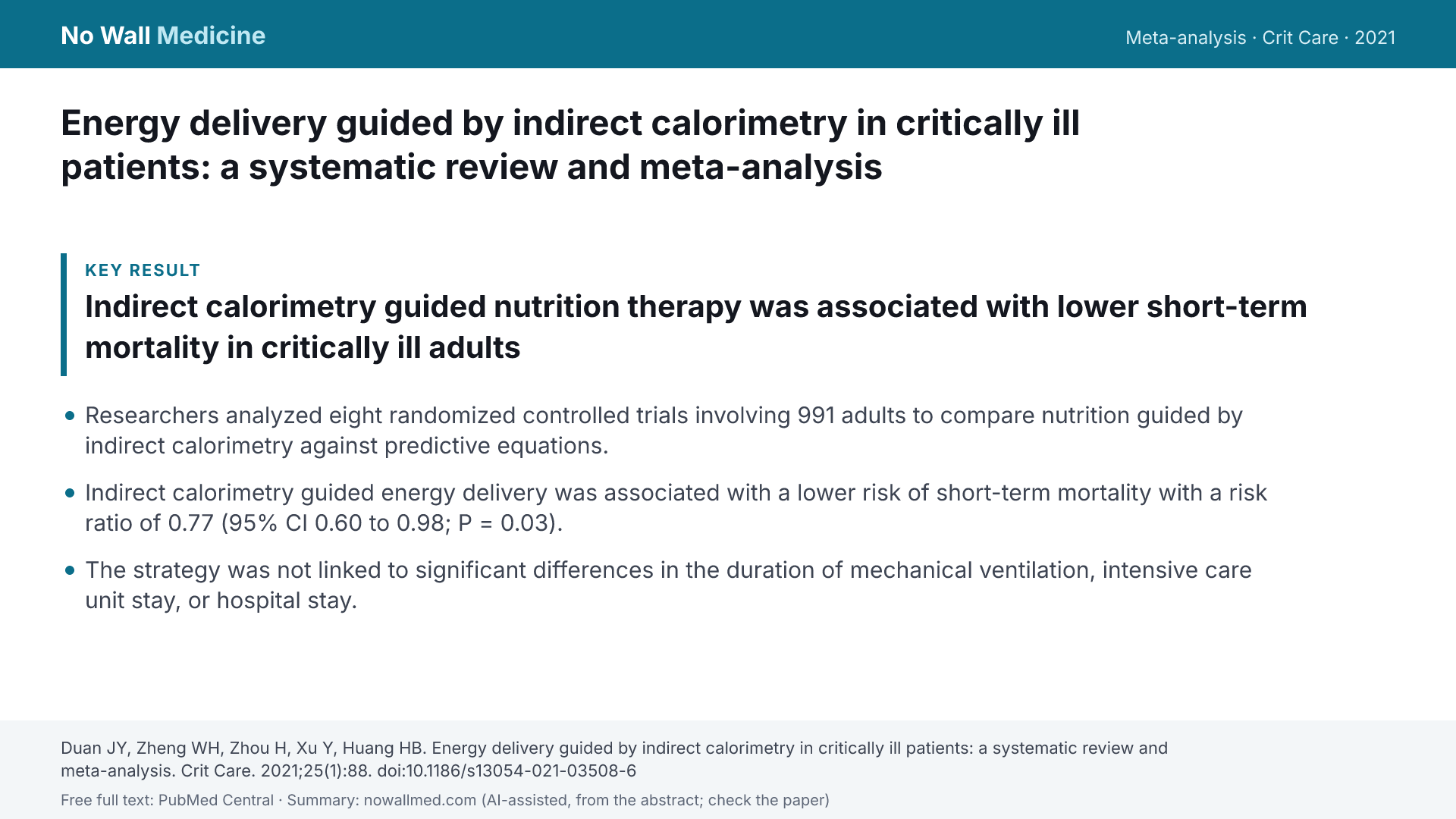
Indirect calorimetry guided nutrition therapy was associated with lower short-term mortality in critically ill adults
Energy delivery guided by indirect calorimetry in critically ill patients: a systematic review and meta-analysis
Key points
- Researchers analyzed eight randomized controlled trials involving 991 adults to compare nutrition guided by indirect calorimetry against predictive equations.
- Indirect calorimetry guided energy delivery was associated with a lower risk of short-term mortality with a risk ratio of 0.77 (95% CI 0.60 to 0.98; P = 0.03).
- The strategy was not linked to significant differences in the duration of mechanical ventilation, intensive care unit stay, or hospital stay.
Limitation the authors note: More high-quality studies are still needed to confirm these findings.
Headline and key points written with AI from the paper’s abstract, with every number checked against it. Read the paper before relying on them.
Was this summary helpful?
Abstract
Background
The use of indirect calorimetry (IC) is increasing due to its precision in resting energy expenditure (REE) measurement in critically ill patients. Thus, we aimed to evaluate the clinical outcomes of an IC-guided nutrition therapy compared to predictive equations strategy in such a patient population. Methods
We searched PubMed, EMBASE, and Cochrane library databases up to October 25, 2020. Randomized controlled trials (RCTs) were included if they focused on energy delivery guided by either IC or predictive equations in critically ill adults. We used the Cochrane risk-of-bias tool to assess the quality of the included studies. Short-term mortality was the primary outcome. The meta-analysis was performed with the fixed-effect model or random-effect model according to the heterogeneity. Results
Eight RCTs with 991 adults met the inclusion criteria. The overall quality of the included studies was moderate. Significantly higher mean energy delivered per day was observed in the IC group, as well as percent delivered energy over REE targets, than the control group. IC-guided energy delivery significantly reduced short-term mortality compared with the control group (risk ratio = 0.77; 95% CI 0.60 to 0.98; I2 = 3%, P = 0.03). IC-guided strategy did not significantly prolong the duration of mechanical ventilation (mean difference [MD] = 0.61 days; 95% CI - 1.08 to 2.29; P = 0.48), length of stay in ICU (MD = 0.32 days; 95% CI - 2.51 to 3.16; P = 0.82) and hospital (MD = 0.30 days; 95% CI - 3.23 to 3.83; P = 0.87). Additionally, adverse events were similar between the two groups. Conclusions
This meta-analysis indicates that IC-guided energy delivery significantly reduces short-term mortality in critically ill patients. This finding encourages the use of IC-guided energy delivery during critical nutrition support. But more high-quality studies are still needed to confirm these findings.
Abstract reproduced under the article’s CC BY licence.
Subject terms
Headline, design, result, key points, caveat and citation as plain text.
Cite this article
Duan JY, Zheng WH, Zhou H, Xu Y, Huang HB. Energy delivery guided by indirect calorimetry in critically ill patients: a systematic review and meta-analysis. Crit Care. 2021;25(1):88. doi:10.1186/s13054-021-03508-6
Spotted a mistake? Suggest a correction