Initial defibrillation energy doses for children in cardiac arrest showed no significant difference in outcomes
Energy doses for paediatric defibrillation in cardiac arrest: systematic review and meta-analysis
Systematic review and meta-analysisNo clear difference
Are different initial defibrillation energy doses better for children in cardiac arrest?
Who
Infants and children with ventricular fibrillation or pulseless ventricular tachycardia · In-hospital cardiac arrest
Compared
Initial doses approximating 2 J/kg
Initial doses <1.5 J/kg or >2.5 J/kg
Main outcome
Survival to hospital discharge and return of spontaneous circulation
Bottom line: Initial defibrillation doses of <1.5 J/kg or >2.5 J/kg are not significantly better or worse than 2 J/kg.
Limitation: The overall certainty of evidence was very low.
Resusc Plus · 2025-05-26Download image
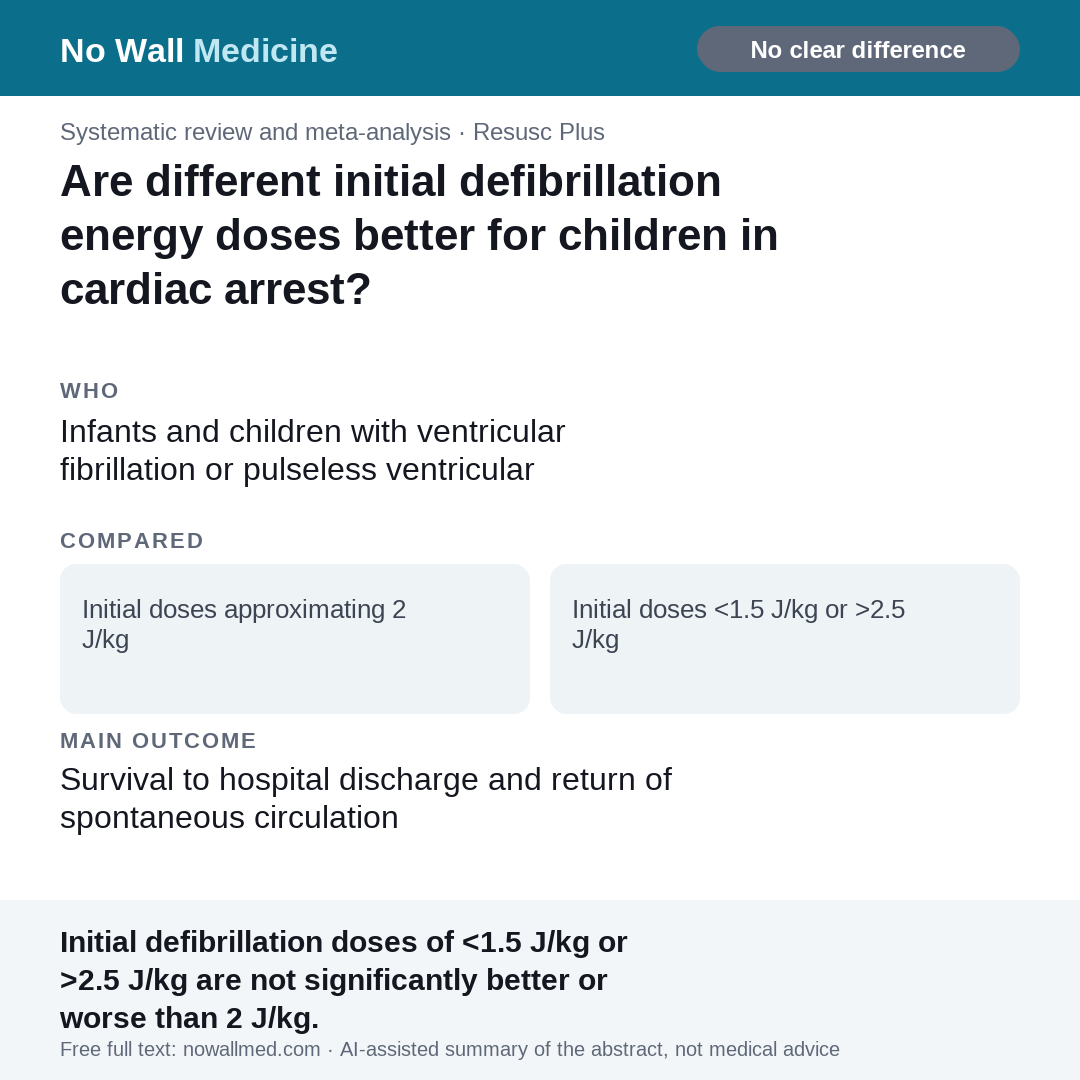
Clinical question: Are different initial defibrillation energy doses better for children in cardiac arrest?
Why it matters: The optimal energy doses for initial and subsequent shocks in pediatric cardiac arrest remain controversial.
Key points
- Researchers conducted a systematic review of 7 observational studies involving infants and children in cardiac arrest with shockable rhythms.
- Outcomes including survival to hospital discharge and return of spontaneous circulation were not significantly better or worse when using initial doses of <1.5 J/kg or >2.5 J/kg compared to 2 J/kg.
- The overall certainty of evidence for these findings was very low.
Limitation the authors note: The authors state that the overall certainty of evidence was very low and well-designed randomized trials are needed.
Headline and key points written with AI from the paper’s abstract, with every number checked against it. Read the paper before relying on them.
Was this summary helpful?
Cite this article
Acworth J, Del Castillo J, Tiwari LK, Atkins D, de Caen A, Bansal A. Energy doses for paediatric defibrillation in cardiac arrest: systematic review and meta-analysis. Resusc Plus. 2025. doi:10.1016/j.resplu.2025.100991
Spotted a mistake? Suggest a correction
Top studies every Monday
The week’s key trials and guidelines in your specialties, plus any topics you follow. By email, free.
Get the weekly digest